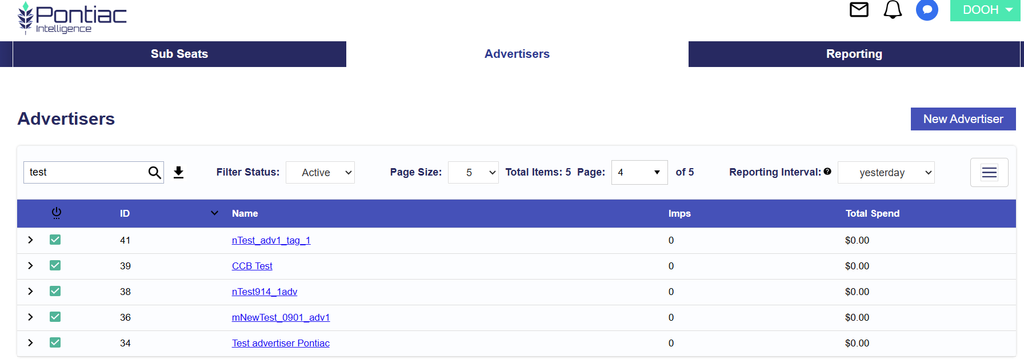
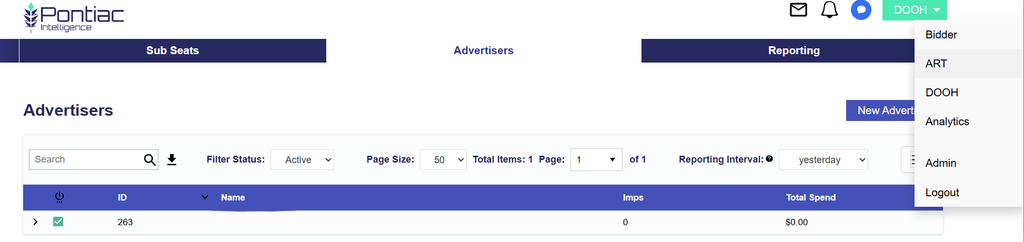
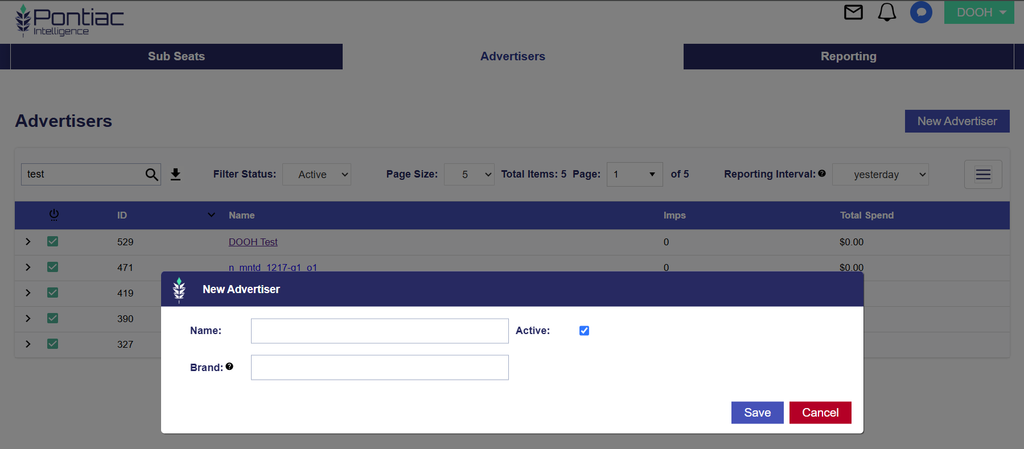
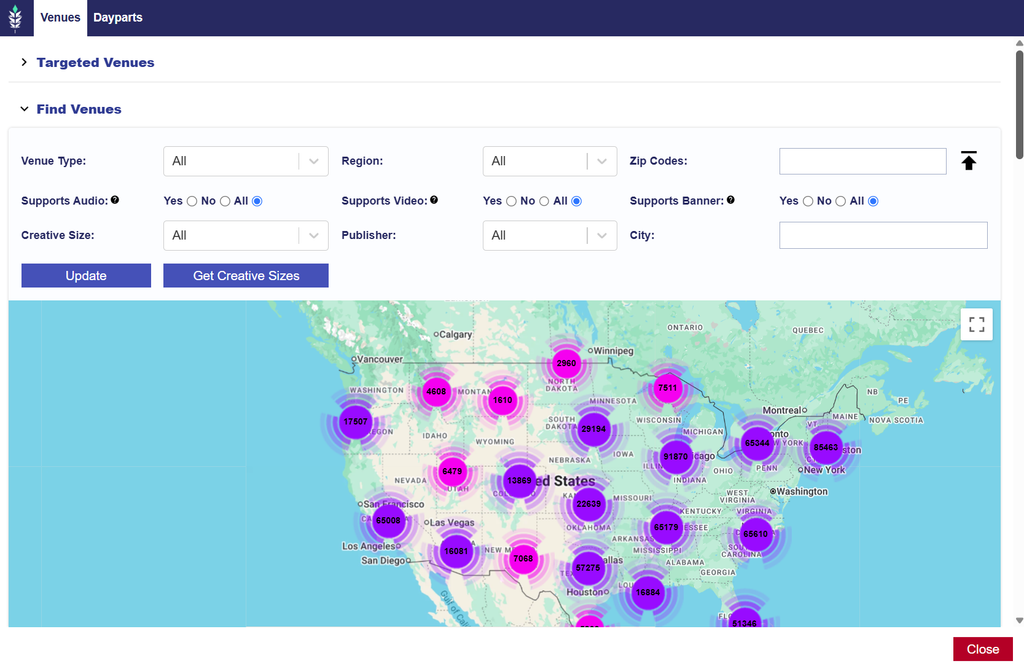
Pontiac Intelligence’s Digital Out-of-Home (DOOH) platform allows advertisers to reach consumers through digital screens in physical locations, including shopping malls, airports, retail stores, transit environments, restaurants, and outdoor advertising placements.
Through Pontiac’s integration with Vistar Media, advertisers can access programmatic DOOH inventory across a global network of digital screens, with flexible budgets, targeting, and bidding options.
DOOH provides opportunities to reach consumers in relevant physical environments, making it particularly useful for brand awareness, geographic targeting, local advertising, and contextual messaging.
Pontiac DOOH provides access to:
Place-Based Media: Digital screens in environments such as shopping malls, airports, taxis, retail stores, restaurants, medical offices, and other commercial venues.
Large-Format & Outdoor Media: Digital billboards, transit shelters, curbside displays, and other outdoor advertising placements.
Venue-Based Targeting: Target inventory based on venue categories, geographic locations, publishers, and media types.
Programmatic Buying: Access eligible inventory through Open Exchange or available Private Marketplace (PMP) Deals.
Flexible Campaign Management: Configure budgets, bidding, targeting, and Creatives with no Campaign minimums and the ability to adjust strategies or messaging as needed.
For example, advertisers can target screens in airports to reach travelers, shopping malls to reach consumers near retail environments, or medical offices to deliver contextually relevant messaging.
How DOOH Advertising Works
Unlike traditional digital advertising, which typically delivers an impression to an individual device, DOOH advertisements play on physical screens that may be viewed by multiple people.
When a DOOH advertising opportunity becomes available, Vistar sends a bid request containing information about the screen, venue, location, available Creative formats, and estimated audience impressions.
Pontiac evaluates the opportunity against the Line’s targeting, budget, bidding, and Creative settings to determine whether to submit a bid.
If the bid is successful, the advertisement is delivered or scheduled for playback on the eligible screen.
DOOH Impression Measurement
DOOH inventory is purchased on a CPM (Cost per 1,000 Impressions) basis.
However, DOOH impressions differ from traditional digital impressions because a single advertisement played on a physical screen may be viewed by multiple people.
Vistar provides an estimated impression value for each advertising opportunity, representing the expected audience exposure associated with that placement.
DOOH audience estimates may incorporate factors such as:
Ad Playback Timestamps: When the advertisement is scheduled or displayed.
Venue Type: The type of physical environment where the screen is located.
Screen Location: Whether the screen is indoors or outdoors and its surrounding environment.
Geographic Location: The physical location of the advertising placement.
Audience & Mobility Data: Available location and audience measurement data used to estimate traffic and potential exposure.
For example, a single advertisement played on a digital screen in a busy shopping mall may represent multiple estimated impressions based on the expected audience near that screen.
Important: DOOH impressions represent estimated opportunities for consumers to view an advertisement, not confirmed individual views. One ad play can generate multiple impressions, and impression counts should not be interpreted as unique viewers or guaranteed exposure.
Important: Unlike Pontiac Bidder, DOOH does not have a separate Campaign level. Lines are the primary objects responsible for bidding and delivery.
Explore the DOOH Documentation
The following documentation provides detailed instructions for configuring and managing DOOH advertising in Pontiac:
Getting Started with DOOH: Accessing the platform, creating Advertisers, and exploring available venues.
DOOH Venue Categories: Understanding available DOOH environments and venue types.
DOOH Creatives: Creative specifications, supported sizes, uploads, and approvals.
DOOH Line Item Setup: Creating Lines, configuring budgets and bidding, targeting venues, and associating Creatives.
DOOH Line Flight Metrics: Monitoring Line delivery, budget consumption, and pacing against expected delivery.
DOOH Reporting: Monitoring delivery, impressions, spend, and performance.
For additional assistance, contact the Pontiac team through the Help Center.
DOOH Venue Categories
Pontiac DOOH provides access to digital screens across a variety of physical environments, including transit, retail, outdoor, entertainment, and healthcare locations.
Venues are organized into Venue Categories and Venue Types, allowing advertisers to identify inventory that aligns with their audience, geographic strategy, and advertising goals.
Venue Category: A broader classification of DOOH inventory, such as Transit, Retail, or Entertainment.
Venue Type: A more specific environment within a category, such as Airports, Grocery, or Movie Theaters.
Available Venue Categories
The following table outlines common DOOH Venue Categories and their associated Venue Types available through Pontiac.
Advertisers can explore available DOOH inventory and select placements based on their advertising objectives.
When evaluating venues, consider:
Venue Category & Type: Select environments relevant to the intended audience and campaign message.
Geographic Location: Narrow available inventory by location, including State and ZIP Code.
Publisher: Review the media owners providing available inventory.
Media Type: Consider whether the placement supports the intended Creative format.
Venue Availability: Review available screens, estimated impressions, and venue details before adding placements to a Line.
Important: Venue Categories and Types describe the physical environment where advertisements may appear. They do not guarantee that individuals viewing the advertisements belong to a particular demographic or audience segment.
Actual inventory availability depends on the selected location, publisher, screen specifications, and other targeting criteria.
Pontiac DOOH allows advertisers to explore available digital screens and select specific locations for their advertising.
Venues can be filtered using geographic, inventory, and placement criteria to identify screens that align with the intended audience and advertising strategy.
Search for Available Venues
Open the appropriate DOOH Advertiser.
Select New Line.
Under Line Setup, select Edit Targeting to open Venue Targeting.
Expand the Find Venues section.
Enter the desired search criteria to filter available inventory.
Select Update to display matching Venues on the map and in the results table.
Available Search Filters:
Venue Type: Filter by Venue Category or specific Venue Type.
Region: Select the desired State or Region.
ZIP Codes: Search within specific postal codes.
City: Filter Venues by City.
Publisher: Select specific inventory providers.
Creative Size: Find Venues supporting specific Creative dimensions.
Supports Audio, Video, or Banner: Filter by supported Creative formats.
Multiple filters can be combined to narrow the available inventory.
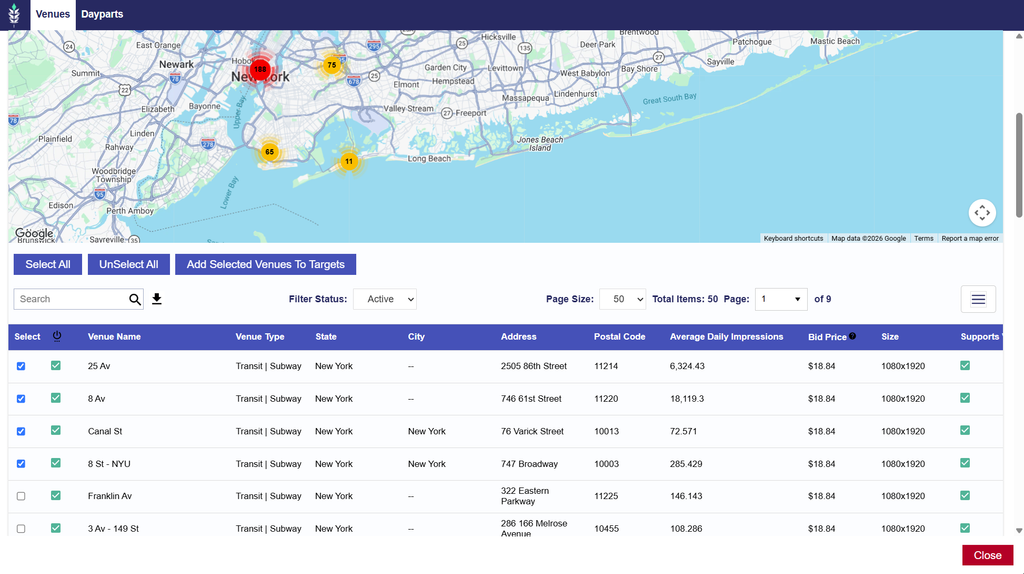
Matching Venues are displayed on an interactive map and in a table below the map. Review the results or select a Venue to see additional placement details.
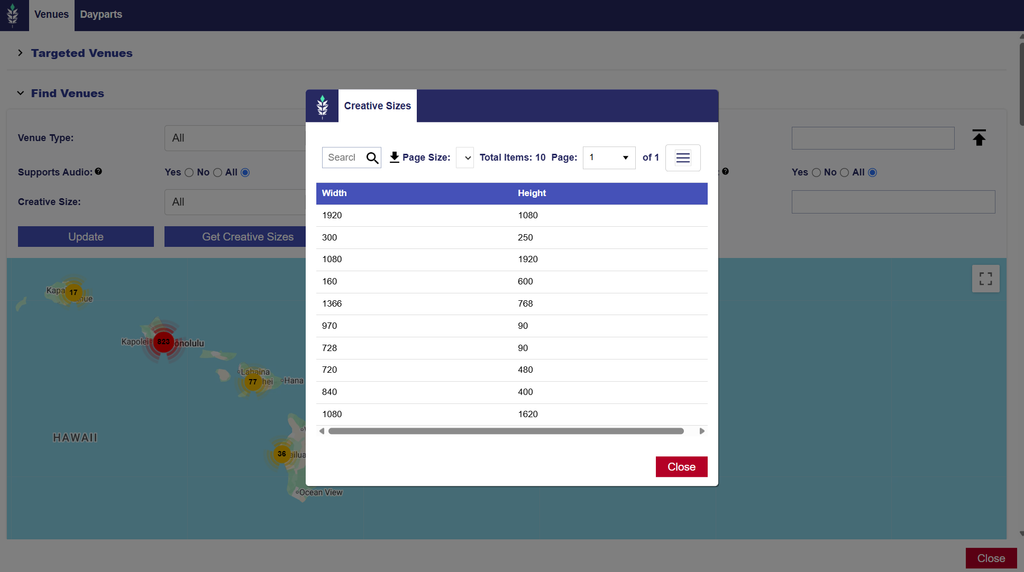
Recommendation: Use the Get Creative Sizes button to identify the Creative dimensions required by your selected inventory before uploading Creatives.
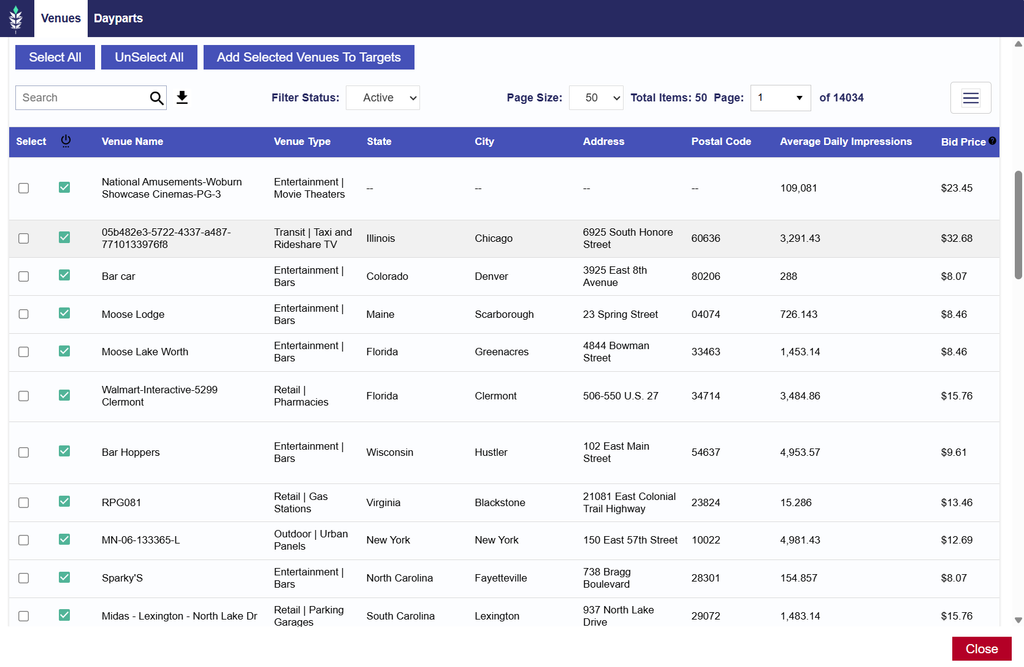
Matching Venues are displayed on the interactive map and in the results table below. Scroll horizontally to view all available columns.
The results table includes:
Venue Name
Venue Type
State
City
Address
Postal Code
Average Daily Impressions
Bid Price
Size
Supports Video Flag
Supports Audio Flag
Supports Banner Flag
Publisher
Adding Venues to Targeting: Use the checkbox next to each Venue to select the placements you want to target. Once selected, click Add Selected Venues To Targets to add them to the Line’s targeting. You can also use Select All or UnSelect All to manage selections.
Country: Each DOOH Line can target Venues within one Country. The selected Country determines which Venues are available for targeting.
Media Type: Each Line supports one media type. Associated Creatives and selected Venues must support the same format: Banner, Video, or Video with Audio.
Creative Sizes: Different Venues may require different Creative dimensions. Review specifications before uploading and associating Creatives.
Inventory Availability: Venue availability varies by location, Publisher, and Media Type. Applying multiple restrictive filters may significantly reduce available inventory.
Recommendation: Explore available Venues and their required Creative sizes before finalizing your Creative assets and Line targeting.
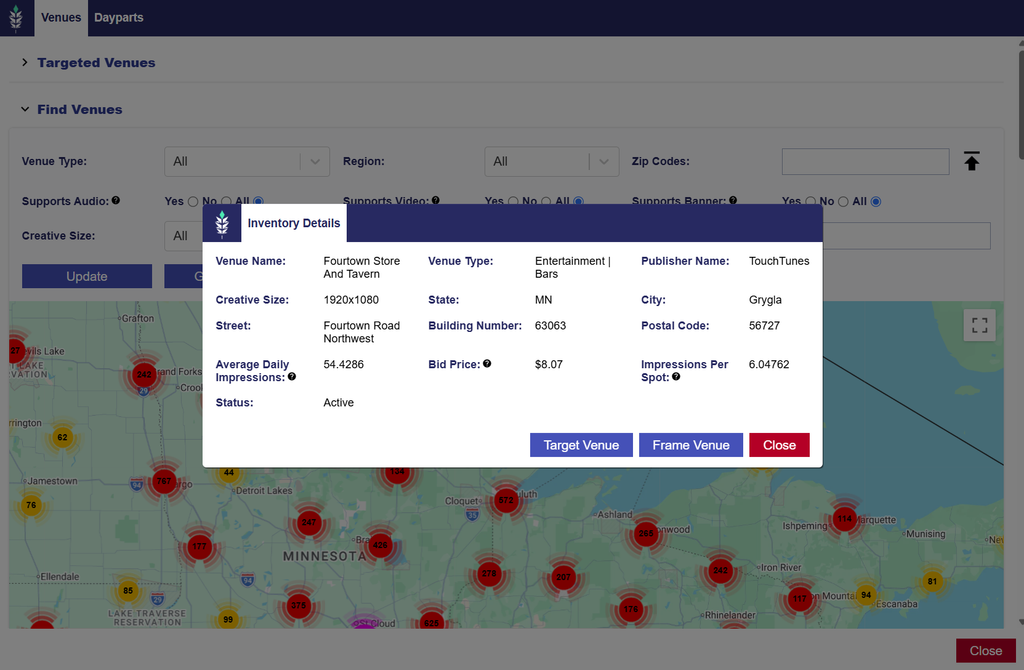
When exploring available DOOH inventory, select a Venue on the map to open the Inventory Details window. This provides information about the placement, Creative requirements, estimated audience impressions, and bidding.
Inventory Details
The Inventory Details window includes:
Venue Name & Type: Name and classification of the advertising location.
Publisher Name: Media owner providing the inventory.
Creative Size: Required Creative dimensions for the placement.
Location: State, City, Street, Building Number, and Postal Code.
Status: Indicates whether the Venue is Active.
Average Daily Impressions: Estimated average number of audience impressions available at the Venue per day.
Bid Price: CPM pricing guidance for the placement.
Impressions Per Spot: Estimated number of audience impressions associated with a single ad play.
Understanding Venue Metrics
Average Daily Impressions: The estimated average number of individuals per day who will view an ad displayed on this venue’s screen. This metric is provided by Vistar and is estimated through a combination of mobile data and other location-based tactics to triangulate the number of individuals exposed.
Bid Price: The recommended CPM (cost per 1,000 impressions) to serve an ad on this screen. This is a price floor provided by the publisher and will be the minimum bid required to win inventory on this screen.
Impressions per Spot: The estimated average number of individuals who will view an ad displayed on this venue’s screen during a 15 second spot. This metric is provided by Vistar and is estimated through a combination of mobile data and other location-based tactics to triangulate the number of individuals exposed.
Important: Impression estimates do not represent confirmed individual views or unique viewers. Actual delivery may vary based on inventory availability, targeting, and bidding.
Venue Actions
The Inventory Details window provides three actions:
Target Venue: Add the selected Venue to the Line’s targeting.
Frame Venue: Center the map on the selected Venue.
Close: Close the Inventory Details window.
Recommendation: Before targeting a Venue, confirm that its Creative Size, estimated inventory availability, and Bid Price align with your Line’s configuration and delivery goals.
Pontiac DOOH supports Image and Video Creatives for digital screens across a variety of Venues.
Creative dimensions and supported formats vary by Venue. Before uploading Creatives, review the requirements of the inventory you plan to target.
Media Type
Creative Size
File Format
Max File Size
Color Space
Ad Duration
Display
Varies by Venue
JPG
10 MB
RGB, CMYK
Video
Varies by Venue
MOV or MP4
50 MB
5 – 60 seconds
Important Creative Requirements
Creative Size: Dimensions must match the requirements of the targeted Venue.
Media Type: Confirm that the Venue supports Banner, Video, or Video with Audio.
Video Duration: Video Creatives must meet the supported 15- or 30-second duration requirements.
Brand Matching: The advertised brand must match the Brand configured on the DOOH Advertiser.
Creative Approval: All Creatives must complete the applicable approval process before serving.
Recommendation: Identify your targeted Venues and required Creative sizes before producing or uploading assets. Different Venues may require multiple Creative dimensions.
DOOH Creatives are uploaded and managed at the Advertiser level. Once uploaded, Creatives can be associated with Lines under that Advertiser.
Before uploading, confirm that the Creative meets the specifications required by your targeted Venues.
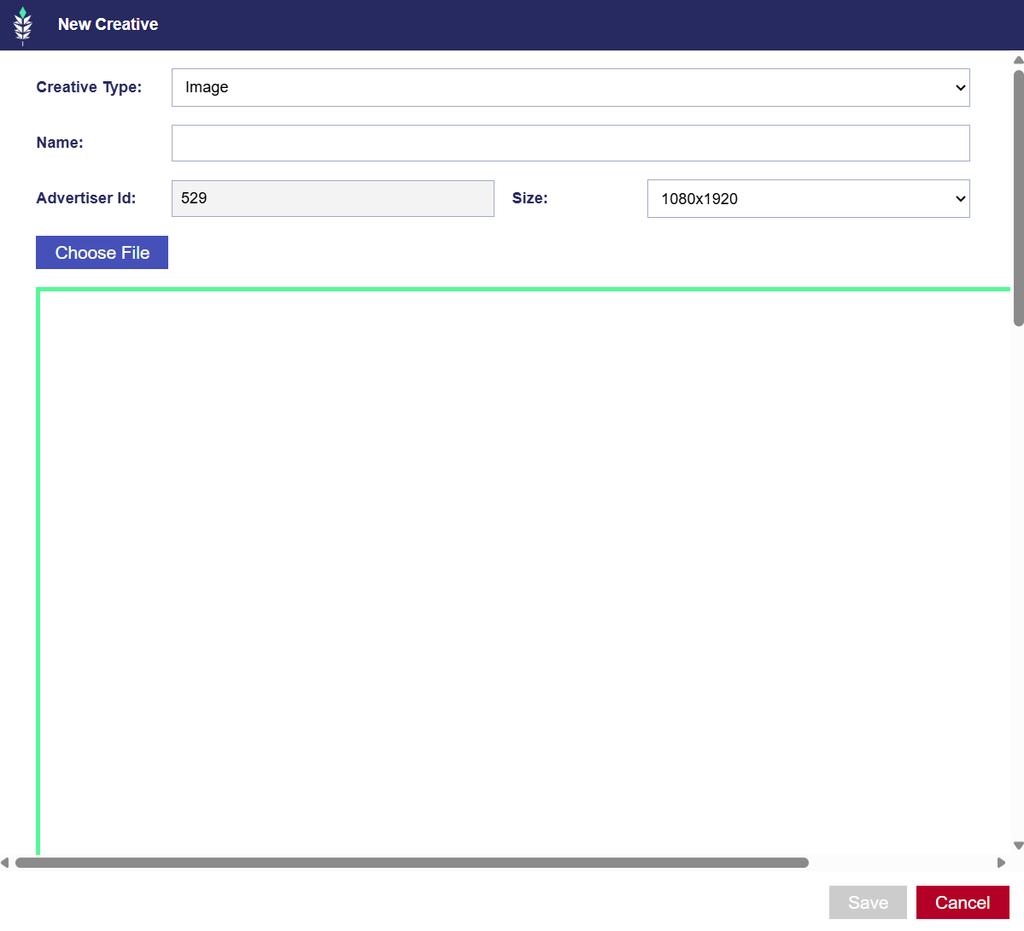
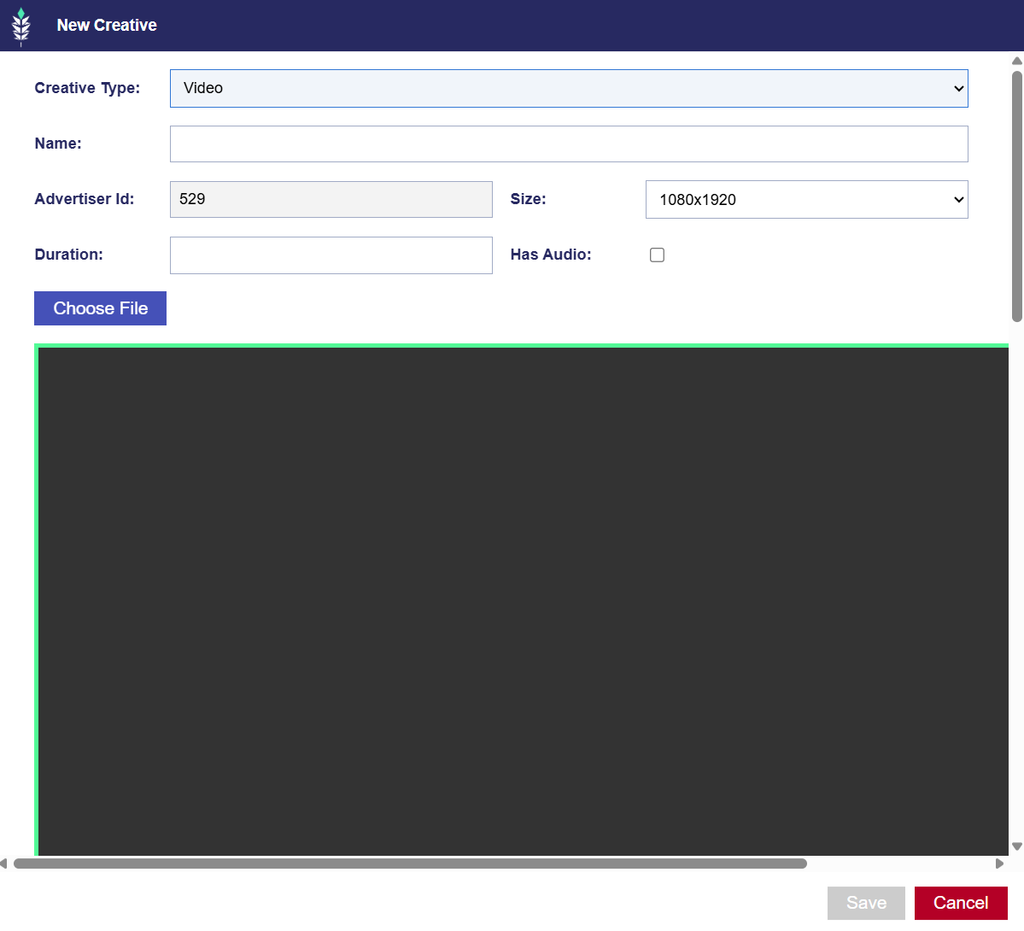
Upload a DOOH Creative
Open the appropriate DOOH Advertiser.
Select New Creative.
Under Creative Type, select Image or Video.
Enter a Name for the Creative.
Select the applicable Size from the dropdown.
If uploading a Video Creative, complete the additional required fields:
Duration: Enter the Video’s duration in seconds. 15 or 30.
Has Audio: Select this checkbox if the Video contains Audio.
Click Choose File and upload the Creative.
Review the uploaded Creative in the preview area.
Select Save.
The Advertiser ID is automatically populated based on the selected Advertiser.
Image Creative
Video Creative
Note: Video Creatives require additional information, including Duration and whether the Creative contains Audio. These fields appear when Video is selected as the Creative Type.
Once saved, the Creative will enter the applicable approval process.
Important Considerations
Creative Specifications: Image and Video files must meet the supported formats, dimensions, file sizes, and duration requirements.
Creative Size: The selected Size must match the uploaded Creative and the requirements of the targeted Venues.
Video Duration: Enter the correct duration for Video Creatives.
Audio: Select Has Audio only when the Video contains Audio. The targeted Venues must also support Audio.
Brand Matching: The advertised Brand must match the Brand configured on the Advertiser.
Approval: Creatives must complete the applicable Pontiac and Publisher approval processes before serving.
Recommendation: Upload all required Creative sizes before launch and allow sufficient time for Pontiac and Publisher approvals.
Associate Creatives With a Line
Uploading a Creative does not automatically associate it with a Line.
To associate Creatives:
Open the appropriate DOOH Line.
Navigate to the Creatives section.
Select Associate Creatives.
Select the Creatives you want to use.
Save the Line.
Important: Creatives must be associated with the Line and compatible with the targeted Venues to be eligible for delivery.
All DOOH Creatives must complete an approval process before serving on eligible inventory.
The Creative Audit process consists of two stages:
Pontiac Internal Audit: Pontiac reviews the Creative for compliance with platform requirements and advertising policies.
Publisher Audit: Individual Publishers review Creatives according to their own content policies and approval requirements.
Creative Approval Timelines
Audit Stage
Estimated Processing Time
Pontiac Internal Audit
Up to 24 hours
Publisher Audit
24 hours to 14 days
Important: A Creative marked Approved in Pontiac is not necessarily approved by every Publisher. Individual Publisher restrictions and approval timelines may affect which Venues are eligible to serve the Creative.
Recommendation: Upload Creatives well in advance of the intended Line start date to allow sufficient time for both approval stages.
Sensitive Categories
Advertisements within the following categories are allowed on the Pontiac DOOH platform but restricted to Publishers that have approved this type of content.
These Creatives may display an Approved status in Pontiac, but final eligibility remains subject to Publisher discretion.
CBD or Hemp (No pictures of flower, hemp/marijuana leaves, or the words “Get High”)
Adult Store (must lead to a landing page without nudity or toys)
Paraphernalia, Pharmaceuticals and Supplements
Politics
Social Issues / makes claims
Weight Loss
Sexual Health
Affiliate Offers
Consumer Loans
Tobacco and Smoking Products
Online Games
Gambling & Online Gambling – See “Gambling Advertising” below
Firearms and Weapons (Sporting Goods stores, education, accessories)
Tabloid / Advertorial (cannot infringe on copyrights)
Underwear / Lingerie
Strip Club / Gentlemen’s Club
Dating
Important: Sensitive-category advertisements may have limited Publisher eligibility, which can restrict available inventory and impact Line delivery.
Prohibited Categories
Advertisements within the following categories will be rejected during the Pontiac Internal Audit and will not be submitted for Publisher approval.
Broken Ads or blank Creative
Creative brand does not match “Brand” entered
Pornography, Nudity, Obscenities, or other “Adult” Content
Hate Speech or Defamatory Language
Sale of, or instructions for creating, guns, bombs, ammunition, or weapons
Displaying fake errors to induce user action, or messaging that implies knowledge of a user’s computer or operating system
Discussing or promoting sale of federally illegal drugs, illegal pharmaceuticals, and other schedule 1 drugs.
Charging for government forms and services
Enabling or Permitting Piracy
Misappropriation of Copyright, Trademark, Trade Secret, or Patent
Inappropriate content (at our discretion)
Misleading or sensationalized messaging, content or images
Non-compliance with restricted advertising category guidelines (dating, pharmaceuticals, weight loss, health and beauty, etc.)
Important: If a Line is not delivering as expected, confirm that its associated Creatives are approved and eligible for the targeted Publishers and Venues.
For additional assistance with Creative approvals, contact Pontiac through the Help Center.
DOOH Line Item Parameters
DOOH Lines control how and where your advertisements are delivered, including budgets, bidding, flight dates, Venue targeting, Dayparts, Deals, and Creative associations.
Lines are created directly under an Advertiser and are responsible for bidding and delivery.
Explore the articles below for detailed instructions on configuring and managing DOOH Lines.
Important: A Line must have eligible Venue targeting, compatible and approved Creatives, and appropriate bidding and budget settings to deliver impressions.
To create a new DOOH Line:
Open the appropriate DOOH Advertiser.
Select New Line.
Configure the Line’s setup parameters.
Configure Venue Targeting, Creatives, and Deals as applicable.
Select Submit New Line to save.
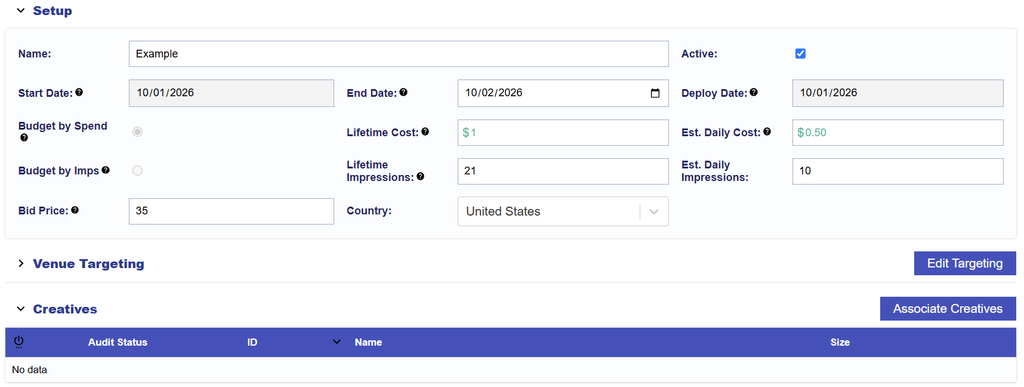
Line Setup Parameters
Parameter
Description
Name
Enter a name to identify the Line.
Active
Controls whether the Line is enabled for delivery.
Start Date
The launch date for the Line.
End Date
The last date the Line will serve.
Deploy Date
The date the Line was created. This field automatically populates when the Line is submitted.
Budget by Spend
The Line will budget according to DOLLAR amount entered in ‘Lifetime Cost’ field and provide an ESTIMATED number of impressions the Line will serve based on total budget and bids.
Budget by Imps
The Line will budget according to IMPRESSIONS entered in ‘Lifetime Impressions’ field and provide an ESTIMATED cost in dollars to serve that number of impressions based on bids and budgeted impressions.
Lifetime Cost
The total desired spend in dollars for the lifetime of the campaign. This will auto-fill with an estimated cost if ‘Budget by Imps’ is selected.
Lifetime Impressions
The total desired number of impressions for the lifetime of the campaign. This will auto-fill with an estimated impressions if ‘Budget by Spend’ is selected.
Estimated Daily Cost
Estimated daily spend calculated using the budget, flight dates, and bid data. Actual daily spend may vary.
Estimated Daily Impressions
Estimated daily impressions calculated using the budget, flight dates, and bid data. Actual daily impressions may vary.
Bid Price
This is the CPM (cost per 1,000 impressions) that the Line Item will bid on the inventory selected. When venues are selected in the following section, a minimum bid price will be displayed for each venue, as well as a recommended bid price for the Line Item.
Country
Determines which country’s Venues are available for targeting. Each Line can target one Country.
Budget Configuration
Pontiac DOOH supports two budgeting methods:
Budget by Spend: Enter the desired Lifetime Cost. Pontiac estimates the number of impressions the Line may deliver.
Budget by Imps: Enter the desired Lifetime Impressions. Pontiac estimates the corresponding spend.
Important: Estimated costs and impressions are projections based on the configured budget and bidding information. Actual delivery may vary depending on inventory availability, competition, and targeting.
Important Setup Considerations
Active Status: Confirm that the Line is Active when it is ready to begin delivery.
Flight Dates: Ensure Start Date and End Date reflect the intended delivery period.
Budget: Select the budgeting method that aligns with your delivery goal and review the estimated daily spend or impressions.
Bid Price: Review the minimum and recommended Bid Prices of targeted Venues. Bids below applicable minimums may prevent delivery.
Country: Each Line can target Venues in only one Country. Once the Line is saved, the selected Country cannot be changed. Verify the Country before submitting.
Inventory Availability: Narrow Venue targeting, insufficient bidding, or incompatible Creatives may restrict delivery.
Recommendation: Review available Venues, estimated impressions, and Bid Prices before finalizing your budget and bidding strategy.
Complete the Line Setup
After configuring the Line parameters, complete the remaining sections:
Venue Targeting: Select the locations where advertisements should run.
Dayparts: Configure delivery schedules if needed.
Creatives: Associate eligible Creatives with the Line.
Deals: Add applicable DOOH Deals if required.
Important: Saving a Line does not guarantee delivery. The Line must be Active, within its scheduled dates, and have eligible Venue targeting, appropriate bidding, and compatible approved Creatives.
Once your Line is active, monitor its delivery, spend, and pacing directly from the Line details screen. See DOOH Line Flight Metrics for definitions of the available metrics and guidance on interpreting the Pacing Bar.
Adding Venues to Targets
After identifying available DOOH inventory, you can add individual Venues or multiple Venues to your Line’s targeting.
To access Venue Targeting:
Open the appropriate DOOH Line in Edit Mode, or select New Line.
Under Line Setup, select Edit Targeting.
Expand Find Venues and search for the desired inventory.
Review the placement information in the Inventory Details window.
Select Target Venue to add the Venue to the Line’s targeting.
Repeat for additional Venues as needed.
Option 2: Add Multiple Venues From the Results Table
Scroll to the results table below the map.
Use the checkbox next to each Venue to select the desired placements.
Select Add Selected Venues To Targets.
Repeat as needed to add additional Venues.
You can also use Select All or UnSelect All to manage Venue selections.
Managing Targeted Venues
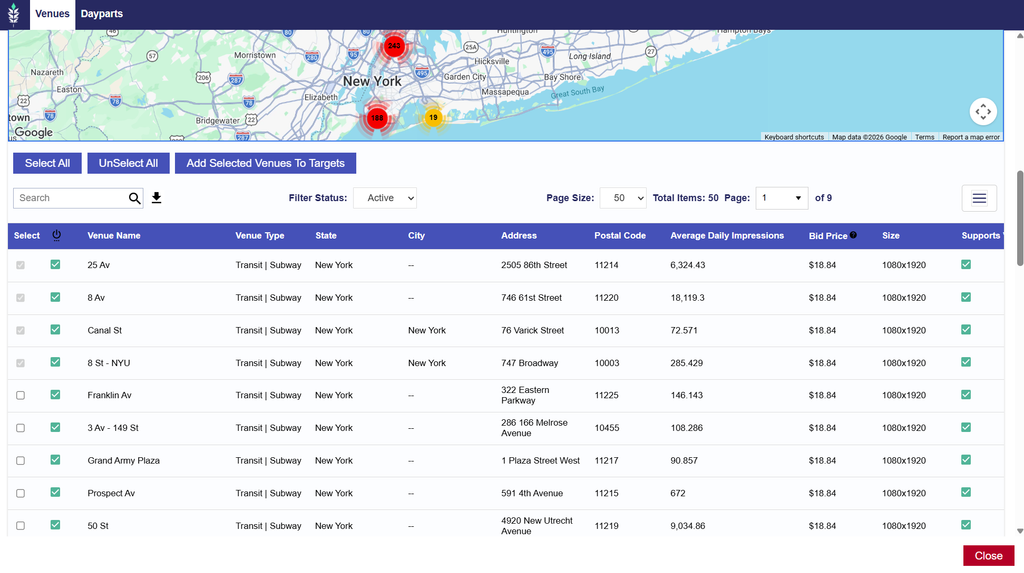
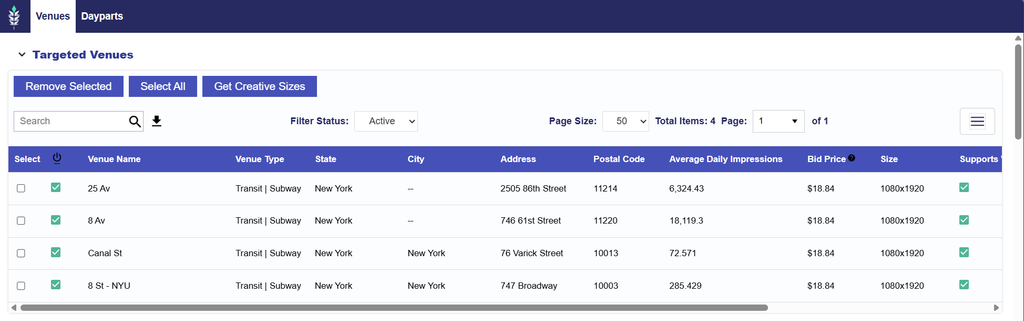
After selecting Add Selected Venues To Targets, the checkboxes for those Venues become greyed out in the search results table, indicating that they have already been added to the Line’s targeting.
You can continue searching for and adding additional Venues at any time.
To review or manage previously selected Venues:
Scroll to the top of Venue Targeting.
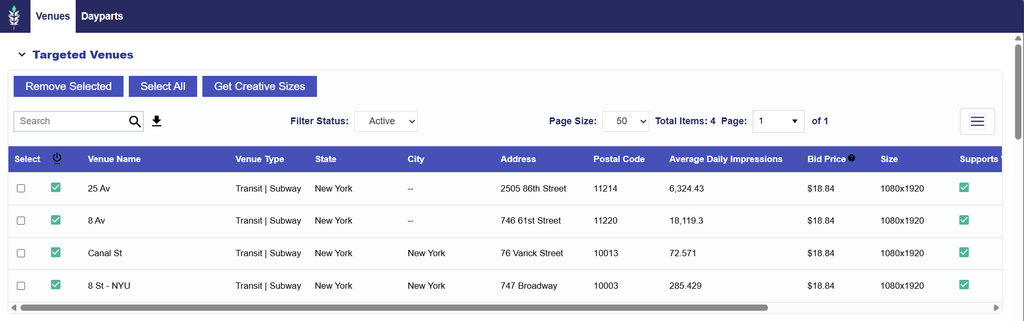
Expand the Targeted Venues section.
Review the Venues currently associated with the Line.
From this section, you can:
Remove Selected: Select individual Venues and remove them from targeting.
Select All / Remove Selected: Select all targeted Venues and remove them in bulk.
Get Creative Sizes: View the required Creative dimensions for the currently targeted Venues.
Important: To remove a Venue that has already been added, use the Targeted Venues section. The greyed-out checkboxes in the Find Venues results table cannot be used to remove existing targets.
Recommendation: After selecting your Venues, use Get Creative Sizes under Targeted Venues to confirm the Creative dimensions needed for the Line before associating Creatives.
Review Targeted Venues
Expand Targeted Venues to review the inventory added to the Line.
Confirm that the selected Venues align with your intended geographic locations, Media Types, Creative Sizes, and bidding strategy.
Once targeting is configured, save or submit the Line to retain your selections.
Important Targeting Considerations
Creative Compatibility: Targeted Venues must support the dimensions and Media Type of the associated Creatives.
Bid Price: Review Venue Bid Prices and ensure the Line’s CPM bid meets applicable minimums.
Country: Venues must be within the Country selected for the Line.
Inventory Availability: Targeting a limited number of Venues may restrict available impressions and impact delivery.
Recommendation: Review the required Creative Sizes of your targeted Venues before associating Creatives. Multiple sizes may be needed to serve across all selected locations.
Important: Adding Venues to targeting does not automatically associate Creatives. Make sure compatible, approved Creatives are associated with the Line before launch.
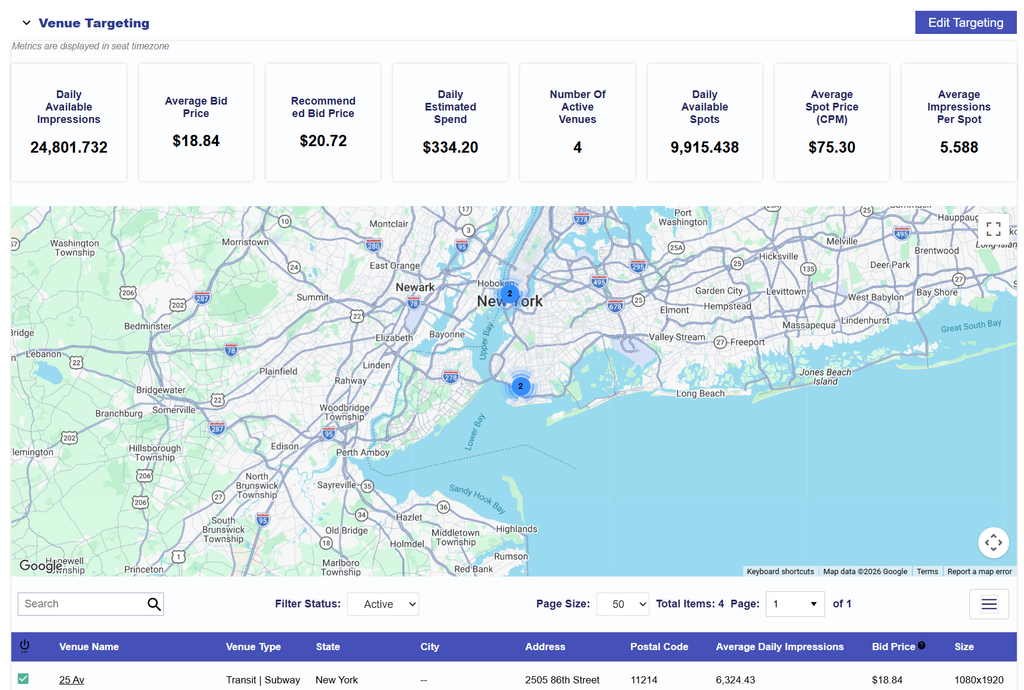
After adding Venues to a DOOH Line and closing the Edit Targeting Window, Pontiac displays cumulative and average metrics across the selected inventory.
These metrics help advertisers evaluate available impressions, estimated spending potential, and recommended bidding before launching a Line.
Available Venue Metrics
Daily Available Impressions: The total number of estimated impressions available per day across all selected Venues. Actual daily impressions will vary and depend on the estimated daily cost, bids, and number of auctions won.
Average Bid Price: The average cost per 1,000 ads (CPM) across all selected Venues.
Recommended Bid Price: The cost for the Venue with the highest CPM plus a 10% hedge.
Daily Max Estimated Spend: The estimated maximum potential spend for the Line across the selected Venues. This is calculated using the CPM and available daily impressions for each Venue. Actual daily spend will vary and depend on the estimated daily cost, bids, and number of auctions won.
Number of Venues: The total number of Venues targeted by the Line.
Daily Available Spots: A Publisher-provided estimate of the number of 15-second advertising slots available per day across the selected screens.
Average Spot Price: The average cost of a 15-second advertising slot across the selected Venues.
Average Impressions per Spot: The estimated average number of individuals who will see an advertisement during a 15-second spot on one of the selected screens.
Using Venue Metrics for Line Setup
When configuring your Line, consider the following:
Available Inventory: Review Daily Available Impressions and Daily Available Spots to understand the estimated inventory available across your targeted Venues.
Bidding: Compare the Average Bid Price and Recommended Bid Price when configuring the Line’s CPM bid.
Budget: Review Daily Max Estimated Spend alongside your Line’s Estimated Daily Cost to evaluate whether the selected inventory can support your intended spending.
Venue Coverage: Review the Number of Venues to confirm the intended locations have been added.
Recommendation: Use the Recommended Bid Price as a starting point when configuring your Line’s CPM bid, then monitor delivery and adjust as needed.
Important: Venue Metrics are estimates based on the selected inventory. They do not guarantee that the Line will win every available advertising opportunity or achieve the estimated impression volume. Actual delivery depends on bidding, budgets, targeting, and inventory availability.
DOOH Dayparting allows you to control which days of the week and hours of the day a Line is eligible to deliver advertisements.
Configure DOOH Dayparts
Open the appropriate DOOH Line in Edit Mode, or select New Line.
Under Line Setup, select Edit Targeting.
Navigate to the Dayparts tab.
Select or deselect the desired days and hours to configure the delivery schedule.
Save your changes.
Understanding Daypart Selection
Blue: Selected hours and days when the Line is eligible to deliver impressions.
Grey: Unselected hours and days when the Line is not eligible to deliver impressions.
Click a blue selection to remove it from targeting, or click a grey selection to enable delivery during that period.
Important Considerations
Delivery Restrictions: The Line will only be eligible to serve during the selected days and hours.
Inventory Availability: Restricting delivery to specific time periods may reduce available impressions and impact pacing.
Venue Availability: Actual delivery depends on whether the targeted screens have available advertising opportunities during the selected hours.
Recommendation: Use Dayparts when your advertising strategy requires specific delivery windows, such as business hours or commuter periods. For broader reach and more consistent delivery, consider allowing additional days and hours.
Important: Dayparting controls when the Line is eligible to bid, but it does not guarantee that impressions will be delivered during every selected hour.
DOOH Creatives are uploaded at the Advertiser level and must be associated with a Line before they can serve.
Each DOOH Line supports one Media Type: Banner, Video, or Video with Audio. All associated Creatives must be compatible with the selected Media Type and targeted Venues.
Associate Creatives With a Line
Open the appropriate DOOH Line in Edit Mode, or select New Line.
Expand the Creatives section.
Select Associate Creatives.
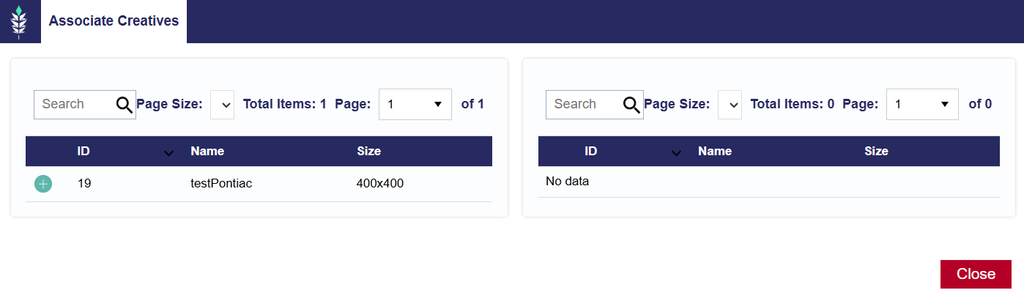
In the left table, locate the Creative you want to associate with the Line. You can search by Creative or review its ID, Name, and Size.
Click the green + icon next to the Creative to add it to the Line.
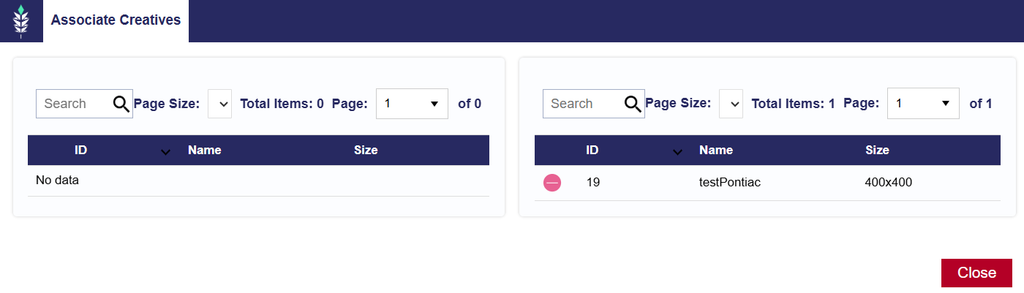
The Creative will move to the right table, indicating that it is now associated.
To remove an associated Creative, click the red − icon in the right table.
Select Close, then save the Line to retain your changes.
Available Creatives (Left): Displays Creatives available to associate with the Line.
Associated Creatives (Right): Displays Creatives currently associated with the Line.
Important Creative Compatibility Requirements
Media Type: All associated Creatives must use the same Media Type: Banner, Video, or Video with Audio.
Creative Size: Creatives must match the dimensions required by the targeted Venues.
Venue Compatibility: Selected Venues must support the associated Creative’s Media Type.
Creative Approval: Creatives must complete the applicable Pontiac and Publisher approval processes before serving.
Recommendation: Before associating Creatives, use Get Creative Sizes under Venue Targeting to identify the dimensions required by your selected Venues.
You can also filter inventory under Find Venues using Supports Audio, Supports Video, and Supports Banner to identify compatible placements.
Important: Associating a Creative with a Line does not guarantee that it can serve across every targeted Venue. Venues with incompatible Creative sizes, unsupported Media Types, or missing Publisher approvals may be ineligible for delivery.
In addition to Open Exchange inventory, Pontiac DOOH supports Private Marketplace (PMP) Deals, which may provide access to inventory unavailable through the Open Exchange.
DOOH Deals can be Biddable First Price or Fixed Price and are associated with individual Lines.
Available Deal Types
Public Deals: PMP Deals available directly within Pontiac for eligible users.
Negotiated Deals: Deals made available through negotiated agreements with Media Owners and are only exposed to you.
Associate DOOH Deals
Open the appropriate DOOH Advertiser.
Select New Line.
Expand the Deals section.
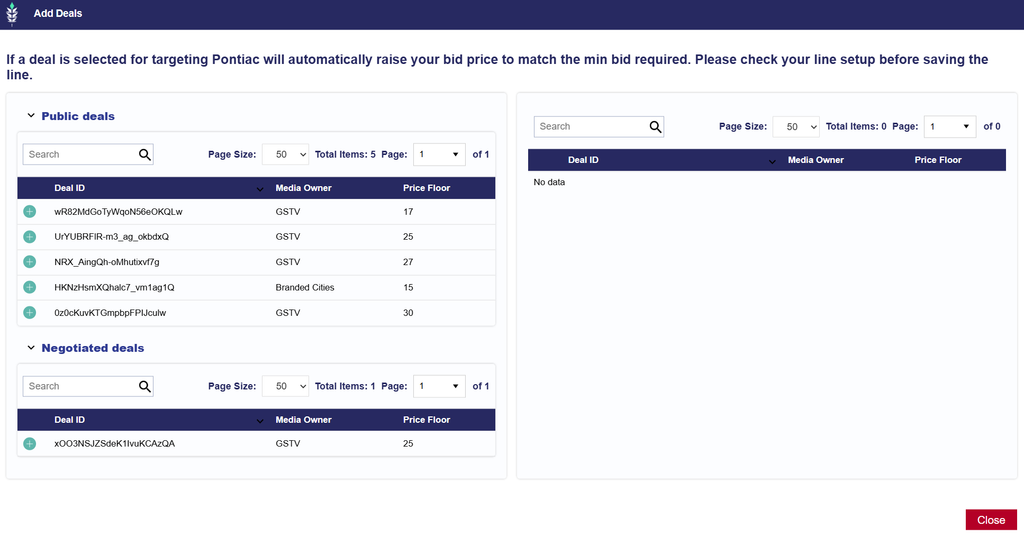
Select Add Deals.
Browse the available Public Deals or Negotiated Deals.
Review each Deal’s Deal ID, Media Owner, and Price Floor.
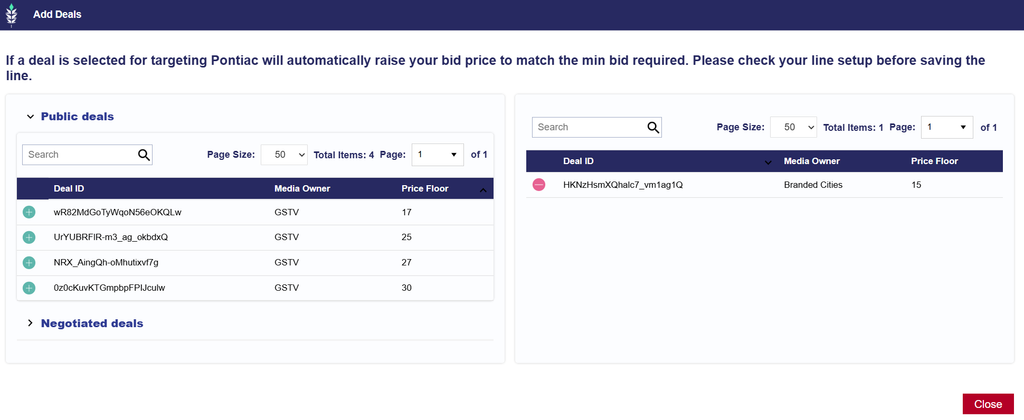
Click the green + icon next to the Deal you want to target.
The selected Deal will move to the table on the right, indicating that it has been associated with the Line.
Select Close and review the Line’s updated Bid Price before submitting the Line.
Important Deal Considerations
Automatic Bid Adjustment: When a Deal is associated, Pontiac automatically increases the Line’s Bid Price if necessary to meet the Deal’s minimum required bid.
Price Floors: Review the Price Floor associated with each Deal before selecting it.
Deal Association: Deals must be associated during initial Line creation.
Venue Targeting: Confirm that selected Venues align with the inventory available through the Deal.
Creative Compatibility: Associated Creatives must meet the Media Type, dimensions, and approval requirements of the selected Deal inventory.
Important: If a DOOH Line is created without a Deal, a Deal cannot be added to that existing Line later. You must create a new Line to target PMP inventory.
Recommendation: Decide whether to use Open Exchange inventory or PMP Deals before creating your Line. After selecting Deals, review the updated Bid Price and estimated costs to ensure they align with your budget and delivery goals.
Pontiac DOOH provides access to Gas Station TV (GSTV) inventory through Private Marketplace (PMP) Deals.
GSTV inventory requires a GSTV-owned Deal to be associated with the Line. Multiple GSTV Deals may be available, each with different Price Floors and inventory requirements.
Important: GSTV Venues will not serve without an associated GSTV Deal. The Deal must be selected during initial Line creation. If a Line was created without a Deal, you must create a new Line to target GSTV inventory.
Configure a GSTV Line
Open the appropriate DOOH Advertiser.
Select New Line.
Expand the Deals section and select Add Deals.
Under Public Deals or Negotiated Deals, locate the applicable GSTV Deal.
Review the Deal ID, Media Owner, and Price Floor.
Click the green + icon to associate the Deal with the Line.
Select Close and review the Line’s updated Bid Price.
Under Venue Targeting, select the specific GSTV screens you want to target.
Associate compatible Video Creatives and submit the Line.
GSTV Deal Pricing
GSTV Deals may have different Price Floors depending on the selected inventory.
When a GSTV Deal is associated, Pontiac automatically increases the Line’s Bid Price if necessary to meet the Deal’s minimum required bid.
Recommendation: Review the Deal’s Price Floor and the Line’s updated Bid Price before submitting the Line to ensure they align with your budget.
Important Setup Considerations
Deal Required: GSTV Venues require an associated GSTV-owned Deal to serve.
Initial Line Creation: Deals must be selected when creating the Line. A Line created without a Deal cannot have one added later.
Venue Targeting: Associating a GSTV Deal does not automatically target all GSTV screens. Select the desired Venues separately.
Creative Compatibility: Confirm that associated Creatives meet the selected Deal’s Video duration, dimensions, and Media Type requirements.
Creative Approval: Creatives must complete the applicable Pontiac and Publisher approval processes.
Bid Price: Pontiac automatically adjusts the Line’s Bid Price to meet the selected Deal’s Price Floor.
Important: If you attempt to save a Line targeting GSTV Venues without a GSTV-owned Deal, Pontiac will display a warning that these Venues will not serve without a Deal. You may still save the Line, but a new Line with an associated GSTV Deal will be required for delivery to GSTV inventory.
Pontiac provides Flight Metrics directly on each Digital Out-of-Home (DOOH) Line to help advertisers monitor delivery, budget consumption, and pacing throughout the Line’s flight.
These metrics provide a quick overview of how a Line is performing against its planned budget and flight dates.
Viewing Line Flight Metrics
Open the appropriate DOOH Advertiser.
Select the Line you would like to review.
Locate the Flight Metrics section on the Line details screen.
Flight Metrics display the following information:
Est. Daily Budget: The estimated dollar amount the Line is expected to spend per day, calculated using its budget, flight dates, and bidding configuration. Actual daily spend may vary.
Total Imps Served: The total number of estimated impressions delivered by the Line through the previous day’s reporting activity.
Total Spend: The total dollar amount spent by the Line through the previous day’s reporting activity.
Budget Type: Indicates whether the Line is configured to budget by Spend or Impressions.
Est. Daily Spots: The estimated number of 15-second advertising spots delivered by the Line during the previous day.
Pacing: The percentage of actual budget consumption compared with expected budget consumption, based on the Line’s budget and flight dates.
Understanding DOOH Pacing
The Pacing Bar provides a visual comparison between the Line’s actual pacing and Perfect Pacing. Perfect Pacing represents the expected budget consumption at the current point in the Line’s flight. A pacing percentage of 100% indicates that the Line is delivering according to its planned budget schedule.
Pacing
Interpretation
Below 90%
The Line is underpacing and delivering below its expected budget consumption.
90%–110%
The Line is pacing within the recommended range.
Above 110%
The Line is delivering ahead of its expected budget schedule.
For example, if a Line displays 96.675% Pacing, it is slightly behind Perfect Pacing but remains within the recommended range.
Important: DOOH Pacing is calculated using delivery from the Line’s Start Date through the previous day. It is updated daily and does not represent real-time pacing.
Monitoring and Troubleshooting Delivery
Review Flight Metrics regularly to identify potential delivery or pacing issues.
If a Line is consistently underpacing, consider reviewing the following settings:
Venue Targeting: Confirm that enough eligible Venues are targeted to support the Line’s budget and delivery goals.
Inventory Availability: Review available impressions across the selected Venues. Targeting a limited number of locations may restrict delivery.
Bid Price: Ensure the Line’s CPM bid is competitive and meets applicable Venue or Deal price floors.
Creative Compatibility: Confirm that associated Creatives are approved and match the Media Types and dimensions required by targeted Venues.
Dayparts: Review selected delivery hours and days. Restrictive Dayparts may limit available advertising opportunities.
Deals: Confirm that required Deals are associated with the Line, particularly when targeting inventory that is only available through a Private Marketplace (PMP) Deal.
Recommendation: Use the Pacing Bar to identify Lines that may need adjustments, then review Venue availability, bidding, and targeting settings to determine which factors may be affecting delivery.
Important Considerations
Reporting Delay: Flight Metrics are updated each morning to include the previous day’s activity. Current-day delivery is not included in Total Impressions, Total Spend, or Pacing.
Estimated Values: Estimated Daily Budget and Estimated Daily Spots are estimates, not guaranteed delivery amounts.
DOOH Impressions: One advertising playback may generate multiple estimated impressions because a physical screen can be viewed by multiple people. Reported impressions represent estimated audience exposure rather than confirmed individual views.
Pacing vs. Delivery: A Line may be within its recommended pacing range while still experiencing fluctuations in daily delivery due to inventory availability and auction conditions.
For more detailed performance analysis, use DOOH Standard Reporting or Custom Reporting to review delivery by Venue, Media Owner, geographic location, and reporting interval.
For additional assistance with delivery or pacing issues, contact the Pontiac team through the Help Center.
DOOH Reporting
Pontiac’s Digital Out-of-Home (DOOH) Reporting provides visibility into advertising delivery, impressions, spend, and performance across targeted Venues.
Reporting is divided into two sections:
Standard Reporting: View delivery metrics, geographic performance, Venue Types, and Media Owners through predefined reports, tables, and maps.
Custom Reporting: Build reports using selected dimensions and metrics, filter by Advertiser or Line, and configure automated delivery.
Important: DOOH reporting is not real-time. Reporting data is updated each morning to include the previous day’s activity. Metrics displayed during the current day may not yet reflect the most recent delivery.
For a quick overview of an individual Line’s delivery, budget consumption, and pacing, see DOOH Line Flight Metrics. These metrics are available directly from the Line details screen.
Metrics
Impressions: The total number of impressions served in the selected reporting interval.
Spend: The total dollar amount spent to serve ads in the selected reporting interval.
Average CPM: The average cost per 1,000 impressions served in the selected reporting interval.
Standard Reporting
Standard Reporting provides an overview of DOOH delivery and performance through predefined reporting sections.
Viewing Standard Reports
Navigate to DOOH Reporting.
Open Standard Reporting.
Select the appropriate reporting filters:
Advertiser: Select the Advertiser to review.
Line: Select a specific Line, if applicable.
Reporting Interval: Select the desired reporting period.
Select Update Reporting to refresh the results.
The reporting sections will display data corresponding to the selected filters and reporting interval.
Overview Metrics
The top of Standard Reporting displays three primary performance metrics:
Impressions: The total number of estimated DOOH impressions delivered during the selected reporting interval.
Spend: The total dollar amount spent on delivered impressions during the selected reporting interval.
Average CPM: The average cost per 1,000 impressions delivered.
Average CPM is calculated as:
Average CPM = (Total Spend ÷ Total Impressions) × 1,000
These metrics provide a high-level summary of delivery and cost efficiency.
Venue Delivery
The Venue Delivery section provides geographic visibility into the physical locations where advertisements were served.
Results are available through an interactive map and a corresponding Venue delivery table.
The table includes:
Field
Description
Venue ID
Unique identifier for the Venue where impressions were delivered.
Total Impressions
Total estimated impressions delivered at the Venue.
Building Number
Building or street number associated with the Venue.
Street
Street address of the Venue.
City
City where the Venue is located.
Postal Address
Postal address information associated with the Venue.
State
State or region where the Venue is located.
Latitude
Geographic latitude of the Venue.
Longitude
Geographic longitude of the Venue.
Use this section to review delivery across individual locations and identify where impressions were served.
Recommendation: Compare Venue Delivery results with the locations targeted on your Lines to evaluate geographic coverage and delivery distribution.
Venue Type
The Venue Type section summarizes delivery across different categories of physical environments.
For example, Venue Types may include retail locations, airports, transit environments, restaurants, medical offices, and other DOOH placements.
The table includes:
Venue Type: Category of the environment where the advertisement was delivered.
Total Impressions: Total estimated impressions delivered within that Venue Type.
Total Spend: Total spend associated with the Venue Type.
Average CPM: Average cost per 1,000 impressions for that Venue Type.
This report helps advertisers understand which types of environments contributed to delivery and how advertising costs vary across Venue categories.
Media Owner
The Media Owner section provides performance results by Publisher or Media Owner.
The table includes:
Media Owner: Publisher responsible for the DOOH inventory.
Total Impressions: Total estimated impressions delivered through that Media Owner.
Total Spend: Total spend associated with that Media Owner.
Average CPM: Average cost per 1,000 impressions for that Media Owner.
Use this report to compare delivery volume and cost efficiency across Publishers.
Zip Code
The Zip Code section provides a geographic breakdown of delivery by ZIP Code.
The table includes:
Zip Code: ZIP Code associated with the advertising location.
Total Impressions: Total estimated impressions delivered within the ZIP Code.
Total Revenue: Revenue amount displayed for that ZIP Code.
Average CPM: Average cost per 1,000 impressions within the ZIP Code.
Note: ZIP Code reporting is available for U.S. locations.
This report can help evaluate delivery within specific local markets and geographic areas.
State Map
The State Map section provides a geographic breakdown of DOOH delivery across U.S. states.
Users can switch between Map and Graph views to review geographic performance.
The accompanying table includes:
State: State where the advertising inventory is located.
Impressions: Total estimated impressions delivered within the state.
Total Spend: Total advertising spend associated with the state.
Average CPM: Average cost per 1,000 impressions within the state.
Note: State Map reporting is available for U.S. locations.
This section is particularly useful for evaluating regional delivery and comparing performance across states.
Custom Reporting
Custom Reporting allows advertisers to create reports using specific dimensions, metrics, and reporting periods.
Unlike Standard Reporting, which provides predefined views, Custom Reporting allows users to configure the information included in each report.
Custom Reports can also be scheduled for automated delivery.
Creating a Custom Report
Navigate to DOOH Reporting.
Open Custom Reporting.
Create a new report.
Configure the report settings:
Name: Enter a descriptive name for the report.
Schedule Automated Report: Enable this option if the report should run automatically.
Advertiser ID: Select or enter the Advertiser to include.
Line ID: Select or enter the Line to include, if applicable.
Start Date: Select the beginning of the reporting period.
End Date: Select the end of the reporting period.
Type: Select the report type.
Timezone: Select the timezone to apply to the reporting data.
Select the desired dimensions and metrics available for the chosen report type.
Configure delivery settings if automated reporting is enabled.
Save the report configuration.
Two report types are available: Custom Report and Line Venue Report.
Report Type 1: Custom Report
The Custom Report provides delivery and spend data across a selection of Advertiser, Line, Creative, geographic, and inventory dimensions.
Available Dimensions
Dimension
Description
Line
Line identifier.
Line name
Name of the Line associated with delivery.
Date
Date of reported delivery.
Media owner
Publisher or Media Owner associated with the inventory.
Venue type
Category of physical environment where the advertisement was served.
Creative Id
Unique identifier of the Creative.
Creative Name
Name of the Creative associated with delivery.
Zip Code
ZIP Code of the advertising location.
Region/State
State or region associated with the advertising location.
Advertiser Id
Unique identifier of the Advertiser.
Advertiser Name
Name of the Advertiser.
Available Metrics
Impressions: Total estimated impressions delivered.
Spend: Total advertising spend.
Example: An advertiser can generate a report containing Date, Line Name, Media Owner, and Venue Type to evaluate how impressions and spend are distributed across Publishers and environments over time.
Report Type 2: Line Venue Report
The Line Venue Report provides more granular visibility into delivery at individual Venues. This report is useful when advertisers need to review which physical locations received impressions and when those impressions were delivered.
Available Dimensions
Dimension
Description
Line
Line identifier.
Line name
Name of the Line associated with delivery.
Venue Id
Unique identifier of the Venue.
Venue Name
Name of the Venue.
Address
Street address associated with the Venue.
City
City where the Venue is located.
State
State associated with the Venue.
Zip Code
ZIP Code associated with the Venue.
Date
Date of reported delivery.
Hour
Hour associated with the reported delivery.
Available Metric
Impressions: Total estimated impressions delivered for the selected dimensions.
Important: The Line Venue Report supports Impressions as its reporting metric. To report on Spend, use the Custom Report type.
Example: An advertiser can include Venue Id, Venue Name, Date, Hour, and Impressions to review delivery by location and hour.
Scheduling Automated Reports
Custom Reports can be configured for automated generation and delivery. To schedule a report, enable Schedule Automated Report during report setup.
The following scheduling and delivery settings are available:
Scheduling Settings
Active: Determines whether the automated report schedule is enabled.
Report Frequency: Determines how frequently the report is generated.
Reporting Interval: Defines the reporting period included in each scheduled report.
Report Delivery Options
Deliver by Email: Enable email delivery and enter the recipient email address in the Email field.
Deliver by FTP: Configure delivery to an FTP destination.
Deliver by S3: Configure delivery to an Amazon S3 destination.
Deliver by Google Storage: Configure delivery to a Google Cloud Storage destination.
Select and configure the appropriate delivery method for the report.
Recommendation: Use scheduled reports when delivery data needs to be reviewed regularly or shared with external reporting systems.
Line Flight Metrics
In addition to Standard and Custom Reporting, Pontiac displays delivery and pacing information directly on individual DOOH Lines. Once a Line is active, open the Line to review its Flight Metrics.
The following metrics are available:
Est. Daily Budget: Estimated daily spend based on the Line’s budget, flight dates, and bidding configuration. Actual daily spend may vary.
Total Imps Served: Total estimated impressions delivered by the Line through the most recent reporting update. Current-day delivery is not included.
Total Spend: Total dollar amount spent by the Line through the most recent reporting update. Current-day spend is not included.
Budget Type: Indicates whether the Line is configured to budget by Spend or Impressions.
Est. Daily Spots: Estimated number of 15-second advertising spots delivered by the Line during the previous day.
Pacing: Compares the Line’s actual budget consumption with its expected budget consumption based on the flight dates and total budget.
Understanding Pacing
Pacing indicates whether a Line is delivering according to its planned budget schedule.
Below 90%: The Line may be underpacing and delivering below its expected budget consumption.
90%–110%: The Line is generally pacing within the recommended range.
Above 110%: The Line may be delivering ahead of its expected budget schedule.
Important: DOOH Pacing is updated daily and reflects delivery from the Line’s Start Date through the previous day. It is not a real-time pacing metric.
If a Line is underpacing, review its selected Venues, available inventory, bidding configuration, Creative compatibility, Dayparts, and any applicable Deal requirements.
DOOH reporting is updated each morning with data from the previous day. Current-day delivery may not appear until the following reporting update. Allow for this delay when comparing reporting results with active Line budgets and pacing.
Understanding DOOH Impressions
DOOH impressions differ from traditional digital advertising impressions. Because advertisements are displayed on physical screens, a single ad playback may represent multiple estimated audience impressions. Reported impressions reflect estimated opportunities for consumers to view advertisements rather than confirmed individual views or unique viewers.
Custom Reporting includes a Timezone setting that determines how reporting dates and hours are represented. Review the selected timezone when comparing reports, particularly when using the Date and Hour dimensions.
Custom Report Row Limits
Custom Reports are subject to a maximum of 10,000,000 rows. The applicable limit depends on the report type and delivery method selected. If additional data is required, contact your Pontiac Account Manager.
Differences Between Reporting and Billing Data
Custom Reporting data may come from multiple sources. As a result, reported totals may differ slightly between reports.
Important: The Lifetime/Billing Report provides the most accurate billed figures and should be used when reconciling advertising spend and billing totals.
Use Standard and Custom Reporting to analyze delivery and performance, but refer to Lifetime/Billing reporting when billing accuracy is required.
For additional assistance with reporting configuration, automated delivery, or billing reconciliation, contact the Pontiac team through the Help Center.