Pontiac provides several tools to help diagnose Campaign and Line delivery issues, including Bid Metrics, Bid/Imp Ratios, the Blockers graph, Troubleshoot checks, Inventory Availability Reports, the Pontiac Assistant, and the Help Center.
Need Help?
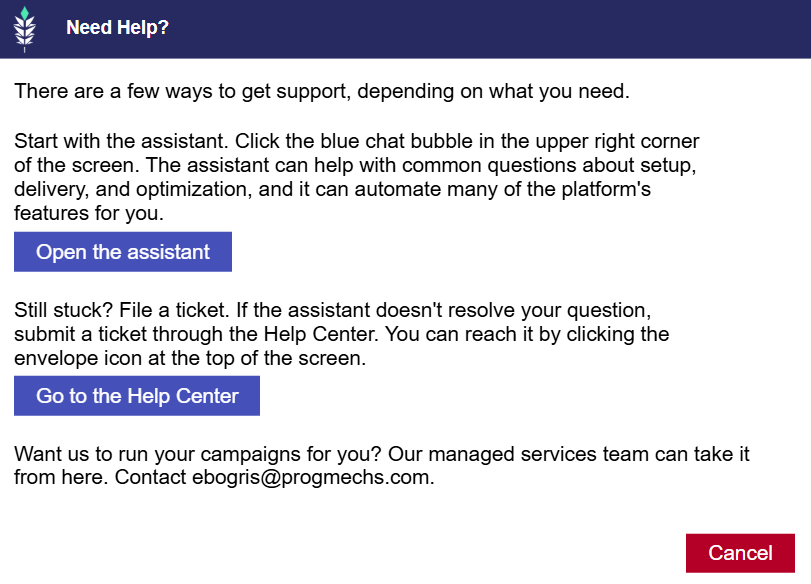
For additional assistance, click the Need Help? button in the bottom-left footer of the Pontiac Platform to access the following support options:
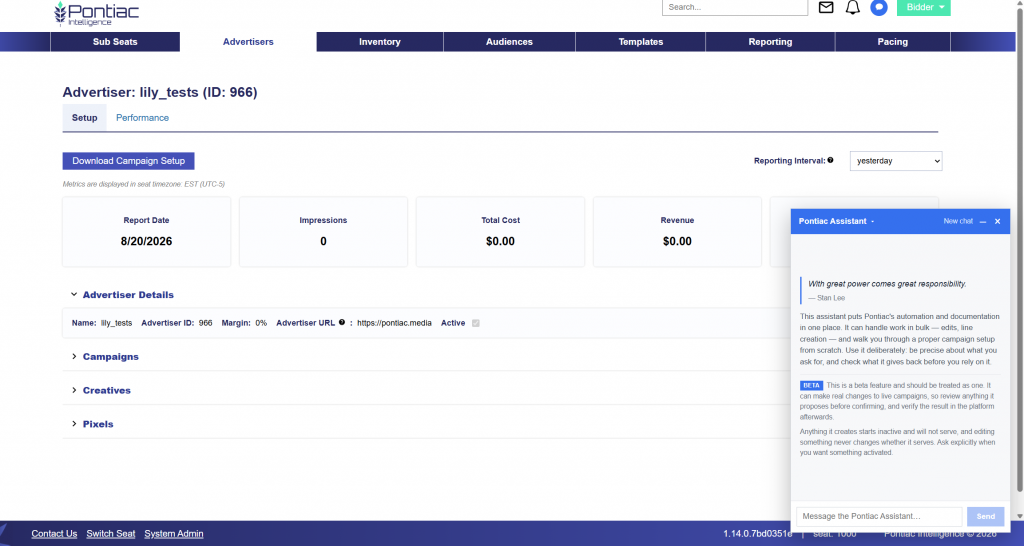
Pontiac Assistant: Get help with Campaign setup, delivery, troubleshooting, and optimization. Click Open the Assistant or use the blue chat icon in the upper-right corner.
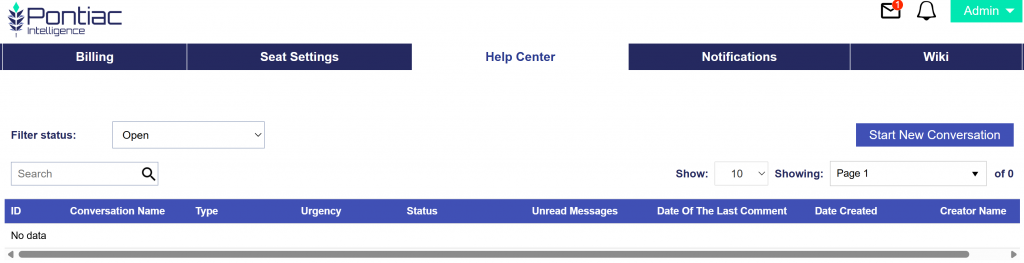
Help Center: Submit a support ticket for further investigation. Click Go to the Help Center or use the envelope icon in the upper-right corner.
Managed Services: For hands-on Campaign management assistance, contact ebogris@progmechs.com.
Understand where delivery is breaking down between Eligible Requests, Bids, and Impressions
Bid Data
Understand how efficiently Eligible Requests turn into Bids and Bids turn into Impressions
Bid/Imp Ratios
Identify which targeting or serving requirements are blocking the most requests
Blockers Graph
Run automated checks for common issues related to Campaign setup, creatives, Deals, targeting, budgets, pacing, and auction performance
Troubleshoot Feature
Determine whether enough inventory is available for the current targeting setup
Inventory Availability
Get guided help interpreting delivery issues, Troubleshoot messages, or Campaign setup
Ask the Pontiac Assistant
Understand how Campaign and Line targeting settings interact
Campaign vs. Line Level Targeting
Troubleshoot rejected creatives or creative category issues
Creative Issues
Contact the Pontiac team for additional investigation or support
Help Center
For Campaign or Line delivery issues, Bid Data is usually the best place to start. Review the delivery funnel to determine where the issue is occurring:
Are there Eligible Requests?
Are Bids being placed?
Are Impressions being won?
Is the Campaign or Line pacing to expectations?
Once you identify where delivery is being limited, use the applicable section above to investigate further.
Need Help? Footer Button
The Need Help? button, located in the bottom-left footer of the Pontiac Platform, provides quick access to support resources and assistance.
Click Need Help? to open a popup with three support options:
Pontiac Assistant: Click Open the Assistant to get help with Campaign setup, delivery, troubleshooting, optimization, and other platform questions. The Assistant can also automate many platform features.
Help Center: Click Go to the Help Center to submit a support ticket or request additional assistance from the Pontiac Support team.
Managed Services: For hands-on Campaign management assistance, contact ebogris@progmechs.com.
The Pontiac Assistant and Help Center can also be accessed directly using the blue chat icon and envelope icon in the upper-right corner of the platform.
Related Documentation
Pontiac Assistant: Learn about the Assistant’s capabilities, supported workflows, and example prompts.
Help Center: Learn how to submit and manage support tickets through the Help Center.
Bid Data
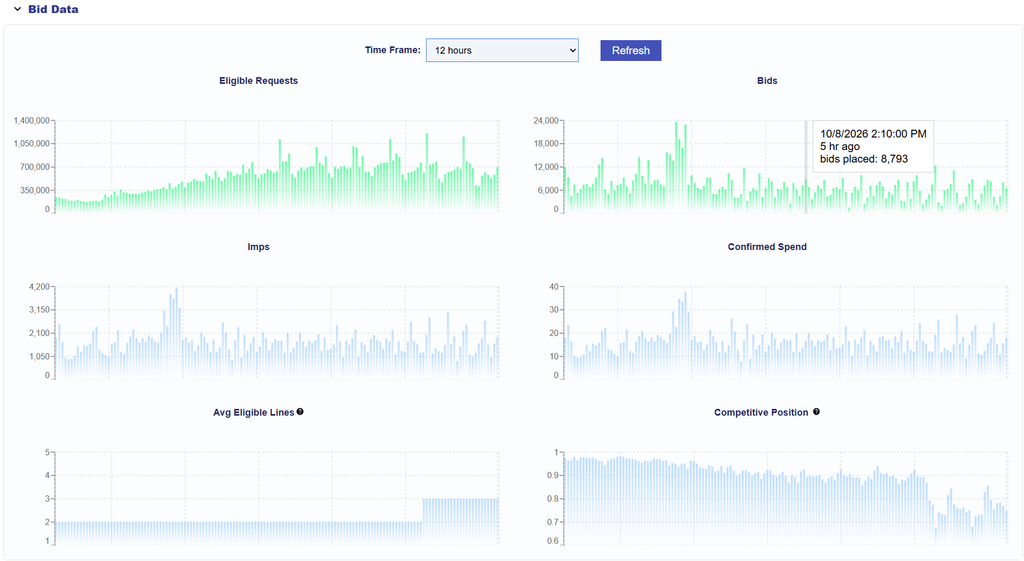
Bid metrics are displayed on the Advertiser, Campaign, and Line details pages to provide insight into the bid funnel, near-real-time delivery, auction competitiveness, and potential issues that may be affecting delivery.
Use Bid Data to understand where delivery may be restricted within the bidding process: Eligible Requests → Bids → Impressions → Confirmed Spend
Reviewing these metrics together can help determine whether a delivery issue is related to available inventory and Targeting, whether the platform is submitting bids on eligible requests, or whether submitted bids are successfully winning impressions.
Bid Data Metrics
Time Frame: Select 15 minutes, 1 hour, 12 hours, or 1 day. Data is displayed in 5-minute intervals.
Eligible Requests: Bid requests that meet the applicable Targeting criteria, including Deals, geo Targeting, inventory Targeting, Audiences, and other Targeting restrictions.
If there are no Eligible Requests, there may be no inventory matching the complete Targeting configuration or the Targeting may be too restrictive.
Review Blockers, Inventory Availability, and Troubleshoot Checks for additional insight.
Bids: Bids placed on Eligible Requests.
If Eligible Requests are present but Bids are low or zero, additional serving requirements may be preventing bids from being placed.
These can include budget or pacing restrictions, Frequency & Recency, Creative eligibility, publisher requirements, bid requirements, or other bidder-level conditions.
Imps: Confirmed impressions served after a submitted bid wins the auction.
If Bids are being placed but few or no Impressions are serving, review bid competitiveness, Deal floors, auction competition, and publisher requirements.
Creatives may also be subject to additional review outside of Pontiac. Pontiac audits and approves Creatives within the platform, but SSPs and publishers may have their own Creative approval processes that can temporarily or permanently affect winning bids.
Confirmed Spend: Confirmed spend generated by impressions served during the selected Time Frame.
Avg Eligible Lines: The average number of Lines across the platform competing for inventory that is also eligible for the Line. Higher values indicate greater competition for the same eligible inventory.
Competitive Position: Indicates how competitive the Line is relative to other eligible Lines on the platform. Values closer to 1 indicate a stronger competitive position.
Users can hover over the charts to view the timestamp and metric value for a specific point in time.
How to Interpret Bid Data
Use the relationship between Eligible Requests, Bids, and Impressions to determine where delivery may be restricted.
No Eligible Requests: Review Targeting, Inventory Availability, Deal activity, Creative compatibility, Audiences, and Campaign/Line Targeting intersections.
Eligible Requests but No Bids: Review budgets, pacing, Frequency & Recency, Creative eligibility, publisher approval, Deal requirements, and bidding configuration.
Bids but Few or No Impressions: Review bid competitiveness, Deal floors, auction competition, publisher requirements, and external Creative approval status where applicable.
Impressions are serving but pacing is low: Review available inventory scale, budgets, Budget Multiplier, pacing configuration, Frequency & Recency, and bid competitiveness.
Tip: Bid Data should be read as a funnel. Eligible Requests but no Bids indicates a different type of delivery restriction than Bids but no Impressions. Identifying where the drop-off occurs can help narrow the next troubleshooting steps.
Bid/Imp Ratios
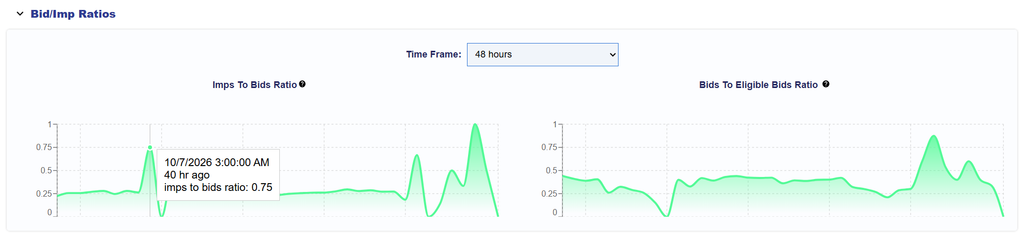
The Bid/Imp Ratios section provides additional insight into how efficiently eligible inventory moves through the bidding and auction process. Bid/Imp Ratios are available on the Campaign and Line Performance tabs.
Available settings and metrics include:
Time Frame: Select 6 hours, 12 hours, 24 hours, or 48 hours.
Imps to Bids Ratio: The ratio of impressions delivered to bids placed. This shows how frequently submitted bids result in won impressions.
A higher ratio indicates that a larger share of bids are winning and converting into impressions.
A lower ratio indicates that many bids are being submitted without winning. This may point to an uncompetitive bid price, auction competition, Deal conditions, or inventory conditions.
Bids to Eligible Bids Ratio: Shows how frequently the platform places a bid after a request passes Targeting eligibility.
A higher ratio indicates that the platform is bidding on a larger share of Eligible Requests.
A lower ratio indicates that requests are passing Targeting eligibility but are frequently being filtered before a bid is placed. This may point to budget or pacing constraints, Creative eligibility, Frequency & Recency, bid requirements, or other bidder-level restrictions.
Users can hover over the charts to view the timestamp and metric value for a specific point in time.
If delivery is being limited by pacing or budget allocation, increasing the Budget Multiplier or enabling Catch-up ASAP may help increase bid volume.
Budget Multiplier: Allows the Line to spend above its calculated daily budget by applying a multiplier to the daily budget target. Increasing the multiplier gives the Line more flexibility to spend when eligible inventory is available. A 1.3 Budget Multiplier is typically recommended as a starting point when additional pacing flexibility is needed.
Catch-up ASAP: Temporarily allows a Campaign or Line that is behind pace to spend more aggressively. While active, Catch-up ASAP overrides the configured Daily Budget and Daily Pacing Type until pacing returns to 100%, then the normal pacing configuration resumes.
These settings should only be adjusted when pacing or budget allocation is the cause of limited bid volume. They will not resolve delivery restrictions caused by Targeting, Creative eligibility, Deal availability, Frequency & Recency, publisher approval, or other serving requirements.
Inventory Availability
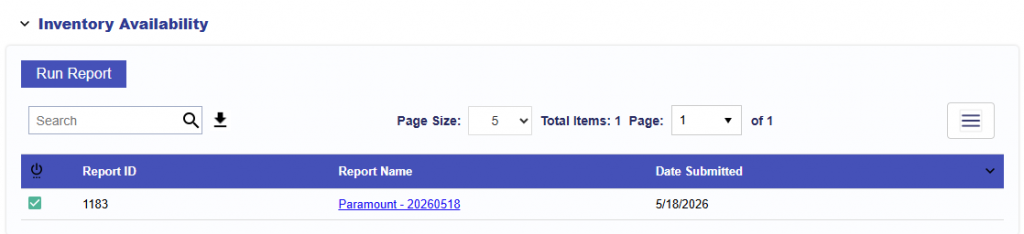
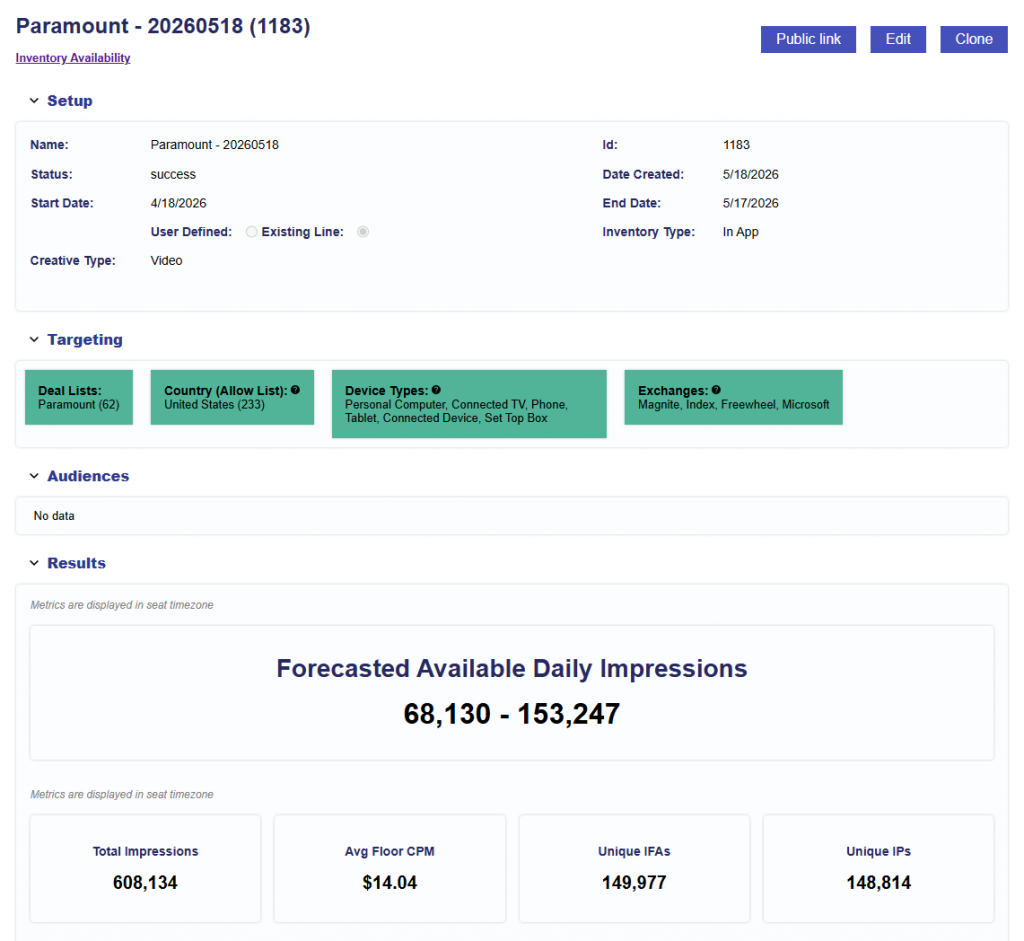
The Line Performance tab includes an Inventory Availability section that allows users to generate an Inventory Availability Report using the Line’s current setup.
Select Run Report to generate a new report.
The report is generated using the line’s current configuration, including:
Inventory type
Creative type
Advertiser
Campaign
Line
Effective targeting (Intersection of the Campaign and Line)
Line level Audiences
If audiences are applied to the Campaign level, users can manually add an additional group and then run the report, but it will not be automatically included.
See Boolean Logic for more details on any and all logic for targeting between groups.
After a report is submitted, it appears in the Inventory Availability report table for that line.
Use Inventory Availability to determine:
Whether inventory exists for the current setup.
Whether targeting may be too restrictive.
Whether selected Deals provide sufficient scale.
What bid floors are available.
Whether expanding targeting or inventory may improve delivery.
This is particularly useful when Eligible Requests are low or zero.
The table includes:
Report Status: Shows whether the report is processing, complete, or has an issue
Report ID
Report Name: Generated using the line name and date. When users click on the name, they are taken to the full report.
Date Submitted
Reports are ordered by Date Submitted, with the newest reports shown first.
Results
Once the report finishes processing, select the Report Name to review the results.
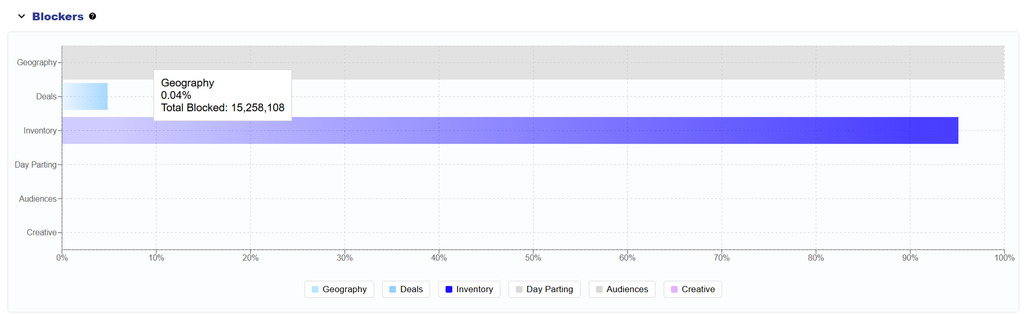
The Blockers section helps identify which types of restrictions are preventing bid requests from becoming eligible for the Line.
The horizontal bar chart groups blocked requests into the following categories:
Geography: Requests blocked by geographic Targeting requirements.
Deals: Requests blocked because they do not meet the applicable Deal Targeting or Deal eligibility requirements.
Inventory: Requests blocked by inventory-related Targeting or eligibility requirements.
Day Parting: Requests blocked because they fall outside the configured Daypart schedule.
Audiences: Requests blocked by applicable Audience Targeting requirements.
Creative: Requests blocked by Creative-related eligibility requirements.
Each blocker category is calculated independently. The chart is not a sequential bid funnel, and the same bid request may be blocked by more than one category.
Hover over a category to view:
Blocked %: The category’s share of the total blocked counts across the blocker categories currently displayed.
Total Blocked: The total number of bid requests blocked by that category.
All visible Blocked % values add up to 100%.
Use the legend below the chart to hide or restore individual blocker categories. The chart automatically rescales based on the categories currently displayed.
A larger Blocked % can help identify which part of the Line configuration is contributing most heavily to restricted inventory.
Important: A request can be blocked by multiple categories. Reducing one blocker does not guarantee that the request will become eligible if another Targeting or eligibility requirement still blocks it.
Use Blockers together with Bid Data and Troubleshoot Checks when investigating delivery. Blockers shows where requests are being filtered at a high level, while Troubleshoot Checks provides more specific validation and recommended areas to review.
Troubleshoot Feature
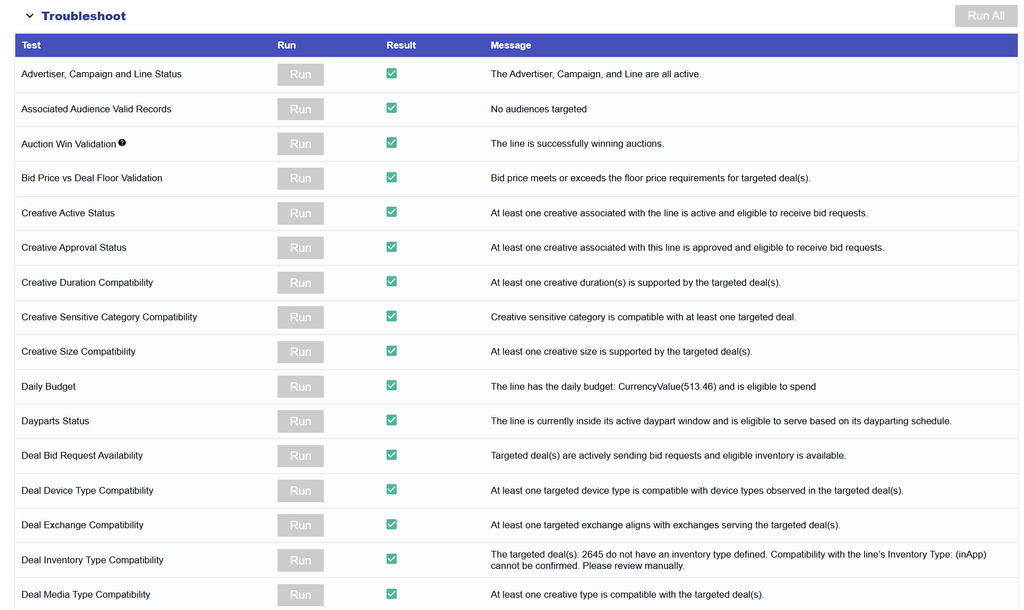
The Troubleshoot feature runs a series of checks designed to identify common delivery blockers related to Campaign and Line setup, Audiences, Creatives, Deals, Targeting, budgets, bidding, Dayparts, and auction performance. Select the Run All button to see the results of each check.
To access the feature:
Open the applicable Line.
Navigate to the Performance tab.
Review the Troubleshoot section below Bid Data.
Use Troubleshoot Checks together with Bid Data, Blockers, and Inventory Availability to determine where delivery may be restricted.
Troubleshoot Checks can return:
Pass: The applicable delivery requirement is satisfied.
Warning: The check cannot be fully verified or part of the configuration requires review.
Fail: The check identified a condition that may prevent or limit delivery.
Status, Audience, and Auction Checks
Active Status: Confirms that the Advertiser, Campaign, Line, and current Flight (when Flights are enabled) are all active.
Pass: All applicable objects are active.
Fail: One or more objects are inactive.
The following are inactive: {Object Name} (ID: {object_id}). To resolve this issue, set the inactive object(s) to active.
Warning: Flights are enabled, but no Flight covers the current date. This may be intentional if delivery is paused. If delivery is expected, review the Flight dates.
Associated Audience Valid Records: Confirms that the effective audiences associated with the line have valid records available for targeting.
Pass: The associated audience(s) have valid records available for targeting: {audience_1} has {audience_1_records} valid records {audience_2} has {audience_2_records} valid records
Warning: The associated audience(s) have partially invalid record availability. The associated audience(s) have valid records available for targeting: {audience_1} has {audience_1_records} valid records. The associated audiences have 0 valid records and will not serve: {audience_2}, {audience_3}. These may limit overall delivery.
Fail: All associated audiences have 0 valid records and will not serve: {audience_1}, {audience_2}, {audience_3}
A Warning may still allow delivery, but Audiences with no valid records can reduce available scale depending on the configured Audience logic.
Auction Win Validation: Confirms that the Line has recently won auctions and served Impressions.
Pass: The Line is successfully winning auctions.
Fail: No qualifying Impressions were found.
If the Line is bidding but not yet winning Impressions, the Creative may still be undergoing an SSP or publisher Creative audit or approval process. These external review periods can take up to 24 hours in some cases and may temporarily prevent the Creative from winning inventory even when Pontiac is actively bidding.
This check reviews Impressions from the previous 48 hours. Recently won Impressions may appear in Bid Data before this check updates, so use Bid Data for the most current activity.
Bidding Checks
Bid Price vs Deal Floor Validation: Confirms that the Line’s bid meets or exceeds the floor price requirements of targeted Deals.
Pass: The bid meets or exceeds the applicable Deal floor.
Fail: The Line bid is below the floor for one or more targeted Deals.
Creative Checks
Creative Active Status: Ensures at least one creative is active
Pass: At least one creative associated with the line is active and eligible to receive bid requests.
Fail: The line is not showing eligible requests because there are no active creatives associated. The failure message identifies the Deal, Deal Floor, and current Bid Price.
Passing this check confirms that the bid meets the minimum floor. It does not guarantee the bid is competitive enough to win auctions.
Creative Active Status: Confirms that at least one Creative associated with the Line is Active.
Pass: At least one associated Creative is Active.
Fail: No Active Creatives are associated with the Line.
Creative Approval Status: Confirms that at least one associated Creative is approved in Pontiac for serving.
Pass: At least one Creative is approved.
Fail: The associated Creative or Creatives are not approved.
Creative Duration Compatibility: For video and audio inventory, confirms that at least one Creative duration is supported by the targeted Deals.
Pass: At least one creative duration(s) is supported by the targeted deal(s).
Fail: The line is not showing eligible requests because creative durations are not supported by the targeted deal(s).
Creative Size Compatibility: Validates creative size against deal requirements
Pass: At least one creative size is supported by the targeted deal(s).
Fail: The line is not showing eligible requests because creative sizes are not supported by the targeted deal(s).
Creative Sensitive Category Compatibility: Confirms that Creatives assigned a sensitive category are targeting inventory that permits that category.
Pass: Creative sensitive category is compatible with at least one targeted deal.
Fail: The line is not showing eligible requests because the creative(s): {creative_ids} must target a deal that allows for the creative’s sensitive category. If a creative has a sensitive category, it is not eligible to run on the open exchange.
Budget and Dayparts Checks
Daily Budget: Confirms that the line’s calculated daily budget is greater than $0.
Pass: The line has a daily budget of {line_daily_budget} and is eligible to spend.
Fail: The line is not eligible to spend because its calculated daily budget is $0.
The message identifies the applicable budget setting or settings that may need to be updated.
Depending on the line’s budget configuration, this may include:
Line Budget Allocation Weight
Line Budget Multiplier
Current Flight Budget
Current Flight Line Budget Allocation Weight
Current Flight Line Budget Multiplier
Only settings applicable to the line’s current budget and flight configuration are included.
The check will also fail when the campaign, flight, or line has no remaining budget.
Remaining Budget Fail: The line is not eligible to spend because the remaining budget is $0. If the line should continue delivering, increase the applicable campaign, flight, or line budget.
Dayparts Status: Confirms whether the line is currently eligible to serve based on its configured dayparting schedule.
Pass: The line is currently inside its active daypart window and is eligible to serve based on its dayparting schedule.
Fail: The line is currently outside of its active daypart window and is not eligible to serve based on its configured dayparting schedule.
A failed result reflects the line’s eligibility at the time the check is run. The line may become eligible when its next active daypart window begins.
Deal Availability and Compatibility Checks
Deal Bid Request Availability: Confirms targeted deals are sending requests
Pass: Targeted deal(s) are actively sending bid requests and eligible inventory is available.
Fail: The line is not showing eligible requests because the deal(s): {deal_ids} are not sending bid requests.
Deal Device Type Compatibility: Validates device targeting matches deal traffic
Pass: At least one targeted device type is compatible with device types observed in the targeted deal(s).
Fail: The line is not showing eligible requests because the deal(s): {deal_ids} do not support the targeted device types.
Deal Exchange Compatibility: Ensures exchange alignment with deals
Pass: At least one targeted exchange aligns with exchanges serving the targeted deal(s).
Fail: The line is not showing eligible requests because the deal(s): {deal_ids} and targeted exchanges are not aligned.
Warning: Unable to verify exchange compatibility for the targeted Deal(s): {deal_1}: {exchange_1}, {deal_2}: {exchange_2}. Insufficient deal sample log data is available. Please verify exchange compatibility manually.
Deal Inventory Type Compatibility: Validates that the line’s selected Inventory Type is compatible with the inventory type of its targeted deal(s). A line only needs one compatible targeted deal for this check to pass.
Pass: At least one targeted deal matches the line’s selected Inventory Type, and the line is eligible to receive bid requests.
Pass – Deal Inventory Type Undefined: The targeted deal(s): {deal_ids} do not have an Inventory Type defined. Compatibility with the line’s Inventory Type: {line_inventory_type} cannot be confirmed. Please review manually.
Fail: No targeted deals match the line’s current Inventory Type: {line’s inventory type}. Update the line’s Inventory Type or target compatible deals to enable delivery.
Line Inventory Type and Compatible Deal Inventory Type
Web: Web or Combined
In App: In App or Combined
Combined: Web, In App, or Combined
Deal Media Type Compatibility: Confirms creative type matches deal media type
Pass: At least one creative type is compatible with the targeted deal(s).
Fail: The line is not showing eligible requests because the deal(s): {deal_ids} have media types that do not match the associated creatives.
Pass: At least one targeted deal has satisfied publisher approval requirements and is eligible for bidding.
Fail: The line is not showing eligible requests because the deal(s): {deal_ids} require publisher approval.
Deal Required Field Presence: Ensures required fields are present in requests
Pass: At least one targeted deal is passing the required field(s) in bid requests and is eligible for delivery.
Fail: The line is not showing eligible requests because the deal(s): {deal_ids} do not pass the required field(s) in bid requests. Deal {deal_id}: Missing {field_name}
Campaign and Line Targeting Intersection Checks
Campaign- and Line-level Targeting are evaluated together. These checks confirm that settings applied at both levels have an intersection.
Deal Targeting Intersection: Ensures campaign and line deal targeting overlap
Pass: Campaign and line deal targeting settings intersect.
Fail: Campaign and line deal targeting parameters have no intersection. Ensures that when targeting is applied to both levels that they match or have an intersection.
Pass: Campaign and line device targeting settings intersect.
Fail: Campaign and line device targeting parameters have no intersection. Ensures that when targeting is applied to both levels that they match or have an intersection.
Pass: Campaign and line exchange targeting settings intersect.
Fail: Campaign and line exchange targeting parameters have no intersection. Ensure that when targeting is applied to both levels that they match or have an intersection.
Pass: Campaign and line geo targeting settings intersect.
Fail: Campaign and line geo targeting parameters have no intersection. Ensure that when targeting is applied to both levels that they match or have an intersection.
Exchange-Specific Checks
Microsoft Creative Audit Approval: Validates Microsoft exchange approval if targeting Microsoft as an Exchange.
Pass: At least one creative is approved for the Microsoft exchange and eligible to receive bid requests.
Fail: The line is not showing eligible requests because the creative(s): {creative_ids} are not approved for Microsoft.
Open Exchange Lines
If no Deals are targeted and the Line is using open exchange inventory, Deal-specific checks are treated as not applicable and display:
No deals targeted; check not applicable for open exchange.
Additional Manual Troubleshooting
Automated checks provide a strong starting point, but some delivery issues require additional investigation.
Before working through the manual troubleshooting steps below, users can also ask the Pontiac Assistant for help reviewing the Line’s configuration and delivery signals. The Pontiac Assistant can help interpret Bid Data, Blockers, Inventory Availability, Troubleshoot Checks, and other Line settings to identify likely causes of limited delivery and recommend areas to review.
A useful troubleshooting order is: Eligible Requests → Bids → Impressions → Pacing
No Eligible Requests
If the Line has no Eligible Requests, first determine whether inventory exists that satisfies the full configuration.
Review the following:
Creative Audit Status: Pending Creatives cannot receive Eligible Requests until Pontiac’s Creative audit is complete. Rejected Creatives cannot serve.
Inventory Availability: Run an Inventory Availability Report using the Line’s current Targeting. Very low or zero estimated inventory may indicate overly restrictive Targeting.
Inventory Type Compatibility: Confirm that Web, In App, or Combined aligns with the selected Media Type, Device Type, and Creative Type.
Campaign and Line Targeting: Confirm that settings at both levels intersect. For example, Campaign Targeting for Florida combined with Line Targeting for Alabama would result in no eligible inventory.
Publisher Creative Requirements: Review Deal sample logs for Creative size, duration, bitrate, category, protocol, and other publisher requirements.
Contextual AI: Contextual AI should not be used with In App-only inventory because it relies on web-page content.
Content-Level Targeting: Confirm that targeted content values match the fields and formatting present in Deal sample requests.
Require Settings: If options such as Require Network or Require Channel are enabled, confirm that targeted Deals actually pass those fields.
Deal Activity: Review the Deal’s Last Served date to confirm that it is still active.
Deal Sample Logs: Confirm Deal floor, Creative requirements, Media Type, and other inventory characteristics align with the Line configuration.
Eligible Requests but No Bids
If Eligible Requests exist but no Bids are being placed, the request has passed Targeting but another serving requirement may be blocking bidding.
Review the following:
Publisher Approval: Determine whether the targeted Deal requires Creative approval from the publisher.
Sensitive Categories: Confirm that Deals explicitly permit any sensitive category assigned to the Creative.
Bid Configuration: Confirm that bids are set correctly for the targeted Deals.
Basic Bid: The Bid Price must meet the applicable Deal floor.
Advanced Bid Controls: When targeting multiple Deals, individual Deal bids can be configured independently.
Max Bid Price: To bid on all targeted Deals, the applicable maximum bid must meet the floor of each Deal.
If these settings appear correct and no Bids are being placed, contact the Help Center for additional investigation.
Bids but No Impressions
If Bids are being submitted but the Line is not winning Impressions, focus on auction competitiveness and publisher requirements.
Review the following:
Bid at Floor Price: If enabled, the Line bids at the Deal floor even when a higher maximum bid is configured. Disabling this option may allow a more competitive bid.
Bid Price: Test incremental bid increases to determine whether win rate improves.
Publisher Requirements: Publishers may have additional Creative specifications or approval requirements that affect whether submitted bids can win.
Deal sample logs and publisher specifications can provide additional detail about bitrate, VAST version, Creative dimensions, duration, and other requirements.
If the Line continues bidding without winning Impressions after these checks, contact the Help Center.
Impressions Are Serving but Delivery Is Low
If the Line is winning Impressions but is not pacing as expected, review whether the Line has enough available scale and enough budget flexibility to increase delivery.
Consider:
Inventory Availability: Confirm that sufficient estimated inventory exists for the current configuration.
Additional Deals: Run Inventory Availability without the current Deal restriction to identify other inventory sources that may provide scale.
Targeting Expansion: Consider adding inventory or expanding applicable Geo or Audience Targeting.
Bid Floors: Review Inventory Availability and Deal data to understand applicable bid floors.
Budget Multiplier: Increase the Budget Multiplier when additional daily pacing flexibility is appropriate. A 1.3 Budget Multiplier is typically recommended as a starting point when additional flexibility is needed.
Budget Allocation Weight: Allocate more Campaign budget to Lines that have available scale and are pacing effectively.
Catch-up ASAP: Enable Catch-up ASAP when a Campaign or Line is behind pace and should temporarily spend more aggressively. Catch-up ASAP overrides the Daily Budget and Daily Pacing Type until pacing returns to 100%.
Frequency & Recency: Increase Frequency Caps when the existing limits are unnecessarily restricting scale.
Bid Price: A low win rate may indicate that the Line’s bid is not competitive. Test incremental increases and review how win rate and delivery respond.
Important: Budget or pacing changes will not resolve a Line that is restricted by Targeting, Deal availability, Creative eligibility, publisher approval, or another serving requirement. Use Bid Data, Blockers, Inventory Availability, and Troubleshoot Checks together to identify the actual point of restriction before making changes.
Ask the Pontiac Assistant
The Pontiac Assistant can be used as an additional troubleshooting resource when reviewing Campaign and Line delivery.
Users can ask the Assistant questions about platform settings, troubleshooting messages, targeting configuration, pacing, Deals, creatives, and other Campaign setup questions.
For the most useful response, provide relevant context such as:
Advertiser ID or Name
Campaign ID or Name
Line ID or Name
Creative ID
Deal ID
Troubleshoot error or warning
Relevant Bid Metrics
Expected versus actual delivery behavior
Example questions include:
Why is Campaign ID: 1234 not spending?
What does this Troubleshoot warning mean?
Why do I have Eligible Requests but no Bids?
How do Campaign and Line targeting interact?
What could be preventing my creative from serving on a Deal?
The Pontiac Assistant can help guide troubleshooting, while the platform’s Bid Data, Blockers, Troubleshoot checks, and Inventory Availability tools provide the underlying delivery information needed for investigation.
Example
Prompt:
Why is Campaign ID: 1234 not spending?
Pontiac Assistant Response:
Here is what is going on with campaign 1234 (“ABC Example”).
Overall status: the campaign itself is active, and it did spend earlier — $100 of its $300 budget, but pacing shows it stopped spending. Looking at the bid funnel, requests and bids were healthy through August 1st at 5pm, then collapsed to essentially zero bids placed since then. So this isn’t “never delivered,” it’s “stopped delivering on the evening of the 1st.”
The cause, from the troubleshoot checks on both active lines (56789 “A” and 24680 “B”):
Deal media type mismatch (the big one, and it lines up with the timing). Your change history shows that at 2026-08-15 16:55, a deal list called “CTV Deals” (100 deals) was added to this campaign’s targeting. Pontiac’s check says every one of those deals has a media type that doesn’t match the creatives currently associated with these lines (six html5 banner creatives). That addition is almost certainly what killed delivery — the timestamp matches exactly where your bid volume drops off in the bid-ratio data.
What I’d suggest:
Review the “CTV Deals” deal list (id 10) against the creatives on these lines. Either swap in creatives whose media type matches those deals, or remove/replace the mismatched deals from the line/campaign’s deal targeting.
Help Center
The Help Center is the primary way to contact the Pontiac team for platform support, troubleshooting, account questions, and feature requests.
Use the Help Center to submit a support ticket, provide relevant campaign or account details, attach screenshots or videos, and track responses from the Pontiac team in one place.
For the fastest response, include as much relevant information as possible when submitting your ticket, such as applicable IDs, names, screenshots, error messages, and a clear description of the issue.
Create a Support Ticket
Step 1: Navigate to the Help Center
You can access the Help Center in two ways:
From anywhere in the platform, select the Messages icon in the top navigation to open the Help Center.
Or, navigate to Admin > Help Center.
Step 2: Select Start New Conversation
Then select Start New Conversation to open the support ticket form and submit a new request to the Pontiac team.
Click on the Help Center tab.
Click the Start New Conversation button to open the support ticket form.
Here you will be able to submit a support ticket and the Pontiac team will efficiently and happily assist you with a variety of issues and questions.
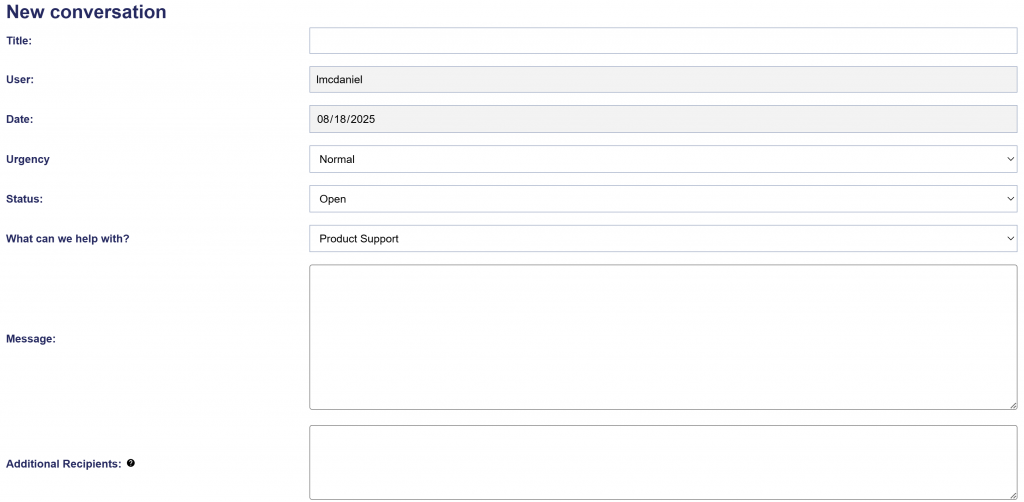
Step 3: Fill Out the New Conversation Form
The following fields will appear:
Title: Provide a brief summary of the issue or request.
User: Your user name which will be auto-filled.
Date: The date of submission which will be auto-filled.
Urgency: Indicate how critical the issue is. Select Normal or Uber Important.
Status: Current status of the ticket. This is set to Open by default. Once the issue is resolved you or a Pontiac team member will change the status to Resolved to close out the ticket.
What can we help with?: Select the category that best matches your issue:
Product Support: Questions or issues related to the platform’s functionality.
Creative Issues: Problems related to creative (incorrect category, upload issue, macro questions, etc.).
Audience Onboarding: Requests or questions about importing or targeting audience segments (Liveramp or Transunion account set up, lookalike audience questions, creating custom pixel audiences, etc.)
Reporting: Questions or issues with analytics, metrics, or data exports.
Billing: Questions related to margin, invoicing, spend, or payment issues.
API: Issues or questions about API access, endpoints, or integrations.
White Label Issues: Problems specific to branded or custom instances of the platform.
Platform Suggestions: Requests for feature enhancements, improvements, or general feedback.
Message: Provide a detailed description of the issue or question. To help the Pontiac team respond as quickly as possible, include all relevant IDs and/or Names where applicable. Examples include: User ID, the Advertiser ID and Name, Campaign ID and Name, Line ID and Name, Creative ID or Name, Pixel ID or Name, etc. The more specific information you provide, the faster and more accurately the support team can address your request.
Additional Recipients: Email addresses of anyone who should receive update notifications for this conversation. Important: All responses must be made through the Help Center ticketing interface, not via the email notification, to ensure your updates are properly logged and tracked.
Attachments: Upload screenshots or videos to support your ticket. This is especially useful for bug-related issues, as visual evidence can help the support team diagnose and resolve problems more quickly.
Step 4: Submit or Save
Click Save to submit the ticket to the Pontiac team.
Click Cancel if you do not want to submit.
The Pontiac team will review your ticket and provide assistance as quickly as possible.
View and Manage Support Tickets
After a ticket has been submitted, you can return to the Help Center at any time to view the conversation, review responses from the Pontiac team, provide additional information, or update the ticket status.
View a Response
When the Pontiac team responds to a ticket, the response will be added to the existing Help Center conversation.
Open the Help Center by selecting the Messages icon in the top navigation or navigating to Admin > Help Center.
Select the conversation you want to review.
Review the latest response and the previous conversation history.
Add a new response if additional information or follow-up is needed.
If email notifications are enabled for you or any Additional Recipients, an email may also be sent when the conversation is updated. All responses should still be made through the Help Center, rather than replying directly to the notification email, so the complete conversation remains logged in the ticket.
Close a Ticket
Once the issue or request has been resolved, the ticket can be closed by updating the Status from Open to Resolved. Either you or a Pontiac team member may mark the conversation as Resolved once no additional assistance is needed.
Resolved conversations remain available in the Help Center so you can refer back to the discussion if needed.
Reopen a Ticket
If additional assistance is needed after a ticket has been resolved, reopen the existing conversation by changing the Status from Resolved back to Open and adding a new response with any relevant details.
Whenever possible, reopen the existing ticket when your question relates to the same issue. This keeps the previous troubleshooting history, attachments, and responses together and gives the Pontiac team helpful context.
For a new or unrelated issue, select Start New Conversation and create a separate support ticket.
Campaign vs. Line Level Targeting
Targeting settings in Pontiac can be applied at either the Campaign level and/or the Line level. Understanding how these interact is key to ensuring your impressions remain eligible.
The Intersection Rule
Campaign level targeting acts as a global filter for all line items under that campaign.
Line level targeting applies only to the specific line.
When targeting is applied at both levels, the effective targeting is the intersection of the two:
Effective Targeting = Campaign Targeting ∩ Line Targeting
This means an impression must satisfy all conditions applied at both levels in order to be eligible.
Best Practices
Use campaign level targeting when the parameter applies universally to all lines (e.g., every line must serve only in the US).
Use line level targeting when the parameter is unique to a strategy (e.g., one line targets ZIPs in California, another in New York).
Apply settings at one level only whenever possible, unless the intent is to explicitly restrict eligible inventory via intersection.
Creative Issues
Rejected Creatives
Creative audit results will be displayed under ‘Audit Status’ next to the name of the Creative, in the ‘Creatives’ section of the Advertiser, Campaign, or Line. If your Creative is rejected, a red box will appear here. Hover over this symbol to view additional information about the audit status. Pontiac Intelligence is unable to change the audit results of Xandr/AppNexus & RiskIQ.
Audit results can only be changed by resolving the issue that caused the Creative to be rejected. If you think your Creative was rejected incorrectly, reach out to the Pontiac Team through the Help Center.
Rejected, Does not display properly: First check to see if there is a preview of the Creative in the green preview box in Pontiac and verify that the Creative fits in the designated area. If it does not fit correctly in the box you may have chosen the incorrect Creative size. You can edit the size then select ‘Save’. The Creative will be sent to audit and this process may take up to one business day to complete.
Rejected, Fails to render: If you are using an ad server tag, verify that the code you uploaded in Pontiac renders on your end. Check with your ad server that the tag is active and available. Email your Account Manager or reach out through the Help Center for additional help.
Rejected, Creative brand does not match Creative landing page: The brand displayed in the ad should match the brand of the website that the ad is driving users to. In order for this Creative to be accepted, you must change the brand displayed in the Creative, or change the Click URL to drive to this brand’s website. If you are driving to a third-party marketplace or other page that does not depict your branding, such as Amazon, check the ‘Use Alternative Mobile Click Url’ and enter a URL that contains the same branding represented in your ad. The audit team will use this URL to validate the branding represented in the creative. This will not be used as the landing page for the creative. Once you have edited the Creative details, ‘Save’ and close the Creative upload window. The Creative will be sent to audit and this process may take up to one business day to complete
Rejected, Creative does not click through properly: Your Creative will be rejected if the Creative is clicked and does not open a landing page, if the Creative is clicked and a landing page opens, but no content loads or if the Creative is clicked and a landing page loads, but an error keeps any content from being displayed. In any of these cases you must either update the landing page and then click ‘Reaudit’ or change the Click URL for the Creative and click ‘save’. The Creative will be sent to audit and this process may take up to one business day to complete.
Rejected, Malicious: Your account will be suspended, you will be notified in writing and an investigation will take place within three business days. Pontiac clients who upload ads deemed malicious will lose access to the platform and forfeit deposited funds.
Incorrect IAB Creative Category
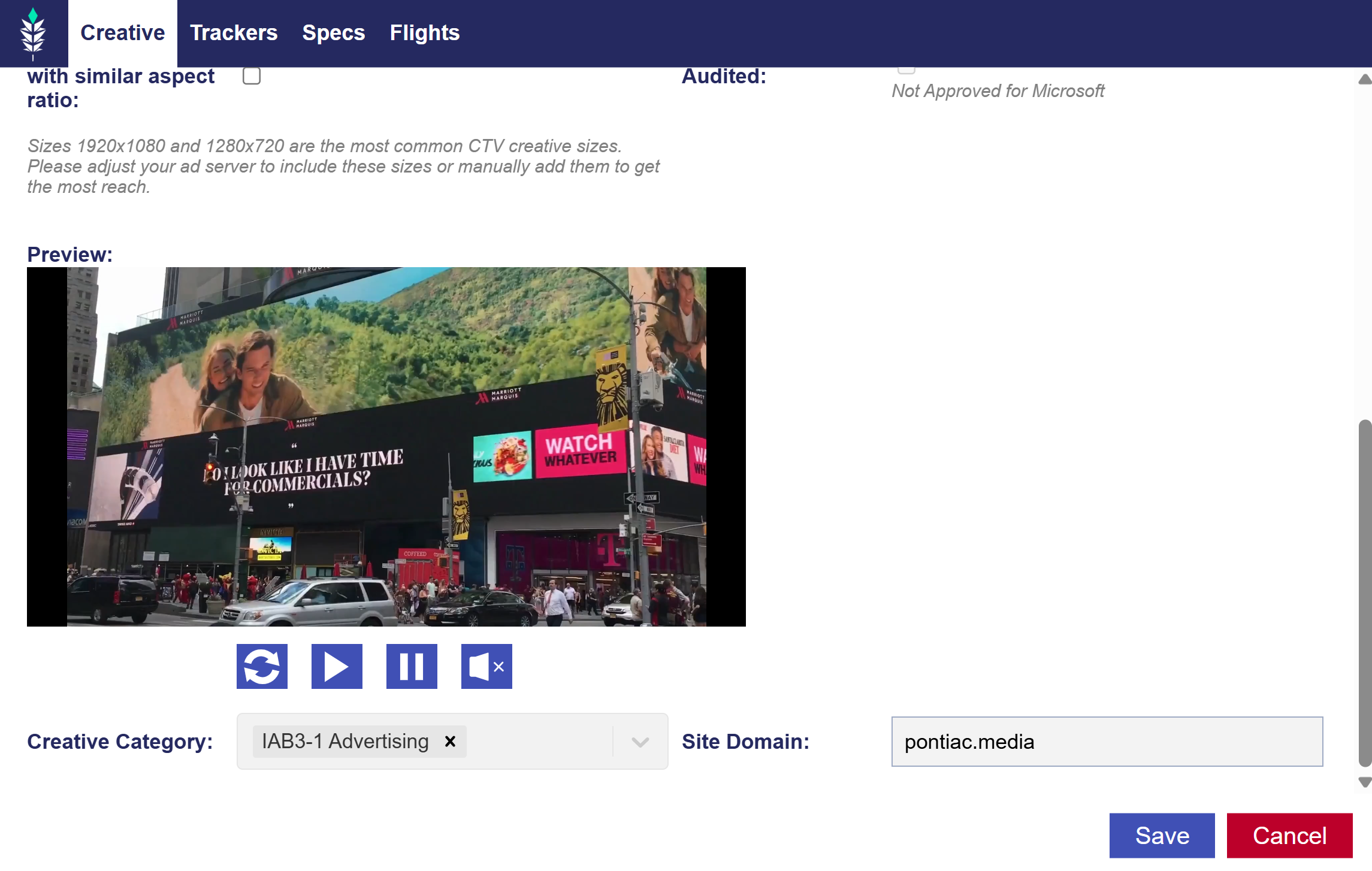
The IAB category assigned to your creative can be found by clicking on the creative name to open the creative details window. This field is displayed below the creative in the ‘Creative Category’ field:
These categories come from the Open RTB Specs, that can be found here in table 5.1 ‘Content Categories’: Open RTB Specs v2.5
If you believe your creative has been assigned an incorrect IAB category, please submit a ticket through the Help Center. Be sure to include the Advertiser Name and ID associated with the creative in question so we can assist you promptly.