Custom Report
The Custom Report allows users to build a downloadable CSV using selected Dimensions and Metrics to analyze Campaign performance at the desired level of detail.
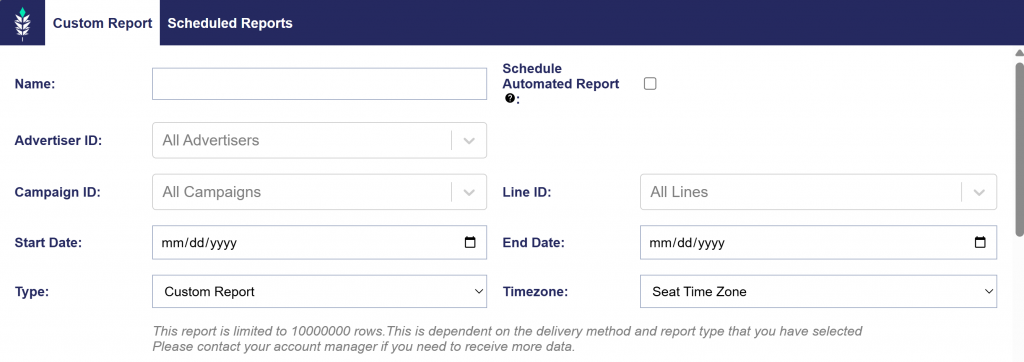
Dimensions determine how report data is grouped, while Metrics determine the performance values included in the report.
Create a Custom Report
- Navigate to Reporting > Custom Reporting.
- Select New Custom Report.
- Select Custom Report as the Type.
- Configure the report settings, Dimensions, and Metrics.
- Select Save.
- Once the report has processed, expand the Custom Reporting section and select Download next to the report name.
- If Schedule Automated Report is enabled, the report will also be delivered using the configured delivery method.
Report Settings
Configure the following when creating a Custom Report:
- Name: Enter a name for the report.
- Schedule Automated Report: Enable this option to generate and deliver the report automatically on a recurring schedule. See Scheduled Reports for setup details.
- Advertiser ID: Select the Advertisers to include. By default, all Advertisers are included.
- Campaign ID: Select the Campaigns to include. By default, all Campaigns under the selected Advertisers are included.
- Line ID: Select the Lines to include. By default, all Lines under the selected Advertisers and Campaigns are included.
- Start Date: Select the beginning of the Reporting Interval.
- End Date: Select the end of the Reporting Interval.
- Type: Select Custom Report.
- Time Zone: Select the time zone used to generate the report, such as Seat Time Zone, User Time Zone, UTC, or another supported time zone.
- Dimensions: Select the categorical fields used to group and segment report data.
- Metrics: Select the quantitative performance values included in the report.
Dimensions
Available Dimensions include:
Date & Time
- Date: The date associated with the reported activity based on the selected report Time Zone. Selecting Date produces both
Date (yyyyMMdd)andDate (M/d/yyyy)in the report output, such as20260903and9/3/2026. - Hour: The hour in which the reported activity occurred, based on the selected report Time Zone. Values are returned using a 24-hour clock.
Advertiser, Campaign & Line
- Advertiser ID: The unique numeric Pontiac ID assigned to the Advertiser.
- Advertiser Name: The name of the Advertiser.
- Advertiser Code: The custom code associated with the Advertiser, when configured.
- Campaign ID: The unique numeric Pontiac ID assigned to the Campaign.
- Campaign Name: The name of the Campaign.
- Campaign Code: The custom code associated with the Campaign, when configured.
- Line ID: The unique numeric Pontiac ID assigned to the Line.
- Line Name: The name of the Line.
- Line Code: The custom code associated with the Line, when configured.
Creative
- Creative ID: The unique numeric Pontiac ID assigned to the Creative.
- Creative Name: The name of the Creative.
- Creative Size: The dimensions of the Creative in pixels, such as
1920x1080.
Inventory
- Deal ID: The Deal ID associated with the inventory transaction, as provided in the bid request. This ID is not Pontiac’s internal numeric Deal ID.
- Deal Name: The Pontiac Deal name associated with the Deal ID.
- Exchange: The Exchange or SSP through which the inventory was purchased, such as
magniteorindexfor example. - Site Domain: The website domain associated with the inventory, when provided. This field may be blank for App inventory.
- App Bundle: The App Bundle ID associated with the inventory. Values may be numeric or alphanumeric.
- App Domain: The domain associated with the App inventory, when provided, such as
samsungtvplus.com. - App Name: The App name provided with the inventory request.
- Impression Tag ID: The impression tag identifier provided with the inventory request. Values may be numeric or alphanumeric.
- Inventory Type: The inventory environment associated with the Impression, such as
app. - Auction Type: The numeric auction type associated with the bid request. For example,
1represents a first-price auction.
Location
- Country Code: The two-character country code associated with where the Impression was served, such as
US. - Country Name: The full country name associated with where the Impression was served, such as
United States. - Region/State Code: The region or state code associated with where the Impression was served, such as
HIfor Hawaii. - Region/State Name: The full name of the region or state where the Impression was served, such as
Hawaii. - DMA Code: The three-digit Designated Market Area (DMA) code associated with where the Impression was served, such as
744. - DMA Name: The name of the Designated Market Area associated with where the Impression was served, such as
Honolulu HI. - Zip Code: The ZIP or postal code associated with where the Impression was served, such as
96706.
Device
- Browser: The browser value associated with the Impression, when available, such as
safari. - Device Make: The device manufacturer or brand provided with the Impression, such as
rokuorsamsung. - Device Model: The device model provided with the Impression, such as
digital video playerortizen tv. - Device Type: The numeric device type value associated with the Impression. For example,
3represents Connected TV and7represents Set Top Box in the sample output. - Device Type Name: The human-readable device type associated with the numeric Device Type value, such as
connectedTvorsetTopBox. - Operating System: The operating system associated with the device, such as
roku osortizen.
Content
- Content Channel: The content channel value provided with the inventory request, when available.
- Content Episode: The episode value provided with the content metadata, when available.
- Content Genre: The content genre provided with the inventory request, such as
entertainment,sports, ornews. - Content Network: The content network value provided with the inventory request, when available.
- Publisher Name: The publisher name provided with the inventory, when available.
- Content Series: The content series value provided with the inventory request, when available.
- Content Title: The content title provided with the inventory request, when available.
- Multi Field: A combined content metadata field that returns an available content value.
Metrics
Available Metrics include:
Delivery
- Impressions: The total number of Impressions served.
- Clicks: The total number of clicks recorded.
- Starts: The number of eligible playback events that reached the Start milestone.
- 25% Complete: The number of eligible playback events that reached 25% completion.
- 50% Complete: The number of eligible playback events that reached 50% completion.
- 75% Complete: The number of eligible playback events that reached 75% completion.
- Completions: The number of eligible playback events that reached 100% completion.
Cost & Revenue
- Total cost: The total cost of the purchased media including applicable DSP fees.
- Media cost: The cost of the purchased media before DSP fees are applied.
- Revenue: The total amount billed to the Advertiser, calculated as Total Cost plus the Advertiser Margin.
- Profit: The difference between Revenue and Total Cost.
CPM
- Total cost CPM: The Total Cost per thousand Impressions, calculated as Total Cost divided by Impressions multiplied by 1,000.
- Media cost CPM: The Media Cost per thousand Impressions, calculated as Media Cost divided by Impressions multiplied by 1,000.
- Revenue CPM: The Revenue per thousand Impressions, calculated as Revenue divided by Impressions multiplied by 1,000.
Fees
- ART Fee: The fee attributed to the use of ART audiences, when applicable.
- CC Fee: The fee attributed to credit card processing, when applicable.
- Chalice Fee: The fee attributed to the use of Chalice, when applicable.
- Contextual Fee: The fee attributed to Contextual targeting, when applicable.
- Creative Hosting Fee: The portion of spend attributed to Creative hosting and serving, when applicable.
- Data Costs: The cost attributed to third party segments used for targeting, when applicable.
- Foot Traffic Fee: The fee attributed to Foot Traffic measurement, when applicable.
- Platform Fee: The portion of spend retained by the platform as margin.