Create an IP Conversion Pixel
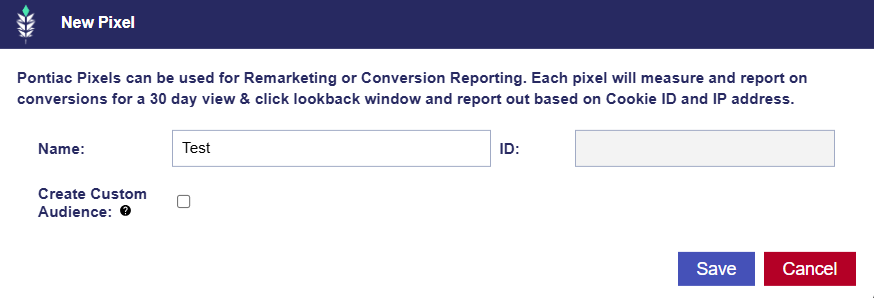
To create an IP Conversion Pixel, follow these steps:
- Navigate to the applicable Advertiser, or create a new Advertiser if needed.
- Select New Pixel.
- Enter a Name for the Pixel.
- Configure the optional Create Custom Audience setting:
- Select Create Custom Audience to create a Pixel IP Audience from qualifying Pixel fires for future targeting or exclusion.
- Days to Live: Determines how long each record remains active in the Audience. The default is 180 days. Common values are 30, 60, or 90 days, with a maximum of 180 days. Users are added to the Audience only from qualifying Pixel activity that occurs after Audience creation is enabled.
- Create Custom Audience (Optional): Check the box if wanting to create an audience for retargeting or exclusion purposes.
- Set Days to Live: Set to 180 days by default. Set the number of days to live. Typically 30, 60, 90 days is input here. The maximum is 180 days.
- Note that users are only added to the audience if they visit the site after the pixel is placed.
- Select Save.
- Allow approximately 30–60 seconds for the Pixel to generate.
- Open the newly created Pixel to view the generated Pixel URLs and additional configuration options.
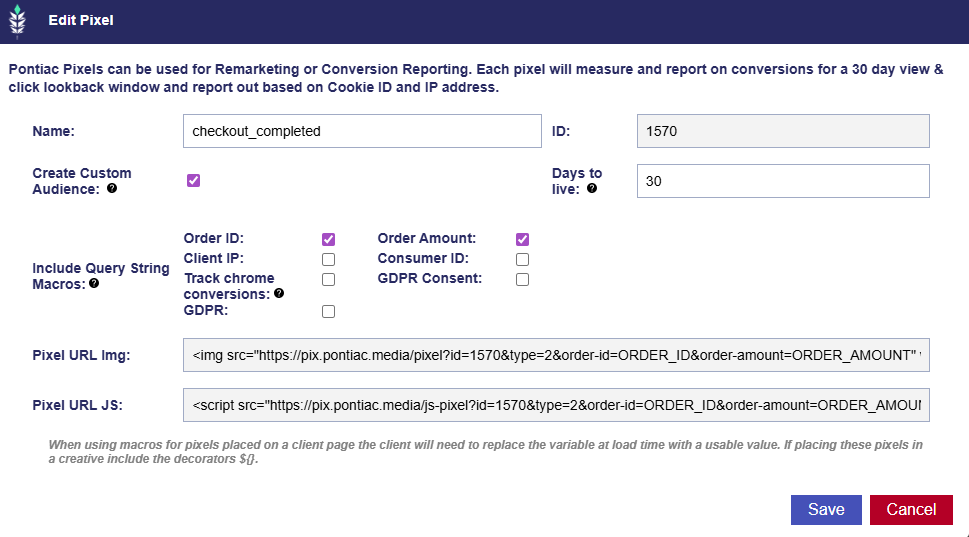
- Configure any optional Query String Parameters:
- Order ID: The unique order ID generated by your site.
- Order Amount: The total order value associated with the Order ID.
- Client IP: The visitor’s IP address captured by your site when the Pixel fires.
- Consumer ID: A unique customer, lead, or visitor ID generated by your site.
- GDPR Consent: The visitor’s consent string collected by your site.
- GDPR: A flag (
0or1) indicating whether GDPR applies to the visitor.- For additional information, see GDPR Query String Macros.
- Custom Variable 1: Adds
var1=VAR1to the Pixel URL and makes the value available as Custom Variable 1 in Custom Reporting. Additional values can be passed usingvar2,var3, andvar4. - When query string parameters are included, work with your web developer to dynamically replace the placeholders with the appropriate values before the Pixel fires.
- Select the desired Pixel implementation:
- Pixel URL Img: Recommended for most use cases. Image pixels are widely supported and work reliably across environments.
- Pixel URL JS: Supports additional functionality and may be used when JavaScript-based tracking is required and supported.
- Implement the Pixel in the desired location:
- Website Activity: Place the Pixel on the Advertiser’s website. It can be placed across the site, such as in the header, or on a specific page such as a product, checkout, or confirmation page depending on the activity you want to measure.
- Creative Exposure: A Pontiac Pixel can also be added to a Creative as an Impression Tracker when Creative exposure tracking or Pixel IP Audience creation is desired.
- Associate the Pixel with the applicable Campaign or Line where conversion performance should be measured.
- For association instructions, see: