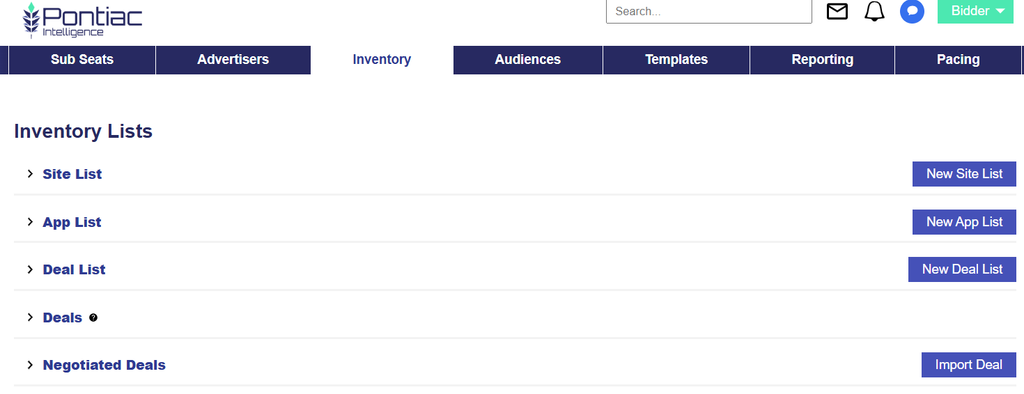
The Inventory section provides the tools used to identify, organize, and target the Sites, App Bundles, and Deals where Campaigns and Lines may be eligible to serve.
From the Inventory tab, users can:
Create and manage custom Site Lists, App Lists, and Deal Lists
Browse available Deals
View and manage Negotiated Deals
Review inventory availability, pricing, Media Types, Inventory Types, Device Types, publisher requirements, and other Deal details
Review sample bid requests to better understand available inventory
Import eligible Negotiated or Programmatic Guaranteed Deals
Use Inventory resources for targeting at the Campaign or Line level
er targeting settings, such as Device Type, Media Type, Deal, Site, App, Geography, Audience, or Creative requirements, do not align.
Inventory Hierarchy
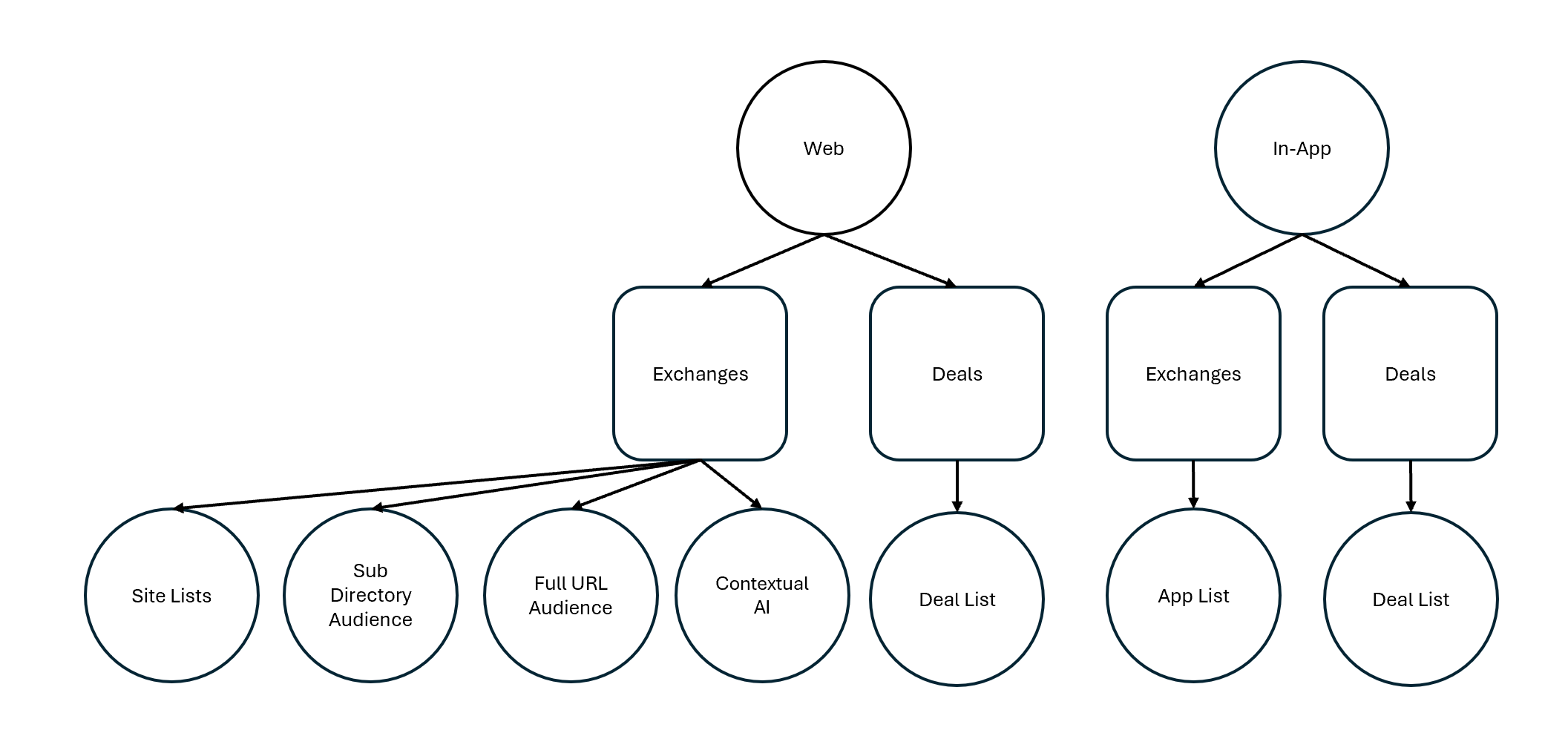
Inventory resources are managed from the Inventory tab and can then be associated with Campaigns or Lines for targeting.
Custom Site, App, and Deal Lists created in the Inventory tab become available within the applicable Campaign and Line Targeting sections. Deals can also be targeted directly at either level. When targeting is applied at both the Campaign and Line levels, the settings must remain aligned for inventory to remain eligible.
Inventory Targeting
Inventory targeting determines the environments and supply sources where a Campaign or Line is eligible to serve. Inventory settings should align with the Line’s media strategy, Creatives, Devices, Deals, and other targeting requirements.
Inventory Type
Web: Ads serve within web browsers across supported desktop, laptop, and mobile environments.
In App: Ads serve within supported applications.
Combined: Includes both Web and In App inventory on the same Line.
Combined allows the Line to receive both Web and In App inventory; it does not require an individual bid request to contain both a Site Domain and App Bundle.
The selected Inventory Type should align with other Line settings:
Site Lists are used with Web inventory.
App Lists are used with In App inventory.
Deals should support the selected Inventory Type.
Device Types should align with the devices observed in the available inventory.
Media Type and Creative Type should align with the inventory available through the targeted Deals.
Inventory Source
Open Exchange: Inventory made available through supply-side platforms (SSPs) in an open real-time bidding marketplace across many publishers.
A Line can access Open Exchange inventory without targeting a Deal.
Private Marketplace (PMP) Deals: Publisher-defined inventory made available through a private auction using a Deal ID.
Programmatic Guaranteed (PG) Deals: Direct publisher agreements with fixed pricing and guaranteed inventory volume. Targeting and delivery requirements are primarily defined by the publisher.
Inventory sources can be further refined using Sites, Apps, Deals, Deal Lists, Exchanges, Device Types, Audiences, Geography, and other Campaign or Line targeting settings.
How Inventory Eligibility Works
Inventory eligibility is determined by all applicable Campaign and Line settings working together. Each additional targeting setting further refines the inventory that is eligible to receive a bid.
For example, a Line may first be limited by its Inventory Type, then further restricted by the selected Inventory Source, Deals, Sites or Apps, Exchanges, Device Types, Media Type, and other targeting requirements.
Inventory Type ↓ Inventory Source / Deals ↓ Sites or Apps ↓ Exchanges / Device Types ↓ Media and Creative Requirements ↓ Other Campaign and Line Targeting ↓ Eligible Inventory
An incoming bid request must satisfy all applicable targeting requirements to remain eligible. Adding more targeting does not expand available inventory; it further restricts the set of requests that can qualify.
Campaign level and Line level targeting are also evaluated together. If an inventory requirement is configured at both levels, the settings must be compatible for inventory to remain eligible.
Inventory Lists Overview
Inventory Lists allow users to group commonly used Site Domains, App Bundles, or Deals into reusable lists that can be applied across multiple Advertiser Campaigns and Lines.
Inventory Lists include:
Site Lists: Groups of website domains used for Web inventory targeting.
App Lists: Groups of App Bundles used for In App inventory targeting.
Deal Lists: Groups of Deals that can be reused across Campaigns and Lines.
Site and App List Targeting
Site and App Lists should be used based on the selected Inventory Type:
Web: Use Site Lists to allow or block website domains.
In App: Use App Lists to allow or block App Bundles.
Combined: Eligible for both Web and In App inventory, so Site and App targeting should be configured carefully based on the intended strategy.
Do not apply both a Site Allow List and an App Allow List to the same Campaign or Line. When both Allow Lists are applied, a bid request must satisfy both targeting criteria to be eligible. Since Web requests typically pass a Site Domain and In App requests typically pass an App Bundle, requiring both will generally prevent delivery.
If the intended strategy is to allow specific Sites for Web inventory and specific Apps for In App inventory, separate the strategy into different Lines:
Web Line: Select Web as the Inventory Type and apply the Site Allow List.
In App Line: Select In App as the Inventory Type and apply the App Allow List.
If needed, clone the existing Line and separate the Site and App targeting between the two Lines. This allows each inventory type to be evaluated against the appropriate Allow List.
Block Lists can still be used where appropriate to exclude unwanted Sites or Apps.
Site Lists
Site Lists group website domains for targeting across Campaigns and Lines. They are intended for Web inventory and can be applied as either an Allow List or Block List.
If no Site List is applied, domain targeting remains open by default, subject to any other Campaign or Line Targeting settings.
Create Custom Site Lists
Navigate to the Inventory tab.
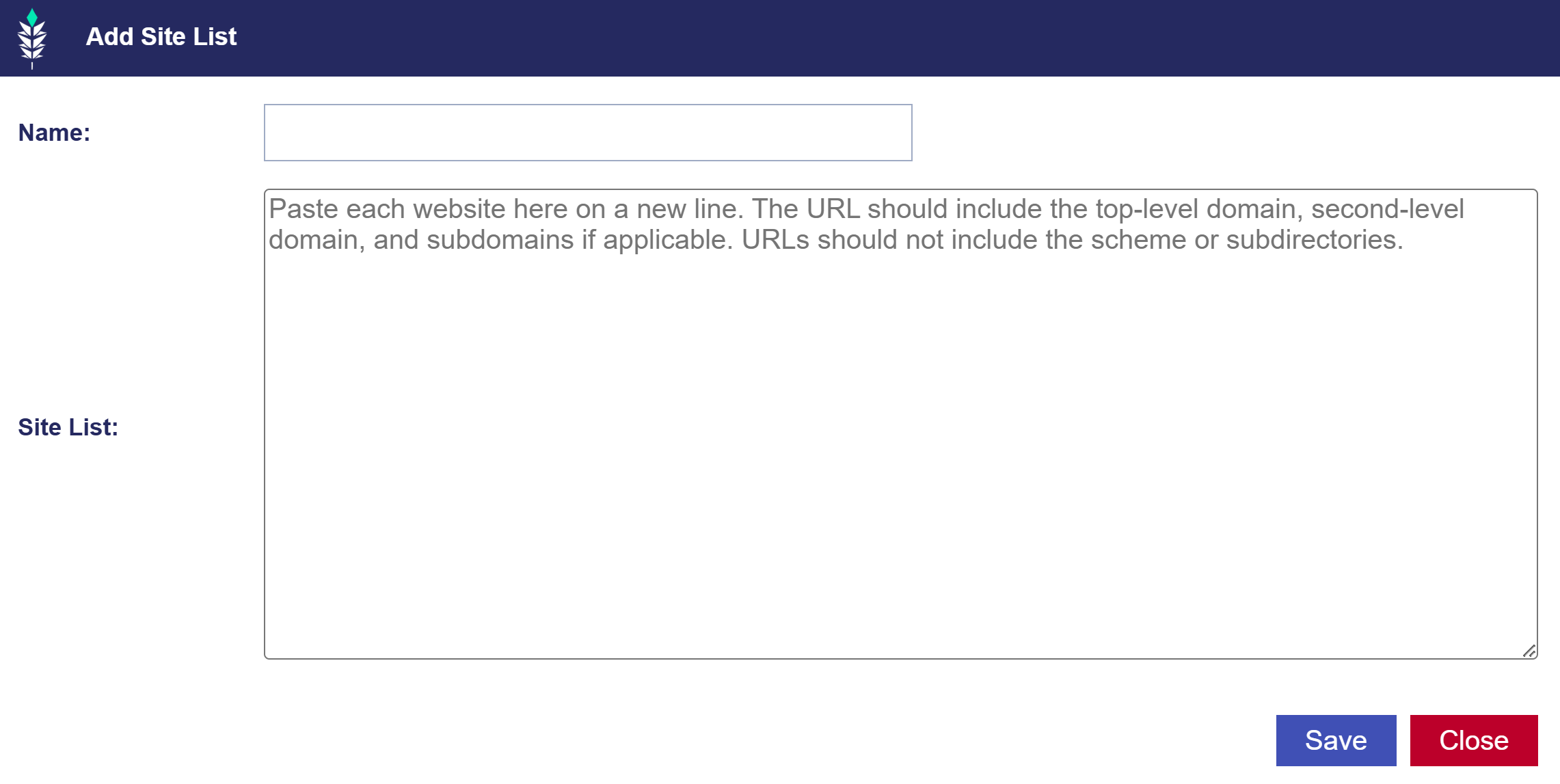
Select New Site List.
Name the new Site List.
Enter each website on a new line.
Include the applicable top-level domain, second-level domain, and subdomain when needed.
Do not include the URL scheme, such as https://.
Do not include page paths or subdirectories.
Use wildcard targeting, such as *.abc.com, when you want to target subdomains of a domain.
Save the Site List.
Once saved, the Site List becomes available for use in Campaign and Line Targeting.
Use a Site List in Campaign or Line Targeting
Site Lists can be applied at the Campaign and/or Line level.
Open the applicable Campaign or Line in Edit Mode.
Navigate to Targeting.
Select Edit Targeting.
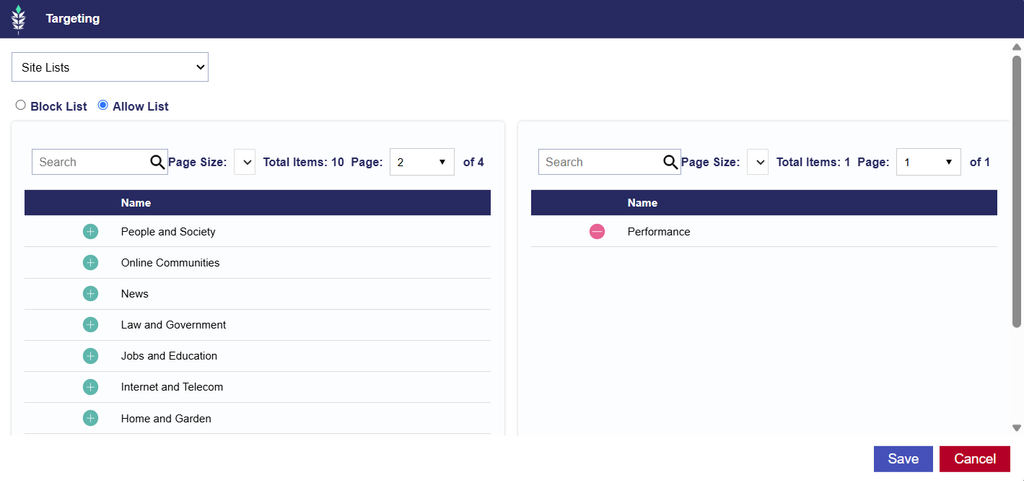
Open Inventory > Site Lists.
Search for the Site List by Name.
Select the green plus sign (+) to add the Site List.
To remove a Site List from targeting select the red minus sign (-).
Select how the list should be applied:
Allow List: Limits eligible Web inventory to domains included in the Site List.
Block List: Prevents the Campaign or Line from serving on domains included in the Site List.
Save the Targeting changes and submit the Campaign or Line update.
If Site List Targeting is applied at both the Campaign and Line levels, the settings are evaluated together. The resulting inventory must satisfy the applicable Targeting requirements at both levels.
Example: If a Campaign Allow List includes example.com and publisher.com, but the Line Allow List includes only example.com, the Line is effectively limited to example.com.
Wildcard Example:*.abc.com can be used to target subdomains such as news.abc.com, sports.abc.com, and www.abc.com.
App Lists
App Lists group App Bundles for targeting across Campaigns and Lines. An App Bundle is the unique application identifier passed in the bid request and can be used to allow or block specific apps from serving.
Once created, an App List can be reused across multiple Campaigns and Lines.
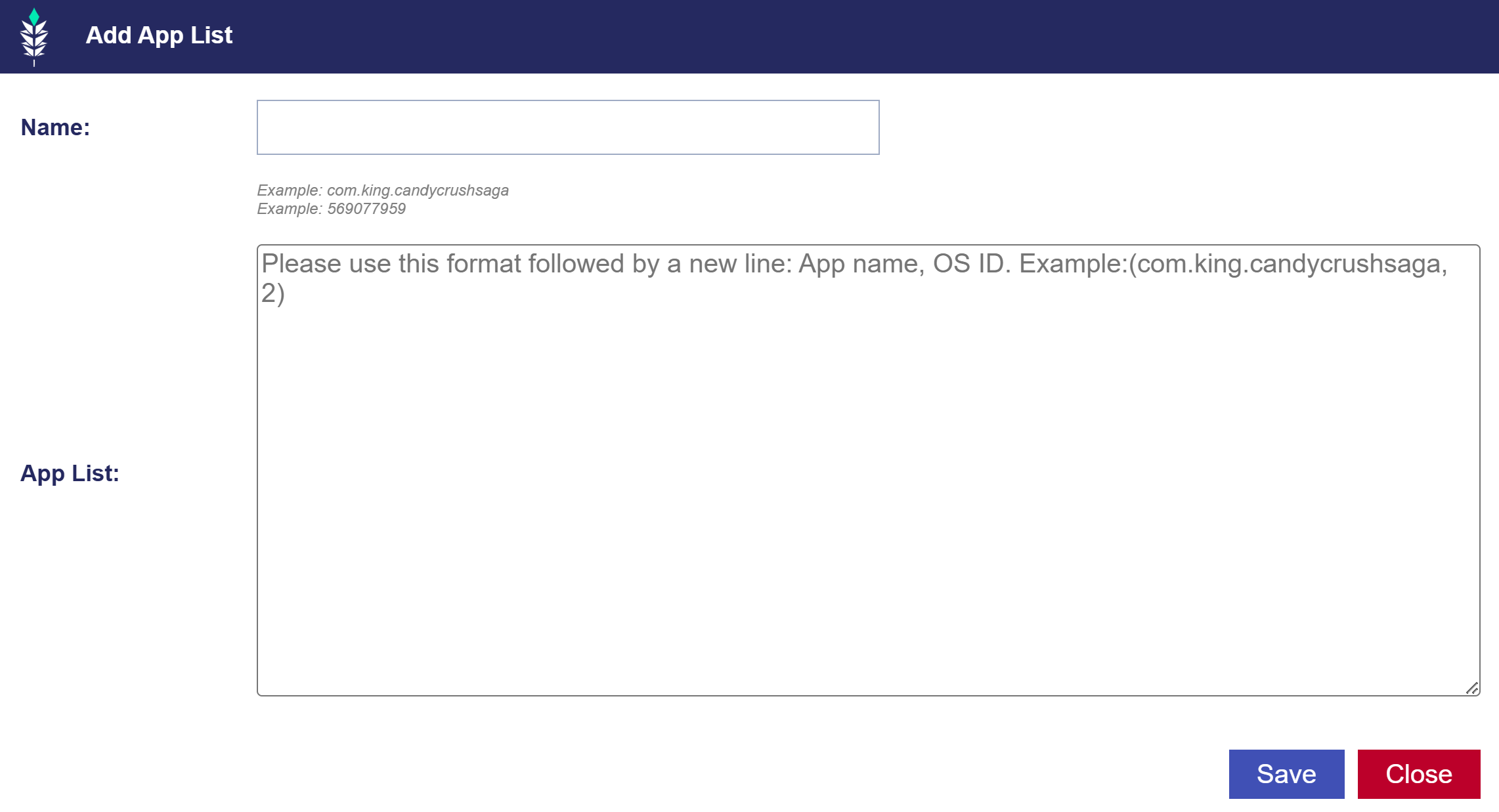
Create Custom App Lists
Navigate to the Inventory tab.
Select New App List.
Name the new App List.
Enter each App Bundle on a new line in the following format:
Line Format: App Bundle
Line Example: com.king.candycrushsaga
Save the App List.
Once saved, the App List becomes available for use in Campaign and Line Targeting.
Use an App List in Campaign or Line Targeting
App Lists can be applied at the Campaign and/or Line level.
Open the applicable Campaign or Line in Edit Mode.
Navigate to Targeting.
Select Edit Targeting.
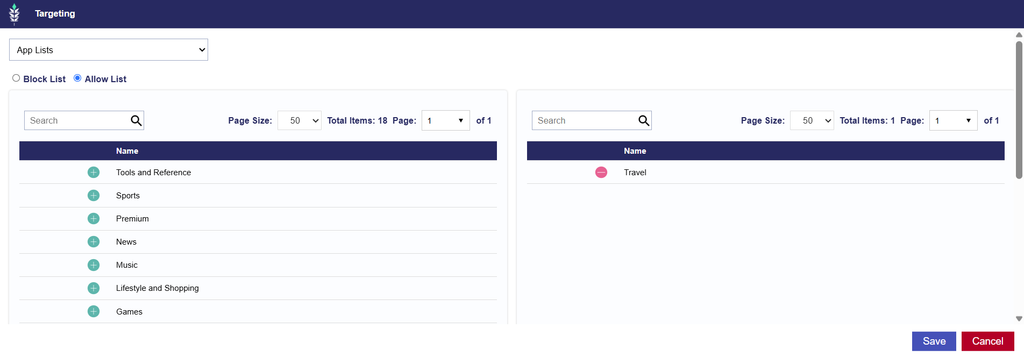
Open Inventory > App Lists.
Search for the App List by Name.
Select the green plus sign (+) to add the App List.
Select how the list should be applied:
Allow List: Limits eligible App inventory to App Bundles included in the App List.
Block List: Prevents the Campaign or Line from serving on App Bundles included in the App List.
Save the Targeting changes and submit the Campaign or Line update.
If App List Targeting is applied at both the Campaign and Line levels, the settings are evaluated together. The resulting inventory must satisfy the applicable Targeting requirements at both levels.
Example: If a Campaign Allow List includes com.publisher.app1 and com.publisher.app2, but the Line Allow List includes only com.publisher.app1, the Line is effectively limited to com.publisher.app1.
App Name Targeting
In addition to targeting by App Bundle ID through App Lists, users can target inventory directly by App Name at the Campaign or Line level.
App Name Targeting uses the app name passed in the bid request and can be configured as an Allow List or Block List.
This can be useful when targeting specific apps by their recognizable name rather than by App Bundle ID.
For more information on configuring App Name Targeting, see the applicable InventoryTargeting Methods documentation.
Deal Lists
Deal Lists allow users to group multiple Deals into a reusable list that can be applied across Campaigns and Lines. They are useful when the same group of Deals will be targeted across multiple strategies.
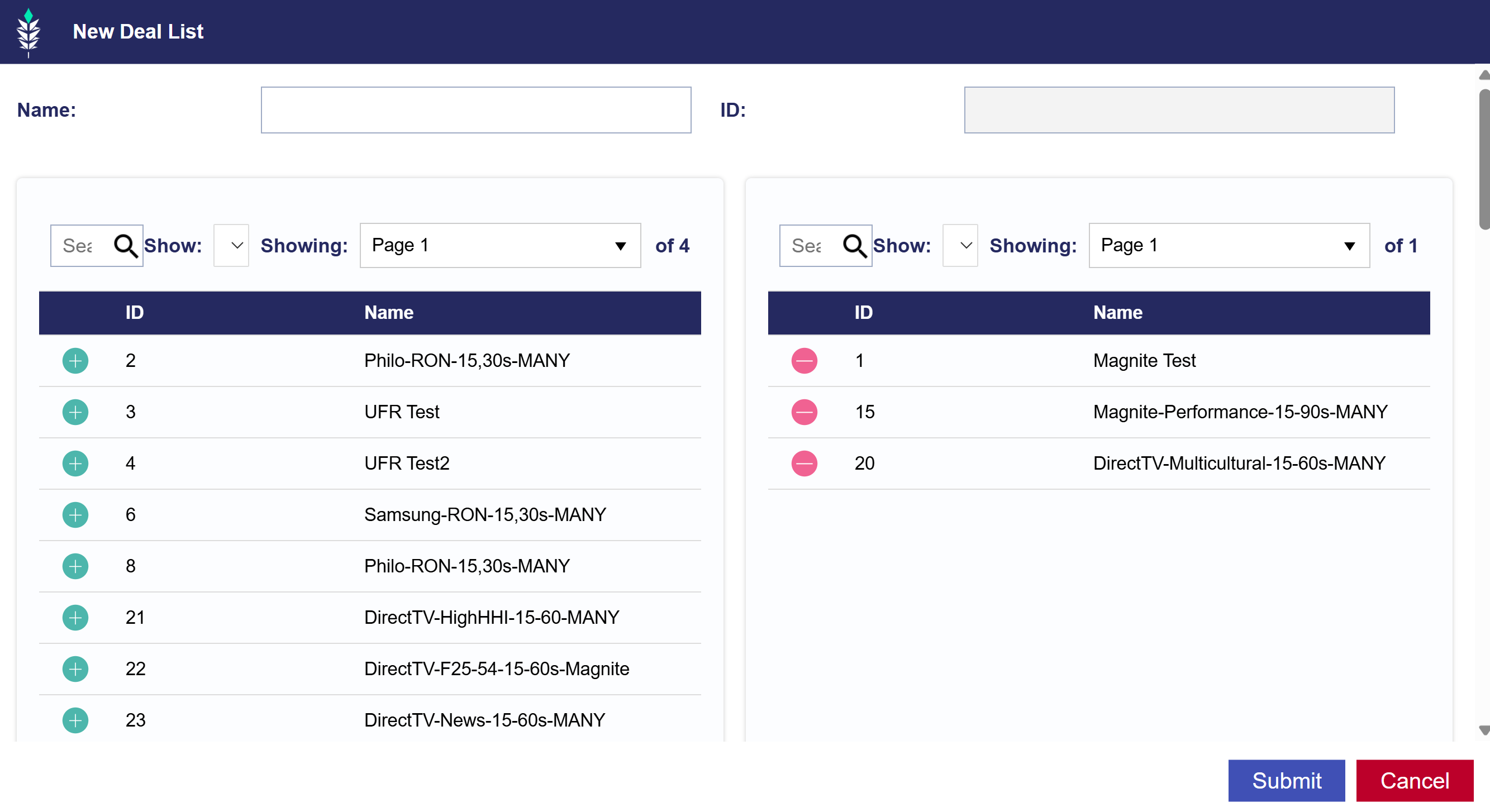
Create Custom Deal Lists
Navigate to the Inventory tab.
Select New Deal List.
Name the Deal List.
Add Deals from the available Deals table using the green plus sign (+).
To remove a Deal, use the red minus sign (−).
Save the Deal List.
Once saved, the Deal List becomes available for use in Campaign and Line Targeting.
Use a Deal List in Campaign or Line Targeting
Deal Lists can be applied at the Campaign and/or Line level.
Open the applicable Campaign or Line in Edit Mode.
Navigate to Targeting.
Select Edit Targeting.
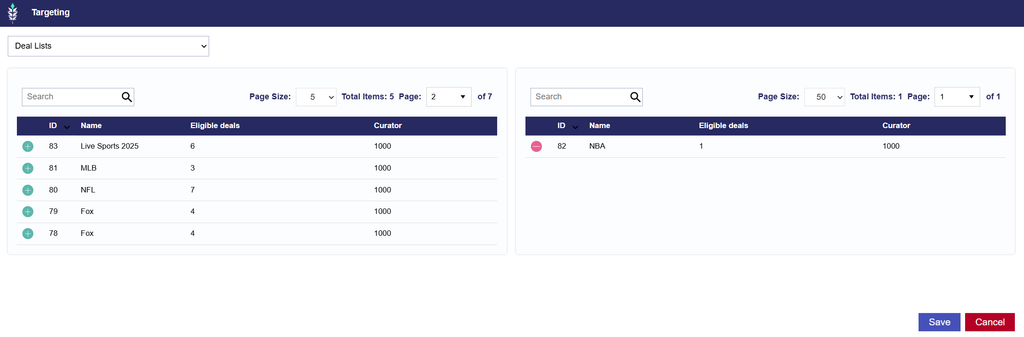
Open Inventory > Deal Lists.
Search for the Deal List by Name.
Select the green plus sign (+) to add the Deal List.
Save the Targeting changes and submit the Campaign or Line update.
If Deal List Targeting is applied at both the Campaign and Line levels, the settings are evaluated together. The resulting inventory must satisfy the applicable Deal Targeting requirements at both levels.
Example: If a Campaign targets a Deal List containing Deals A, B, and C, but the Line targets a Deal List containing only Deals B and C, the Line is effectively limited to Deals B and C.
Deals
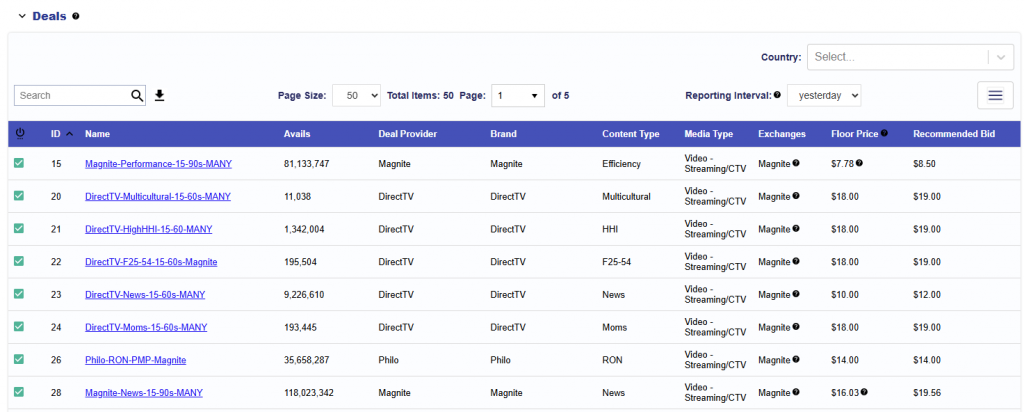
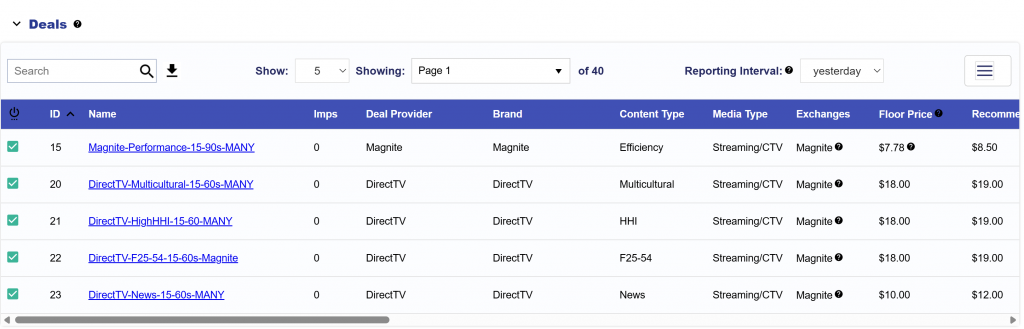
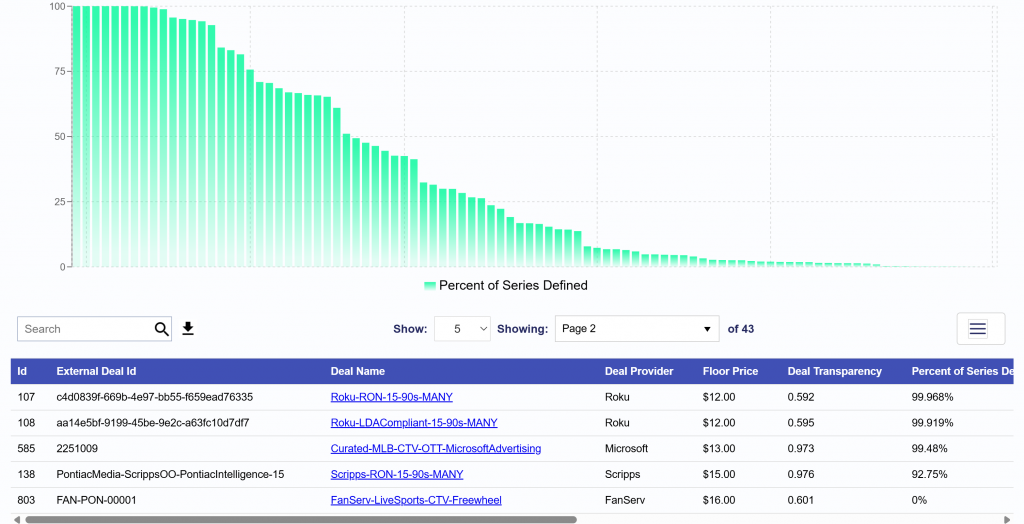
The Deals section displays the Deals available through Pontiac. Use the table to evaluate inventory availability and determine whether a Deal aligns with the Campaign or Line’s media, inventory, device, Creative, geographic, and bidding requirements.
Users can download the table as a CSV for additional review.
Deal Table Fields
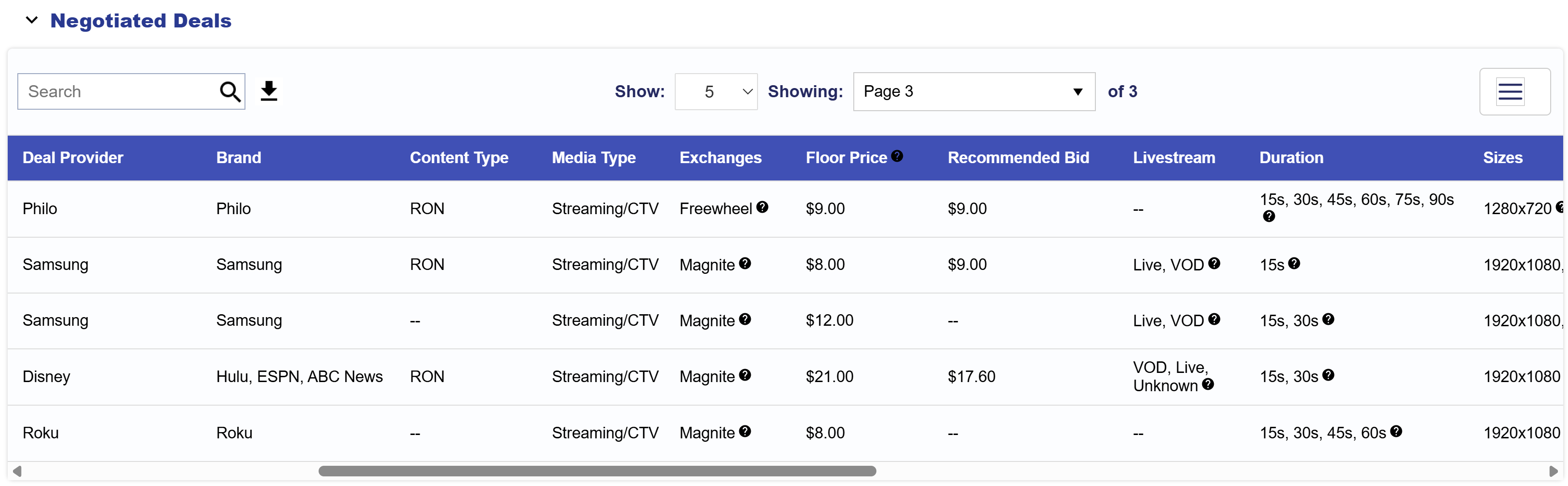
The Deals table includes the following columns:
Deal ID: Pontiac Deal ID.
Name: The deal name. This field is editable.
Avails: The estimated number of bid requests observed for the Deal during the selected Reporting Interval. Avails indicates available request volume and should not be interpreted as expected impressions or guaranteed delivery.
Deal Provider: The provider associated with the deal.
Brand: The brand associated with the deal.
Content Type: The content type associated with the deal.
Media Type: The media type that the deal is set up to serve.
Video – Streaming/CTV
Video – Online (OLV)
Video – Combined
Audio – Combined
Audio – Podcast
Audio – Streaming
Display
Native
Unspecified
Exchanges: The exchange the deal is served through.
Magnite (DV+)
Freewheel
Index
Magnite
Microsoft
Triton
Adswizz
Floor Price: The minimum CPM required to bid on the Deal.
Use the Floor Price as a starting point for bid guidance. For the Max Bid, it is generally recommended to begin approximately $2-5 above the Floor Price to remain competitive in the RTB auction. Once the Line is achieving the desired scale, gradually test lower bids to identify the most efficient bid level while maintaining delivery.
Recommended Bid: The recommended bid price for the deal.
Livestream: Indicates whether live content is coming through the deal. Hover over this field to see the percentage breakdown by type.
Livestream
VOD
Unknown
Duration: The creative duration intervals coming through the deal. Hover over this field to see the percentage breakdown by duration.
15s
30s
45s
60s
90s
Sizes: The creative sizes coming through the deal. Hover over this field to see the percentage breakdown by size.
Auction Type: The auction types coming through the deal. Hover over this field to see the percentage breakdown by auction type.
First Price
Second Price Plus
Device Types: The device types coming through the deal. Hover over this field to see the percentage breakdown by device type.
Mobile/Tablet
Personal Computer
Connected TV
Phone
Tablet
Connected Device
Set Top Box
Unknown
Countries: Shows the countries associated with the Deal. This field is populated based on observed Deal traffic. Hover over the field to view the percentage breakdown by country.
Permitted Sensitive Categories: The sensitive categories that are allowed to serve on the deal. Possible values include:
Beer & Wine
CBD
Cannabis
Firearms & Weapons
Gambling
Lawyer
Liquor
Pharma
Political
Religion
Tobacco
Publisher Approval Required: Indicates whether additional publisher approval is required for the Deal. If required, the applicable approval group may include:
ABC News
Approved by Freewheel
Disney XP
Disney+
ESPN
Hulu
Samsung Political
Notes: Additional notes associated with the Deal.
Start Date: The deal start date, if applicable.
End Date: The deal end date, if applicable.
Last Served Date: The most recent date the Deal served.
Action: Indicates whether the Deal is already available or whether access can be requested.
All deals will be approved within 24 hours after being requested.
Once approved, these can be targeted by individually targeting them or by creating a Deal List and adding them to the Campaign targeting section.
Creative Types: Shows the creative types the deal serves to and the percentage breakdown for each creative type. Possible values include:
Video
Audio
Banner
HTML5
Native
Inventory Types: Shows the inventory type of the deal. Hover over this field to see the percentage breakdown by inventory type. Possible values include:
Web
In App
Combined
Checking Deal Compatibility
When selecting a Deal, compare the Campaign or Line configuration against the corresponding fields in the Deals table to confirm that the inventory supports the intended strategy. Targeting a Deal does not override other Campaign or Line targeting requirements. Requests from the Deal must still satisfy all applicable Inventory Type, Device, Geography, Audience, Creative, and other targeting settings.
Campaign / Line Setting
Deals Table Field
Inventory Type
Inventory Types
Media strategy
Media Type
Creative format
Creative Types
Device targeting
Device Types
Exchange targeting
Exchanges
Country targeting
Countries
Video/Audio duration
Duration
Creative size
Sizes
Livestream targeting
Livestream
Sensitive Creative
Permitted Sensitive Categories
Creative approval
Publisher Approval Required
Bid configuration
Floor Price / Recommended Bid
Available scale
Avails
A Deal may align with one setting but still be ineligible because of another. Review the applicable fields together when configuring or troubleshooting Campaign delivery.
Sample Bid Requests
Select a hyperlinked Deal Name in the Inventory > Deals or Inventory > Negotiated Deals table to review sample bid requests received for that Deal. Sample requests provide a closer look at the inventory attributes being passed to Pontiac by the publisher or SSP.
Users can review or download these logs when validating Deal setup, confirming available inventory, or troubleshooting why a Deal may not align with Campaign or Line targeting.
The fields available in a sample request may vary depending on the Exchange, publisher, Media Type, and Inventory Type.
When troubleshooting delivery, compare the values observed in the sample bid requests with the applicable Campaign and Line targeting settings. A Deal may be receiving bid requests but still be ineligible to serve if the incoming requests do not satisfy all configured targeting requirements.
The deal_id value in the sample logs corresponds to the RTB Deal ID / External Deal ID rather than the Pontiac internal Deal ID.
Sample Download: For reference, download sample bid requests for Spectrum-LiveSports-CTV-OTT-Freewheel (Pontiac Deal ID: 556) to see an example of the inventory information available in these logs.
The Line’s selected Inventory Type must be compatible with the inventory available through the targeted Deal:
Web Line: Compatible with Deals showing Web or Combined under Inventory Types.
In App Line: Compatible with Deals showing In App or Combined under Inventory Types.
Combined Line: Compatible with Deals showing Web, In App, or Combined inventory.
For example, an In App Line targeting a Deal that only shows Web inventory would not be eligible to serve through that Deal.
For example, an In App Line targeting a Deal that only shows Web inventory would not be eligible to serve through that Deal.
A compatible Inventory Type does not guarantee that the Deal is fully aligned with the Line. Review other applicable fields, including Media Type, Creative Types, Device Types, Exchanges, Countries, Duration, Sizes, and any publisher or Creative requirements.
Requesting and Targeting Deals
Deal access requests are generally approved within 24 hours. Once a Deal is available to the Seat, it can be targeted individually or through a Deal List.
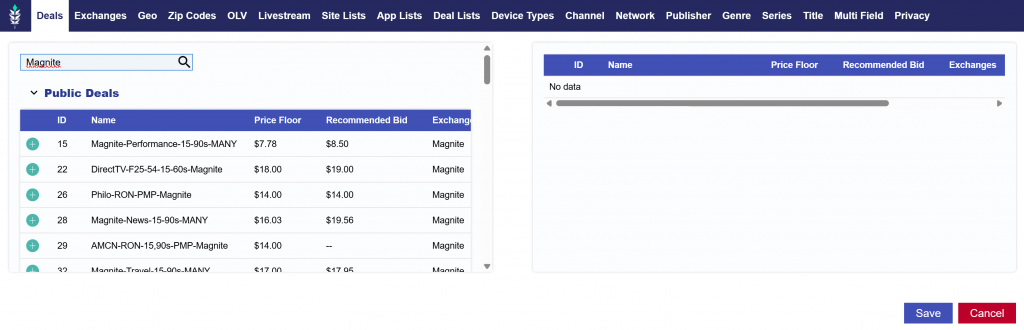
To target an individual Deal:
Navigate to the applicable Campaign or Line.
Open Targeting > Deals.
Search for the Deal by Pontiac Deal ID or Name.
Select the green + button to associate the Deal.
Save the Targeting window and the Campaign or Line.
The Floor Price provides guidance for the minimum bid required to participate in the auction. Because Deals still operate in an RTB environment, competitive bids may be required to achieve the desired scale. Use the Recommended Bid field, when available, as additional guidance.
Deal Identifiers Explained
ID, Name, and RTB Deal ID
Each Deal and Negotiated Deal in the platform is associated with three key identifiers:
ID: A unique internal numeric identifier used by the system.
Name: The human-readable name of the Deal, often used for reporting and navigation.
RTB Deal ID / External Deal ID: The identifier used in RTB auctions to reference the Deal externally.
Understanding the differences between these identifiers is important for importing Deals, setting targeting, and troubleshooting campaign issues.
Deals Example
In the Bidder> Inventory > Deals section, consider the following Deal:
ID: 15
Name: Magnite-Performance-15-90s-MANY
If you click the hyperlinked Deal Name in the interface, you can view sample logs. Scroll to the right to locate the column deal_id to locate the Rtb Deal ID: IOA-PI-RON-CTV-Performance-175622-ED
To target this Deal at the Campaign or Line level:
Navigate to Targeting > Edit Targeting > Deals.
Search by either ID or Name.
Press the green plus button to the left of the deal ID.
Click the Save button on the lower right of the window.
Save the entire Campaign or Line.
Note: You cannot search by Rtb Deal ID in the targeting interface.
Negotiated Deals Example
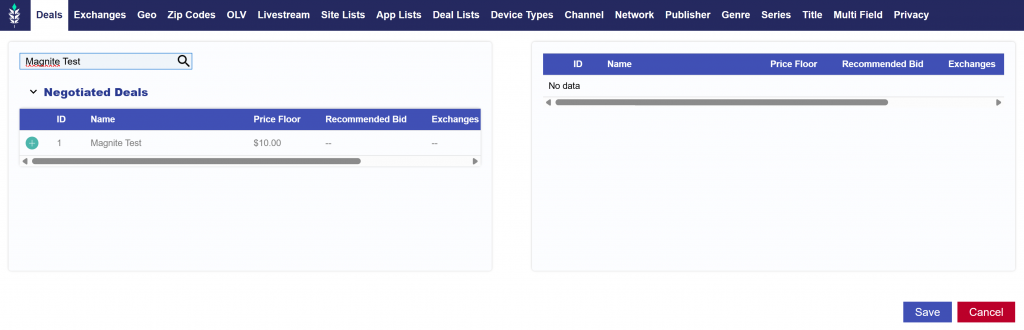
In the Bidder> Inventory > Negotiated Deals section, consider the following Deal:
ID: 1
Name: Magnite Test
Rtb Deal ID: ioa-pi-tamtest-08302022-000000
Clicking the Deal Name allows you to view sample logs. The column deal_id in the logs corresponds to the Rtb Deal ID.
To target this Deal at the Campaign or Line level:
Navigate to Targeting > Edit Targeting > Deals.
Search using either the ID or Name.
Press the green plus button to the left of the deal ID.
Click the Save button on the lower right of the window.
Save the entire Campaign or Line.
Note: You cannot search by Rtb Deal ID in the targeting interface.
Deal Landscape Example
In the ART Platform > Deal Landscape > Deals table, consider the following Deal:
Clicking the Deal Name allows you to view sample logs. The column deal_id in the logs corresponds to the Rtb Deal ID.
Negotiated Deals
Negotiated Deals are Deals created directly between the advertiser and a publisher or SSP and made available to the applicable Pontiac Seat.
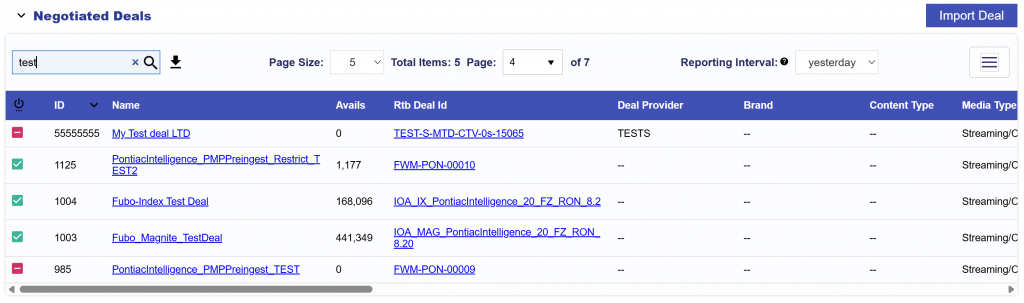
The Negotiated Deals section under the Inventory tab displays the Negotiated Deals available to the Seat. These Deals use the same core table fields described in the Deals section above, including Avails, Media Type, Inventory Types, Device Types, Floor Price, Creative Types, and publisher requirements.
Users can download the table as a CSV for additional review.
Importing Negotiated Deals
Users with access can import their own Negotiated Deals directly through the platform. Reach out to your Account Manager or through the Help Center if this feature is not enabled for your Seat.
When the SSP or publisher sends the Deal to Pontiac, use:
Once available, Negotiated Deals can be targeted individually or added to a Deal List for reuse across Campaigns and Lines.
To target an individual Deal, navigate to the applicable Campaign or Line Targeting > Deals section and select the green + button next to the Deal.
Use the Floor Price as a starting point for bid guidance. For the Max Bid, it is generally recommended to begin approximately $2–$5 above the Floor Price to remain competitive in the RTB auction. Once the Line is achieving the desired scale, gradually test lower bids to identify the most efficient bid level while maintaining delivery.
Import Deal
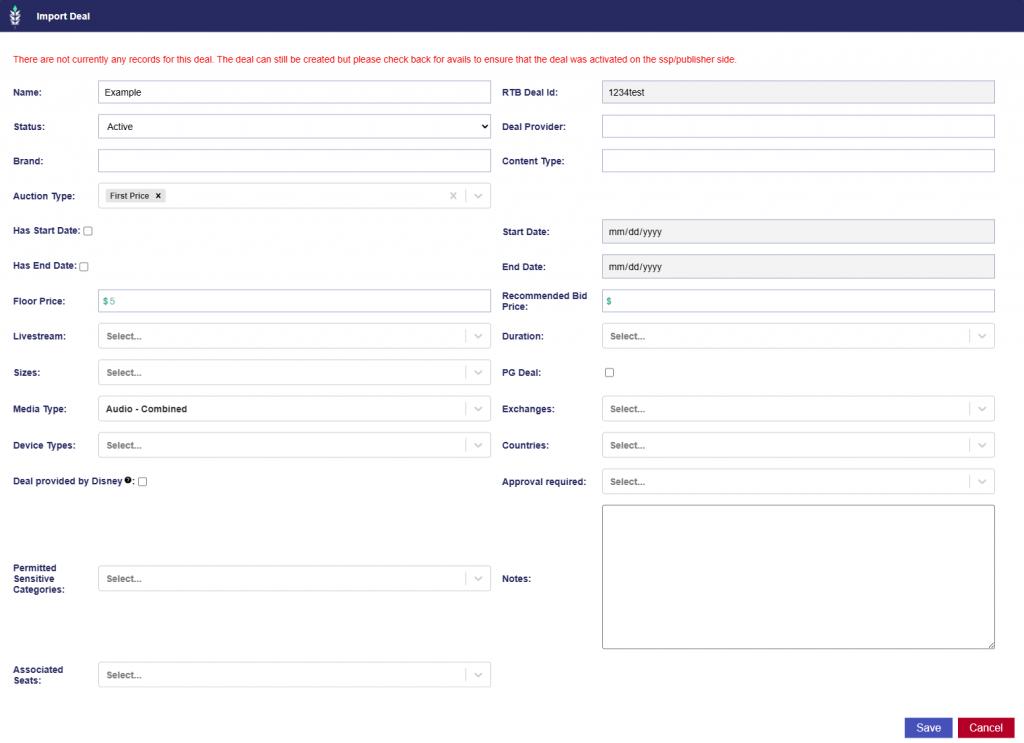
Users can import their own Negotiated Deals directly through the platform by navigating to Bidder > Inventory > Negotiated Deals > Import Deal. Reach out to your Account Manager or through the Help Center if this feature is not enabled for your Seat.
When the SSP or publisher sends the Deal to Pontiac, use:
Pontiac Intelligence: CTV, Video, or Audio
Pontiac – Web: Display
Steps to Import a Deal
Navigate to the Inventory tab.
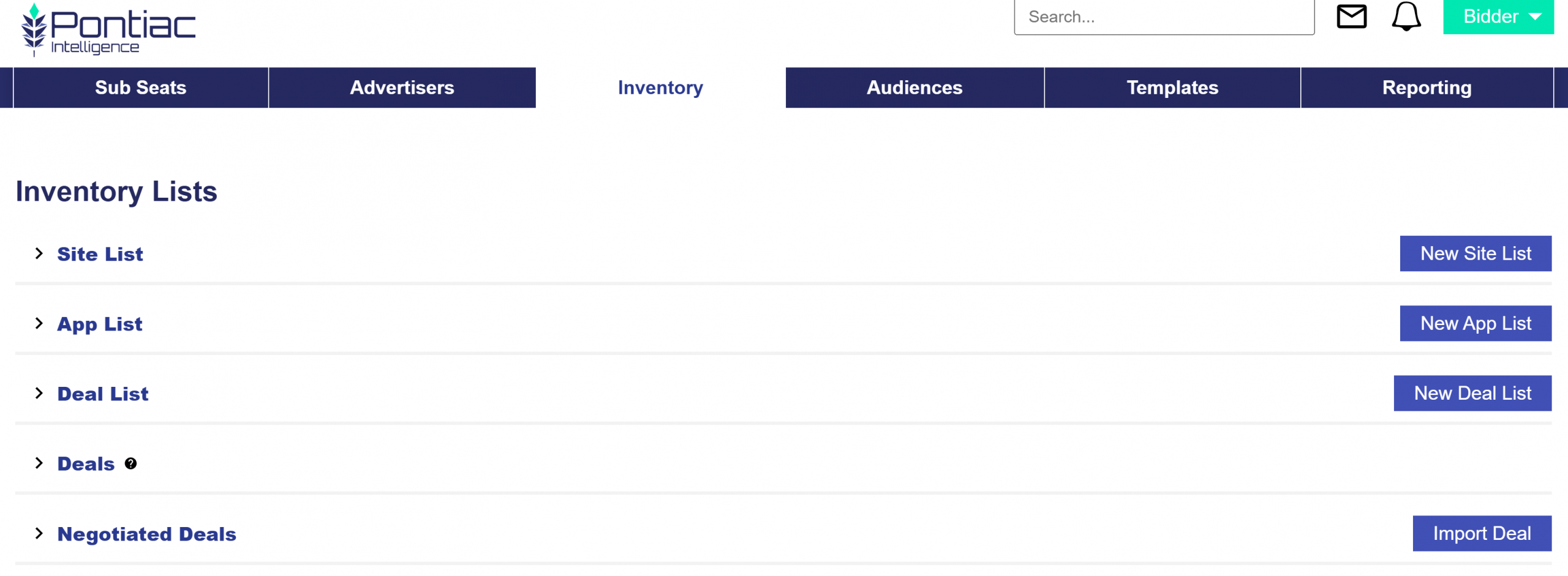
On the right-hand side of the Negotiated Deals section, click Import Deal.
If the button is not available, reach out to your Account Manager or through the Help Center to request access.
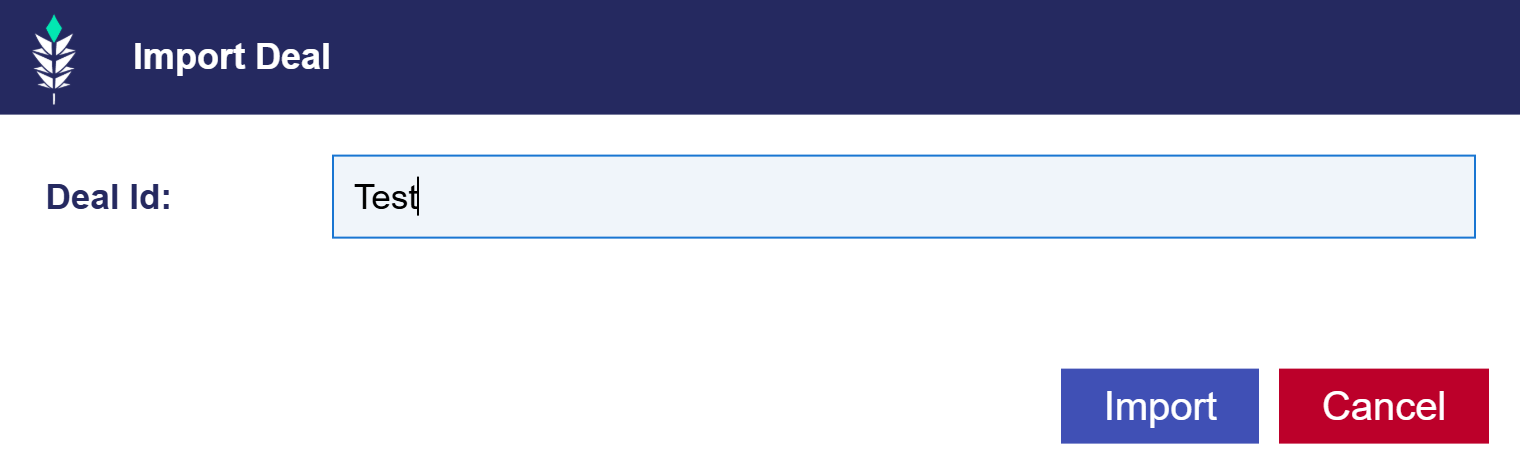
Enter the exact Deal ID supplied by the SSP or publisher.
Deal ID formats vary by provider. Common examples include:
Triton: 5-character short alphanumeric (e.g., M3mmD)
Select Import.
After importing the Deal, one of two scenarios will occur:
Deal Already Exists
If Pontiac is already receiving the Deal and it exists in the database, the Deal details will populate in the dialog box.
Complete any remaining fields and select Save. Once saved, the Deal is available for targeting.
Deal Has Not Yet Been Ingested
If Pontiac has not received bid requests for the Deal, a warning will appear indicating that no records are currently available.
The Deal can still be created and associated with the Seat in advance.
Review Avails once the publisher begins sending traffic to verify that Pontiac is receiving bid requests.
For Programmatic Guaranteed (PG) Deals, importing and configuring the Deal in advance is recommended.
Complete the required fields:
Name
Auction Type
Floor Price
Media Type
PG Deal checkbox, if applicable
Sensitive Supply
The Sensitive Supply checkbox supports privacy requirements for certain exchanges and inventory sources by hiding IP data associated with the imported Negotiated Deal.
Sensitive Supply: When enabled, IP data is hidden for the associated Deal.
Disney Deals: Enable Sensitive Supply for Deals provided by Disney properties, including Hulu, Disney+, ESPN, and ABC. If not selected during import, qualifying Disney inventory is automatically identified through sample bid requests and Sensitive Supply is enabled.
AdsWizz and Triton Deals: Sensitive Supply is automatically enabled and cannot be modified for Deals from these exchanges.
Select Save to complete the import.
Troubleshooting Imported Deals
Check Avails: After importing a Deal, review the Avails column in Inventory > Negotiated Deals.
Avails represents the approximate number of available bid requests received for the Deal during the selected Reporting Interval. Use this field to confirm that Pontiac has started receiving traffic for the imported Deal.
If the Deal does not appear or no requests are being received, common causes include:
Incorrect Platform Endpoint: Confirm that the publisher or SSP sent the Deal to the correct Pontiac endpoint:
Pontiac Intelligence: CTV, Video, or Audio
Pontiac – Web: Display
Deal Date Issue: Confirm the Deal’s Start Date and End Date with the publisher and/or SSP.
If the Start Date is in the future, the Deal may not yet be visible or sending bid requests.
If the End Date has passed or was not extended for the current Campaign flight, the Deal may no longer be sending bid requests.
Best Practices
Ask publishers to set the Deal Start Date as immediate rather than matching the Campaign Start Date. This allows the Deal to be configured in advance.
If a Deal does not appear, first confirm the platform endpoint and Start Date with the publisher or SSP.
If both the Seat and Start Date are correct but the Deal is still unavailable, a synchronization issue may be involved. Requesting a replacement Deal from the publisher may be the fastest resolution.
If the replacement Deal still cannot be found, contact your Account Manager or submit a ticket through the Help Center.
For PG Deals, import and configure the Deal in advance whenever possible to help ensure the Campaign is ready when publisher-side delivery begins.