Navigating the Pontiac Platform
The Pontiac Intelligence Platform provides tools for managing Advertisers, Campaigns, Lines, Inventory, Audiences, and Reporting. This guide covers how to navigate the platform and use common interface features, including searching, filtering, customizing table views, and reviewing performance data.
Switching Between Platform Sections
The dropdown in the upper-right corner allows users to switch between the available Pontiac platform sections.
Available options include:
- Bidder: Manage programmatic advertising Sub Seats (if enabled), Advertisers, Campaigns, Lines, Inventory, Audiences, Templates, and Reporting.
- ART: Access audience research and inventory availability tools.
- DOOH: Access digital out-of-home advertising tools.
- Analytics: Access Pontiac’s Analytics Suite for campaign planning, audience analysis, targeting optimization, and incrementality measurement.
- Admin: Access account administration, Billing, Seat Settings, Help Center, Notifications, and Wiki.
- Logout: Sign out of the platform.
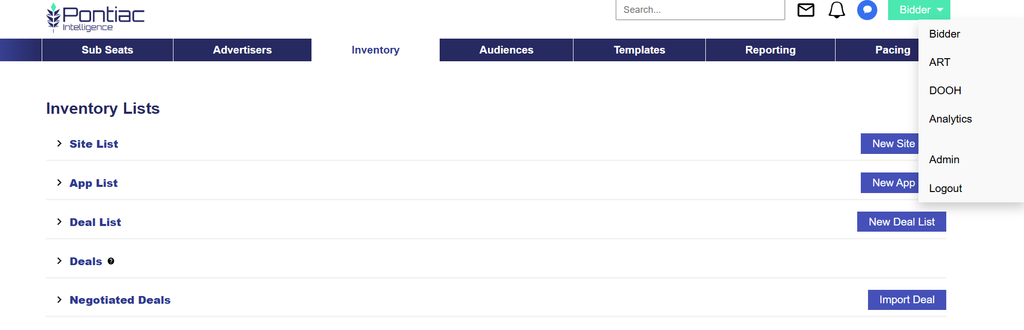
Select the desired section from the dropdown to switch between platform tools. Available options may vary based on account access and permissions.
Bidder Navigation Tabs
Within the Bidder section, the top navigation menu provides access to the following:
- Sub Seats: Access and manage Sub Seats, when enabled.
- Advertisers: Create and manage Advertisers, Campaigns, Lines, Creatives, and Pixels.
- Inventory: Manage Site, App, and Deal Lists, and access available and negotiated Deals.
- Audiences: Create and manage Audiences used for targeting.
- Templates: Manage reusable Campaign and Line templates.
- Reporting: Create and manage performance reports.
- Pacing: Monitor Campaign and Line budgets, pacing, and delivery.
Select a tab to access the corresponding features and tools.
Global Search
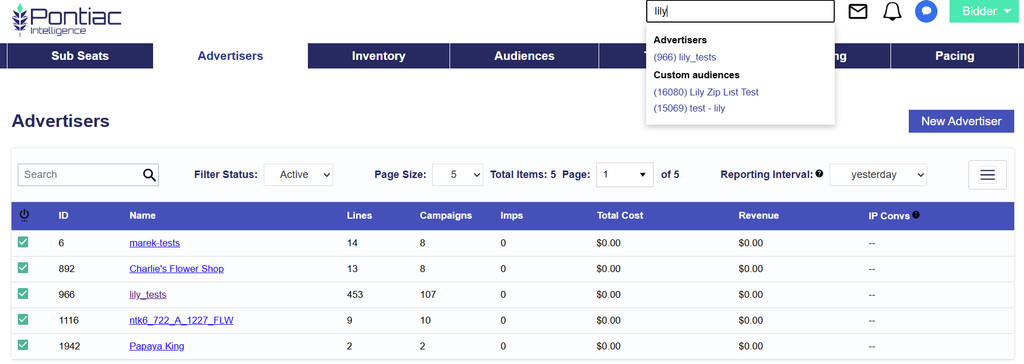
The Search field in the upper-right corner of the platform allows users to search for Pontiac objects across the current Seat, including Advertisers, Campaigns, Lines, Creatives, and Audiences.
Enter a name or ID to locate an object and select a result to navigate directly to it.
Unlike the Search fields within individual tables, Global Search allows users to find objects without first navigating to their corresponding section.
Notifications and Help
Icons in the upper-right corner provide access to additional platform resources, including:
- Envelope Icon = Help Center: View and manage support requests and communications with the Pontiac Support team.
- Bell Icon = Notifications: View platform updates, new feature announcements, and other notifications.
- Chat Icon = Pontiac Assistant: Access Pontiac’s AI-powered assistant for help navigating the platform, understanding features, and managing Campaigns.

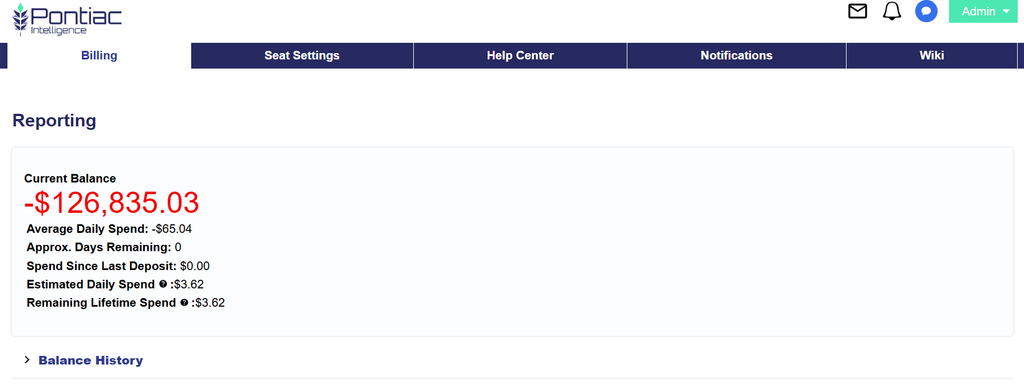
The Admin section also provides access to the Help Center, Notifications, and Wiki.
Pontiac Assistant
The Pontiac Assistant is an AI-powered tool designed to help users navigate the platform, understand available features, and streamline Campaign management.
Users can ask questions in natural language to get assistance with platform functionality, Campaign setup, troubleshooting, reporting, and other common workflows.
To access the Assistant, click the chat icon in the upper-right corner of the platform.
For more information on available capabilities, example prompts, and how to use the Assistant, see Pontiac Assistant.
Footer Navigation and Switching Seats
The footer provides quick access to additional navigation options, including:
- Contact Us: Access Pontiac contact and support resources.
- Switch Seat: Switch between Seats you have access to.
To switch Seats:
- Click Switch Seat in the footer.
- Enter the Seat ID or Seat Name you want to access.
- Select the desired Seat to switch to it.
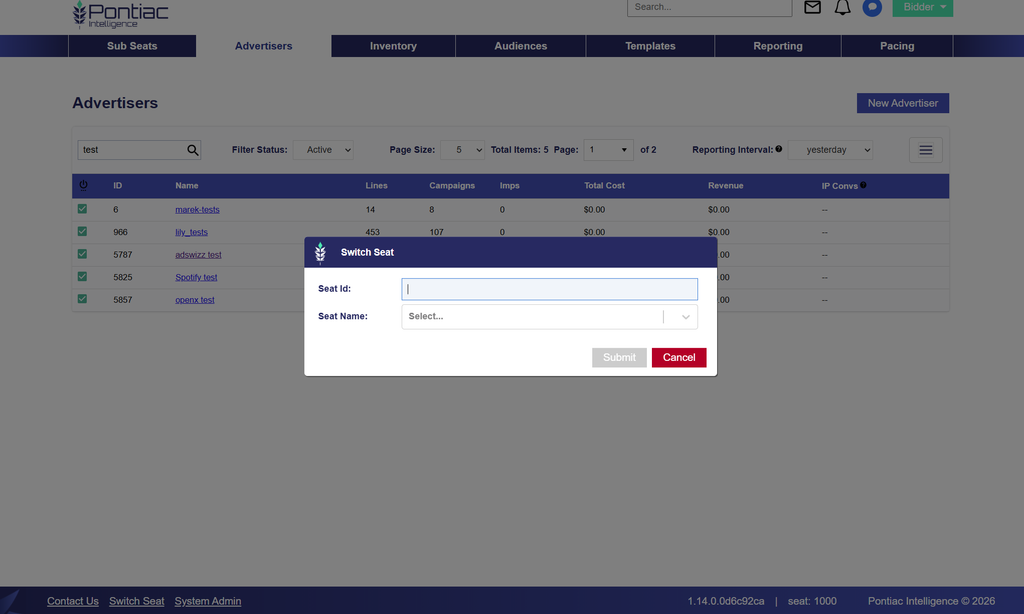
The footer also displays the current Seat ID and platform version.
Note: Always confirm the selected Seat before creating or modifying Campaigns, Inventory, or other settings.
Navigating Advertisers, Campaigns, and Lines
Pontiac organizes Campaign management into four primary levels:
Seat → Advertiser → Campaign → Line
- Seat: The account-level workspace for shared Inventory, Audiences, Templates, Reporting, and Seat Settings.
- Advertiser: Represents an individual brand, client, or product and contains its Campaigns, Creatives, and Pixels.
- Campaign: Organizes Lines under shared Campaign settings, such as budget, dates, Flights, pacing, and frequency caps.
- Line: Controls how media is purchased, including bidding, Inventory Type, targeting, and other delivery settings.
To navigate between levels:
- Select Advertisers from the Bidder navigation menu.
- Click the Advertiser Name to open the Advertiser.
- Select a Campaign from the Advertiser’s Campaigns table.
- Select a Line from the Campaign’s Lines table.
Each level provides access to settings, management tools, and performance information relevant to that object.
For a complete overview of the features available at each level, see Hierarchy.
Searching and Filtering Tables
Tables throughout Pontiac include controls for locating records, filtering results, adjusting page size, and customizing displayed information.
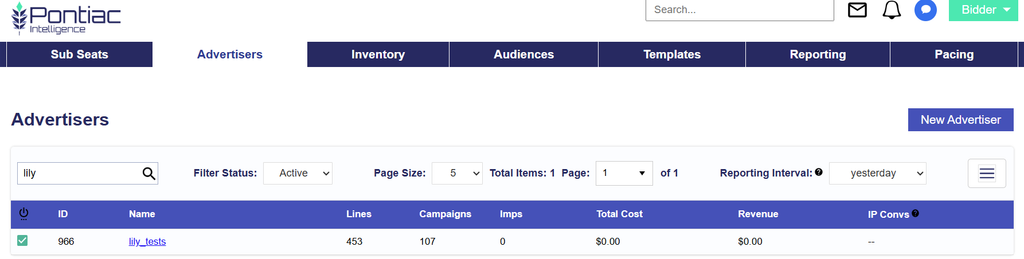
The Advertisers table below provides an example of these controls.
- Search bar
- Filter Status
- Page Size
- Total Items
- Page
- Reporting Interval
- Customizing Table Columns

Search
Use the Search field above a table to find specific records.
Enter a name or ID to narrow the results displayed in the table.
Search functionality may vary depending on the page.
Filter Status
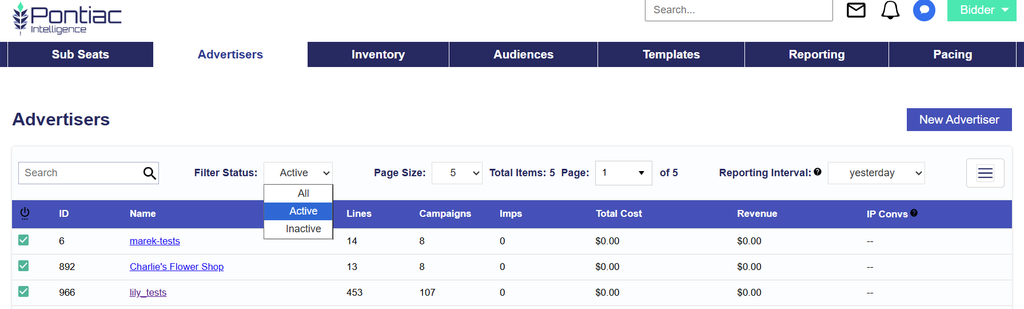
The Filter Status dropdown allows users to filter records by their current status.
- All: Displays both Active and Inactive records.
- Active: Displays only Active records.
- Inactive: Displays only Inactive records.
The default status filter may vary by page.
Changing this filter only affects which records are displayed in the table. It does not modify their actual status.
For example, if you cannot find an Advertiser, Campaign, or Line, check the Filter Status dropdown and select All to include Inactive records.
Understanding Status Indicators and Warnings
Pontiac uses status icons and color-coded indicators throughout the platform to help users identify whether objects are Active, Inactive, or require attention.
These indicators appear in areas such as Advertiser, Campaign, and Line tables, Troubleshoot Checks, Reports, and Creative Audits.
Active and Inactive Status
In Advertiser, Campaign, and Line tables, the Status column displays an object’s configured status.
- Green Check Mark (✓) – Active: The object is enabled.
- Red Minus (−) – Inactive: The object is disabled.
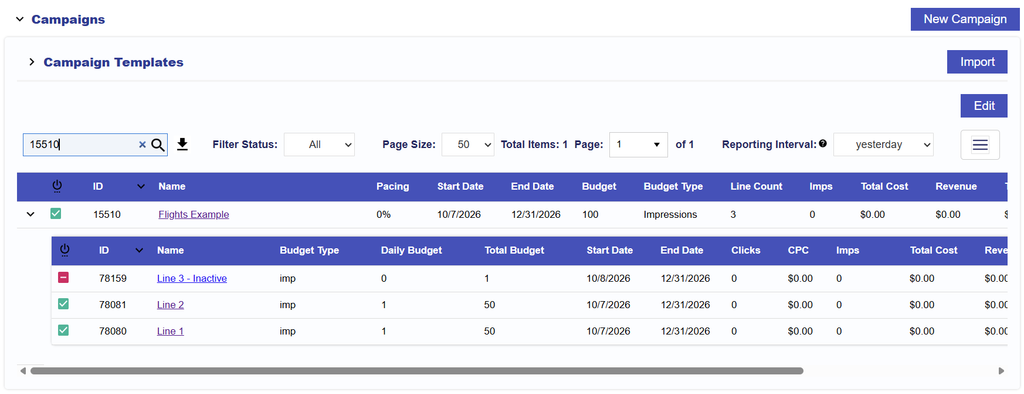
An Active status indicates that an object is enabled, but does not necessarily mean it is currently delivering impressions. Delivery also depends on Campaign and Line dates, budgets, targeting, Creative eligibility, and other settings.
An Inactive status indicates that the object is disabled and is not eligible to serve while inactive.
Note: The Status column displays an object’s configured status, while the Filter Status dropdown controls which objects are visible in the table. To see inactive objects, change the Filter Status to All or Inactive.
Validation Results: Pass, Fail, and Warning
Pontiac also displays validation results within tools such as Line-level Troubleshoot Checks and Creative Audits. These checks help identify potential configuration, eligibility, or delivery issues.
- Green Check Mark – Pass: The evaluated requirements were met.
- Red Indicator – Fail: One or more evaluated requirements were not met.
- Yellow Caution Icon – Warning: A potential issue was identified, or the available information is insufficient to verify the check.
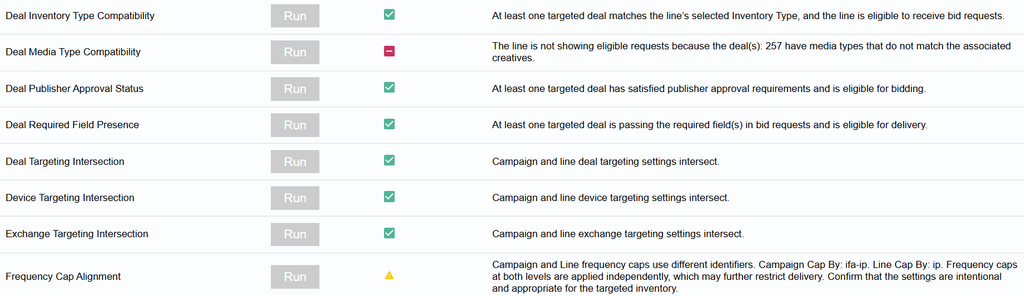
For example, within Line-level Troubleshoot Checks:
- Pass: The targeted Exchange is compatible with the targeted Deal.
- Fail: The targeted Exchange does not align with the Exchange associated with the targeted Deal.
- Warning: Insufficient sample request data is available to verify Deal Exchange compatibility.
Review the individual check results and accompanying messages to understand whether any changes or additional verification are needed.
Creative Audits and Publisher Eligibility
Creative Audit tools help users identify whether Creative assets meet technical requirements and publisher-specific specifications.
Depending on the Creative Type and applicable requirements, these checks may evaluate:
- Creative dimensions and aspect ratio
- Video duration
- Resolution and bitrate
- VAST version and compatibility
- Publisher-specific Creative requirements
A failed check indicates that the Creative does not meet an evaluated requirement and may need to be updated before serving on the applicable inventory.
A warning indicates that additional review or verification may be needed.
Review the individual Creative Audit results to identify which requirements passed, failed, or require attention.
Important: Active/Inactive and Pass/Fail/Warning represent different types of information.
- Active/Inactive indicates whether an Advertiser, Campaign, or Line is enabled.
- Pass/Fail/Warning indicates the outcome of a specific validation or eligibility check.
Although these indicators may use similar colors, they serve different purposes. An Active Campaign or Line may still fail a Troubleshoot Check, and a Creative may pass certain technical checks while failing others.
A green check mark does not guarantee that an object will deliver impressions. It only confirms that the specific status or check is satisfied.
Page Size and Pagination
The Page Size dropdown controls how many records appear on each page.
The Total Items field displays the number of records matching the current view, while the Page dropdown allows users to navigate between available pages.
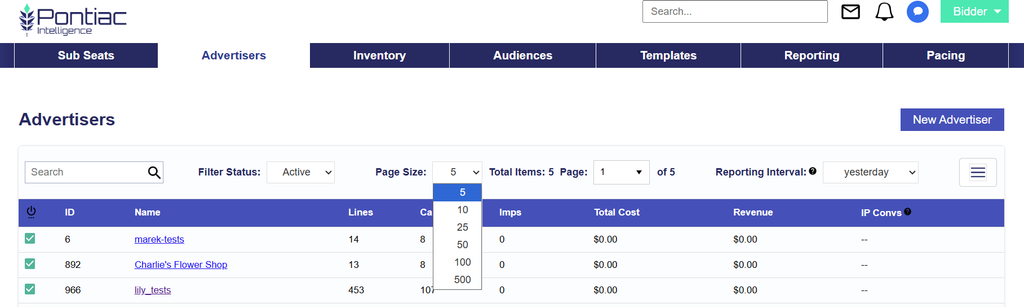
For example, if the table contains 200 records and the Page Size is set to 50, the results will be divided across four pages.
Increase Page Size to display more records at once, or use the Page dropdown to navigate between pages.
Reporting Interval
Many tables include a Reporting Interval dropdown that controls the period used to calculate and display performance metrics.
Depending on the table, available intervals may include Yesterday, Today, 7 Days, 30 Days, Month to Date, Last Month, and Lifetime.
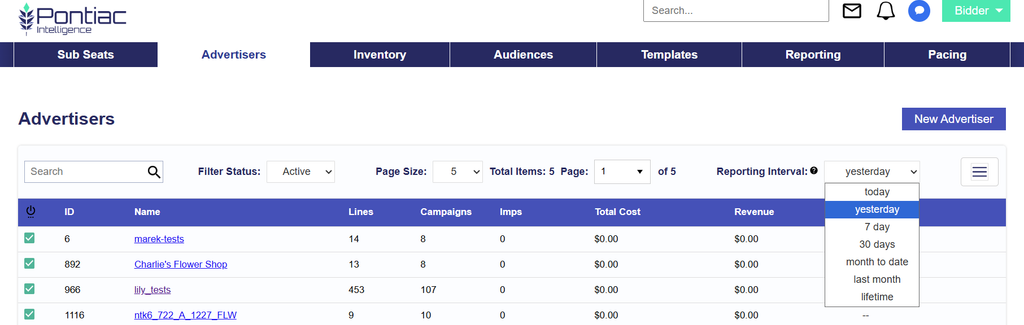
Selecting a different Reporting Interval updates the performance metrics displayed in the table, such as:
- Impressions
- Total Cost
- Revenue
- IP Conversions
- Other available performance metrics
For example, selecting Yesterday displays the previous day’s performance, while selecting 7 Days displays performance for the corresponding seven-day period.
Note: The Reporting Interval changes the reporting period for displayed metrics. It does not modify Campaign settings, budgets, or delivery.
Customizing Table Columns
Many tables allow users to customize which columns and metrics are displayed.
To customize a table:
- Click the column selection icon (three horizontal lines) in the upper-right corner of the table.
- A dropdown will display the available columns.
- Check a column to display it in the table.
- Uncheck a column to hide it from the table.
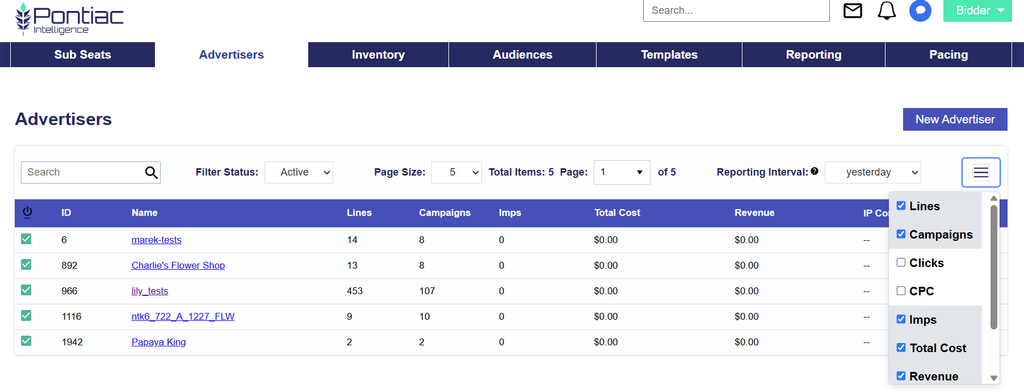
Changes to the selected columns update the information displayed in the table.
For example, users reviewing Advertiser performance may choose to display:
- Lines
- Campaigns
- Imps
- Total Cost
- Revenue
- IP Convs
- Clicks
- CPC
Available columns vary depending on the table and platform level.
Selecting Reporting Dimensions and Metrics
Within Pontiac’s Reporting tools, users can select the Dimensions and Metrics included in their reports.
- Dimensions determine how report data is grouped, such as by Advertiser, Campaign, Line, Creative, or Date.
- Metrics determine which performance values are displayed, such as Impressions, Total Cost, Revenue, or Conversions.
The selected Dimensions and Metrics determine both the columns included in the report and their order.
Important: The order in which Dimensions and Metrics are selected determines the order in which their corresponding columns appear in the report. To change the column order, adjust the selection order when configuring the report.
For additional information on generating reports and selecting available Dimensions and Metrics, see Reporting.
Related Documentation
- Hierarchy: Understand Pontiac’s Seat, Advertiser, Campaign, and Line structure.
- How to Launch Your First Campaign: Step-by-step instructions for creating and launching a Campaign.
- Reporting: Learn how to generate and customize performance reports.
- Pacing: Learn how to monitor Campaign and Line budgets and delivery.
How to Launch Your First Campaign
This guide walks through the full process of launching a campaign in Pontiac, from setting up your Advertiser and Creatives to creating, launching, monitoring, and optimizing your Campaign and Lines. Links to the full documentation for each step are included throughout the guide for additional setup details and instructions.
- Set Up Your Advertiser
- The Advertiser represents an individual brand, product, or client in Pontiac. It serves as the parent level for everything associated with that advertiser, including Campaigns, Lines, Creatives, Pixels, and Audiences.
- Upload Your Creative
- Upload the creative assets or third party tags that will be used in your campaign. Creatives are created and managed at the Advertiser level and can then be assigned at the Campaign and/or Line level.
- Create Your Campaign
- Create the Campaign that will house your Lines and define the overall Campaign settings, including dates, budget, Flights (if applicable) and other Campaign level controls.
- Use Campaign level targeting only for settings that should apply universally across all Lines.
- Use Line level targeting for strategy-specific targeting and optimization.
- Apply targeting at one level whenever possible, unless the intent is to intentionally narrow eligible inventory through intersection filtering.
- Create Your Line
- Lines control how your campaign buys media. This is where you will configure settings such as inventory, targeting, bid price, budget, dates, Creatives, and other strategy specific controls.
- Review Before Launching
- Review your Campaign and Line settings to confirm that budgets, dates, targeting, Creatives, and other required settings are configured correctly. Use the Line level Performance tab troubleshooting checks to identify any setup or delivery issues.
- From the Advertiser level, download the full campaign setup to review Campaign, Flight (if applicable), and Line configurations before launch.
- Confirm that your Creatives meet the specifications for the publishers you plan to target using Creatives > Publisher Spec Eligibility.
- Launch and Monitor
- Once your setup has been reviewed, activate your Campaign and Lines and begin monitoring delivery and performance. Use the Pacing tab, reporting tools, and Line level troubleshooting checks to monitor campaign activity and identify issues that may affect delivery.
- Optimize Performance
- Once your campaign has collected enough performance data, use the Pontiac Analytics suite to identify opportunities for optimization. Run Targeting, Audience, or Incrementality analyses to better understand performance across different variables and audiences. You can also create and upload a User Defined Model to apply your own scoring strategy to campaign optimization.
Terminology
As streaming services have become widely adopted and methods for consuming TV content have drastically changed, the terms OTT and CTV have become exceedingly popular in the advertising world. But with this growing popularity the terms have become ambiguous as players in the industry began to use them interchangeably and the lines between them became blurred. This guide is intended to provide clarity into the industry definitions, Pontiac terminology, and best practices for implementing both CTV and OTT campaigns through the Pontiac Platform.
CTV vs OTT vs Video
- OTT (Over-the-Top) is TV content delivered to a device via an internet connection. OTT is defined as a delivery method and content type (premium TV content delivered via internet) and can be streamed on any device type: smart TVs or mobile devices or desktops. OTT is considered premium digital video, and it is the highest-quality format available programmatically, with completion rates as high as 90%. For example, this could be a user watching Hulu on their phone, desktop, OR on their Smart TV.
- CTV (Connected TV) is a sub-set of OTT Video, where the OTT content is delivered specifically on TELEVISIONS connected to the internet. CTV is defined by the device type and includes – Device types: smart TVs, gaming consoles, and set-top boxes. An example of this would be a user watching Hulu on their TV.
- Video is the creative type for all OTT and CTV. All OTT and CTV campaigns are Video, but not all Video is OTT or CTV. Online Video (OLV) can also run across other websites and apps within content that is not considered OTT and on devices that are not considered CTV. For example, a video ad in the Candy Crush app on a mobile device.
Despite the technical definitions above, it is commonly understood in the industry that CTV refers to any OTT across TVs, and ‘OTT’ is typically used to refer to other ‘non-CTV’ OTT content. For this reason and for the purposes of the Pontiac Platform, ‘CTV’ refers to OTT content that runs across connected television devices – Smart TVs, Game Consoles, and Set Top Boxes. The ‘Inventory Type’ ‘OTT’ will refer to all other OTT content that is not CTV, that being content streamed on other devices – Mobile Phones, Tablets, Desktops and Laptops.
Please see the following page for more information on CTV, OTT, and OLV best practices for setups: Setup Guides
Strategy Guide
Overview
The Pontiac Intelligence DSP offers a wide variety of granular targeting tools that enable Advertisers to better reach their target Audience and subsequently maximize their ad spend. Given how different types of inventories, data, and media interact, there are some complexities as to how targeting parameters and features can be combined and layered on a Campaign and/or Line Item (Inventory, Geo, Audience Targeting). The following Strategies Guide provides insight into creating intelligent and functional targeting on your Line Items according to your media type and KPIs.
Core Framework
| Layer | Options |
|---|---|
| Inventory | Web · In-App · Combined |
| Media Type | Audio · Display · Online Video · Combined Video · Streaming / CTV |
| Device Type | Personal Computer · Phone · Tablet · Connected TV · Connected Device · Set Top Box |
| Creative Type | Video (Ad Server Video Tag, First Party Video), Audio (Ad Server Audio Tag, First Party Audio), Banner (Ad Server Banner Tag, First Party Banner, HTML5), and Native |
Strategies by Media Type
| KPIs & Attribution | Audio | Display | OLV | OTT/CTV |
| CTR | X | X | X | |
| CPC | X | X | X | |
| Viewability | X | X | ||
| Post-Click Conversions | X | X | ||
| Post-View Conversions | X | X | ||
| CPA | X | X | ||
| IP Conversions | X | X | X | X |
| Foot Traffic Conversions | X | X | X | X |
| Video Completion Rate | X | X | ||
| Listen Through Rate | X |
| Device Targeting | Audio | Display | OLV | OTT/CTV |
| Person Computer | X | X | X | X |
| Mobile Phone | X | X | X | X |
| Tablet | X | X | X | X |
| Connected TV | X | X | ||
| Connected Device | X | X | ||
| Set Top Box | X | X |
| Inventory Targeting | Audio | Display | OLV | OTT/CTV |
| App List | X | X | X | X |
| Site List | X | X | X | |
| Contextual AI | X | X | ||
| Deal | X | X | X | X |
| Audience Targeting | Audio | Display | OLV | OTT/CTV |
| Creative Audience | X | X | X | |
| Device ID Targeting | X | X | ||
| Geofencing | X | X | ||
| Geoframed | X | X | ||
| Liveramp CRM Audiences | X | X | ||
| Remarketing | X | X | ||
| Third-Party Audiences | X | X | X | |
| Zip Code Targeting | X | X | X | X |
Strategies by Inventory Type
Web Inventory
Media Type/Device | PC | Phone | Tablet | CTV | Connected Device | Set Top Box | Creative Types |
| Display | X | X | X | | Display, HTML5, Native | ||
| OLV | X | X | X | | Video | ||
| Audio | | | |||||
| Streaming/CTV | | |
In-App Inventory
| Media Type/Device | PC | Phone | Tablet | CTV | Connected Device | Set Top Box | Creative Types |
| Display | X | X | Display, HTML5, Native | ||||
| OLV | X | X | Video | ||||
| Audio | X | X | Audio | ||||
| Streaming/CTV |
Streaming/CTV In-App Inventory
| Media Type/Device | PC | Phone | Tablet | CTV | Connected Device | Set Top Box | Creative Types |
| Display | |||||||
| OLV | |||||||
| Audio | |||||||
| Streaming/CTV | X | X | X | Video |
Combined Inventory
| Media Type/Device | PC | Phone | Tablet | CTV | Connected Device | Set Top Box | Creative Types |
| Display | X | X | X | Display, HTML5, Native | |||
| OLV | X | X | X | Video | |||
| Audio | X | X | Audio | ||||
| Streaming/CTV | X | X | X | Video |
| KPIs & Attribution | Web | Mobile-Web | Mobile In-App | OTT/CTV | Combined |
| CTR | X | X | X | X | |
| CPC | X | X | X | X | |
| Viewability | X | X | X | X | |
| Post-Click Conversions | X | X | X | X | |
| Post-View Conversions | X | X | X | ||
| CPA | X | X | X | X | |
| IP Conversions | X | X | X | X | X |
| Foot Traffic Conversions | X | X | X | X | X |
| Video Completion Rate | X | X | X | X | X |
| Listen Through Rate | X | X | X | X |
| Device Targeting | Web | Mobile – Web | Mobile In-App | OTT/CTV | Combined |
| Person Computer | X | X | X | ||
| Mobile Phone | X | X | X | X | |
| Tablet | X | X | X | X | |
| Connected TV | X | X | |||
| Connected Device | X | X | |||
| Set Top Box | X | X |
| Inventory Targeting | Web | Mobile – Web | Mobile In-App | OTT/CTV | Combined |
| App List | X | X | X | ||
| Site List | X | X | X | ||
| Contextual AI | X | X | X | ||
| Deal | X | X | X | X | X |
| Audience Targeting | Web | Mobile – Web | Mobile In-App | OTT/CTV | Combined |
| Creative Audience | X | X | X | X | |
| Device ID Targeting | X | X | X | X | |
| Geofencing | X | X | |||
| Geoframed | X | X | |||
| Liveramp CRM Audiences | X | X | X | X | |
| Remarketing | X | X | X | X | X |
| Third-Party Audiences | X | X | X | X | X |
| Zip Code Targeting | X | X | X | X | X |
Deal Catalog
The Pontiac premium video deal catalog can be found in the ‘Inventory’ tab of the platform, under ‘Deals’. When selecting deals that best align with your campaign goals, it is recommended to review all columns in this table to ensure your creatives meet specs, approval processes are completed, and campaigns are correctly configured to drive success. You may also want to review the Deal Landscape Tool, to understand the level of transparency in data shared by each Deal. Sample logs and forecasting reports are also available for each Deal in the ‘ART’ tab.
- ID: The Deal ID assigned from Pontiac.
- Name: The Deal Name that the importer assigns to the Deal.
- Avails: The approximate number of available requests for that deal. This changes based on the Reporting Interval: Yesterday, 7 Days, or 30 Days.
- Deal Provider: The entity with a direct relationship with Pontiac and supplies the external deal ID used to import the deal.
- Brand: The brand or publisher of the content in the deal.
- Content Type: The category of content being streamed when the ad is shown. Run of Network (RON) means all inventory from the publisher or deal provider.
- Media Type: The type of media: Streaming/CTV (TV placements), OLV (online video – in-app/web, not streaming TV), Combined Video, Audio, Display.
- Exchanges: The SSP or platform the deal provider uses to send bid requests to Pontiac.
- Floor Price: The minimum bid price (CPM) required to enter the auction. Hover over the price to see Min, Max, Avg, and Median for Bid insight.
- Recommended Bid: Suggested bids based on factors like inventory variation and competition.
- Livestream: The percentage breakdown of sample requests across live content, video on demand (VOD) content, or unknown environments.
- Duration: Allowed ad unit durations; multiple durations show the percentage of requests for each.
- Sizes: The allowed ad unit sizes; hovering over the size tool shows request percentages per size.
- Auction Type:
- First Price: The winning bid is the price the advertiser pays.
- Second Price Plus: The advertiser pays $0.01 above the second-highest bid.
- Device Types: The devices where impressions are served, including Connected Device, Connected TV, Set Top Box, Personal Computer, Phone, and Tablet.
- Countries: The Countries that the Deal is seeing bid requests from.
- Permitted Sensitive Categories: Deals that allow sensitive content to be served.
- Publisher Approval Required: Deals requiring publisher approval for each ad before launch. Submit ads for approval through the Help Center.
- Notes: Any additional deal requirements, restrictions, inventory, or targeting.
- Start Date: When the Deal is eligible.
- End Date: When the Deal is no longer eligible.
- Last Served Date: The most recent date that impressions were served through the Deal.
- Action: Request access to public Deals if needed. Note that all deals will be approved within 24 hours after being requested.
- Creative Types: Shows which creative formats are seen in the bid requests for a specific Deal.
- Inventory Type: Shows what type of inventory is seen in the bid requests for a specific Deal.
Negotiated Deals
If you can’t find the deal you need in the catalog, reach out through the Help Center. The Pontiac Partnership team may be able to negotiate a deal for you or you can bring over your own negotiated deals. Any programmatic guaranteed deals or deals negotiated for a specific advertiser will appear under the ‘Negotiated Deals’ section in the ‘Inventory’ tab. See how to import your own deals documentation here: Import Deal
Planning Tool
The Analytics Planning Tool helps users build media plans using LLM-powered research, campaign inputs, and Pontiac marketplace data. Users can provide campaign goals, audience, geography, budget, inventory types, and optional supporting documents. The tool then researches the brand, recommends audience and content strategies, and matches those recommendations against Pontiac sample bid request data to identify relevant inventory and expected scale.
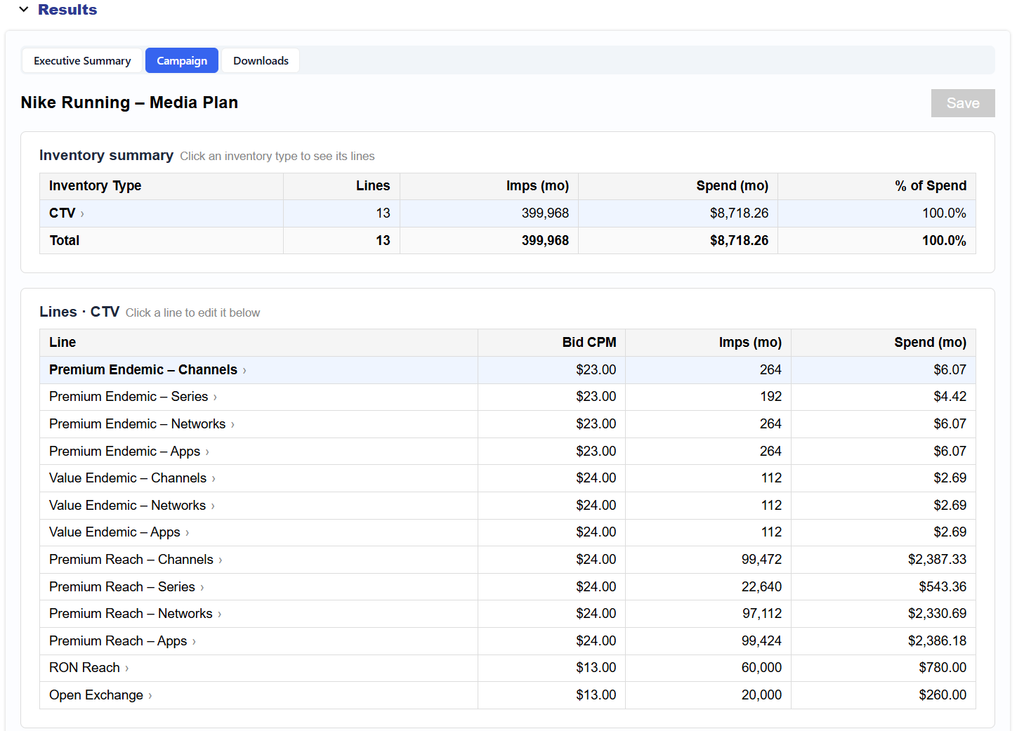
Users can review and refine recommended audiences, content veins, taxonomy selections, geo constraints, impression goals, and line structure before generating the final plan. Plans include projected scale, spend, CPMs, recommended Deals, inventory targeting, and sample availability estimates.
Once generated, the plan can be reviewed in the Executive Summary, Campaign, and Downloads tabs. Users can edit proposed Lines and targeting, download planning and deployment files, and import the completed Planning report directly into a Campaign for final QA and launch.
For complete setup instructions, plan configuration options, output details, and steps for importing a plan into a Campaign, see the full Planning Tool documentation.
Deal Landscape Tool
The Deal Landscape tool provides transparent insights into the data available for targeting and reporting across the accessible Deals through the Bidder. With great inconsistencies in the information shared by each media owner across the industry, this tool can be leveraged in the research and planning process to align campaign goals and expectations with available targeting and reporting capabilities.
For full documentation, see here: Deal Landscape Tool
Transparency Report
The Transparency Report aggregates bid request data to show how much information each deal provides, including fields such as Title, Series, Channel, Network, and Full IP.
This allows you to understand exactly what data is available for targeting and reporting.
- View all bidder-specific deals your account has access to
- Sort by any field to evaluate transparency levels
- Download the full dataset using the arrow next to the search bar
- Share results via a public link (valid for 30 days)
Deal Sample Logs
Click the Deal Name to view sample logs and see exactly what data is being passed.
This allows you to:
- Analyze content details such as publisher, network, channel, series, and title
- Optimize targeting based on real inventory signals
Custom Reporting
The Custom Reporting tool allows you to generate sample request logs for deeper analysis across one or multiple deals.
- Navigate to the Custom Reporting section
- Click New Custom Report
- Select your deal(s), date range, and dimensions
- Generate the report
Use the Deal Landscape Tool to understand inventory, evaluate transparency, and make smarter, data-driven decisions before and during campaign execution.
Inventory Availability Tool
The Inventory Availability Tool is a forecasting tool that provides directional guidance in Campaign planning. If your report returns no data, reach out through the Help Center for more information on the feasibility and potential scale for the selected targeting. By leveraging historical data, delivery trends, sample log data, and Pontiac’s proprietary forecasting formula, the tool helps advertisers:
- Create and refine Inventory targeting lists.
- Assess the feasibility of targeting parameters.
- Optimize bid strategies.
- Estimate potential scale for Campaign planning.
Create an Inventory Availability Report
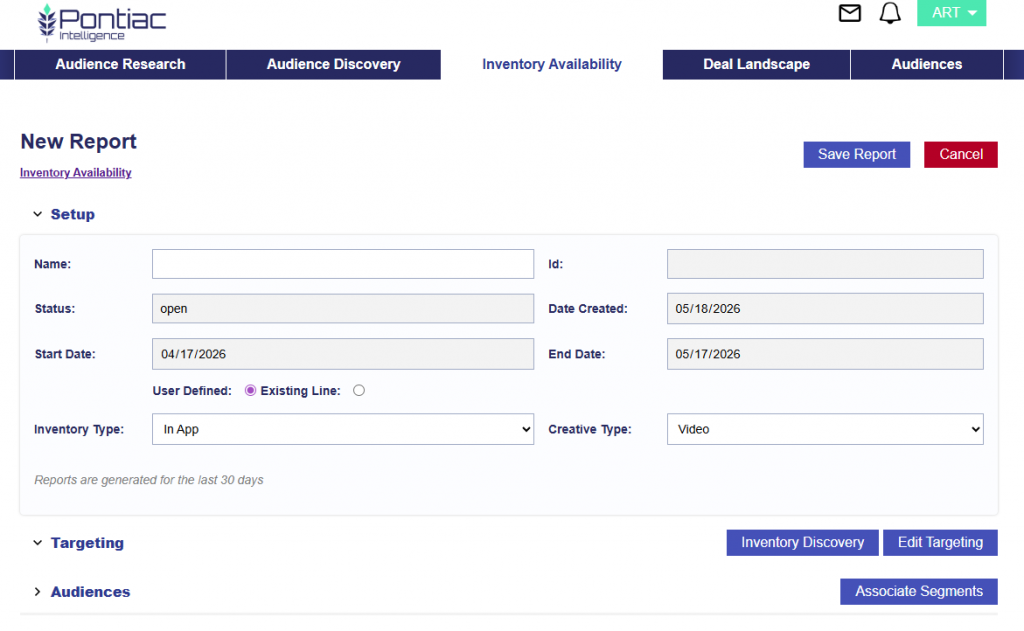
- Switch to the ‘ART’ section using the toggle in the top right corner.
- If the ‘ART’ button is unavailable, contact Pontiac Support via the Help Center.
- Navigate to the ‘Inventory Availability’ tab.
- Click ‘New Report’.
- The start date and end date default to 30 days before today’s date.
- Select how the report is built:
- User Defined: Configure the report from scratch. This is great for when you’re gather precampaign insights.
- Existing Line: Configure the report based on an existing line that is already set up. This is helpful for QAing campaign set up and delivery issues. When selected, the report is generated using the line’s current configuration, including:
- Inventory type
- Creative type
- Advertiser
- Campaign
- Line
- Effective targeting (Intersection of the Campaign and Line)
- Audiences (only Line level)
- If audiences are applied to the Campaign level, users can manually add an additional group and then run the report, but it will not be automatically included.
- Select Inventory Type: In App, Web or Combined.
- Select the Creative Type: Video, Audio, or Banner.
- Only one creative type can be selected per report. If you need to run the same report for different creative types, clone the original report and update the creative type.
- Add Targeting parameters by the follow two methods
- Edit Targeting: Select parameters for forecasting.
- Available targeting options for In App include:
- Deals
- Exchanges
- Geo (Country, Regions, DMAs)
- Zip Codes
- Livestream
- App Lists
- Apps
- Device Types
- Channel
- Network
- Publisher
- Genre
- Series
- Title
- Multi Field
- Available targeting options for Web include:
- Deals
- Exchanges
- Geo (Country, Regions, DMAs)
- Zip Codes
- Livestream
- Publisher
- Site Lists
- Sites
- Device Types
- Available targeting options for Combined include:
- Deals
- Exchanges
- Geo (Country, Regions, DMAs)
- Zip Codes
- Livestream
- Publisher
- Deal Lists
- Device Types
- Site Lists
- Sites
- App Lists
- Apps
- Channel
- Network
- Publisher
- Genre
- Series
- Title
- Multifield
- Available targeting options for In App include:
- Inventory Discovery: Due to the inconsistency in how inventory information is structured across the CTV landscape, this tool helps advertisers create well-informed targeting lists and identify variations in formatting for the desired inventory.
- Search and click to add fields to targeting for the forecast report.
- Edit Targeting: Select parameters for forecasting.
- Associate Audience Segments
- Custom Audiences
- Third Party Audiences
- Contextual Audiences
- ART Audiences
- See Boolean Logic for more details on any and all logic for targeting between groups.
- Run the report and wait a couple of minutes for results to populate.
Understanding the Results
Summary Metrics
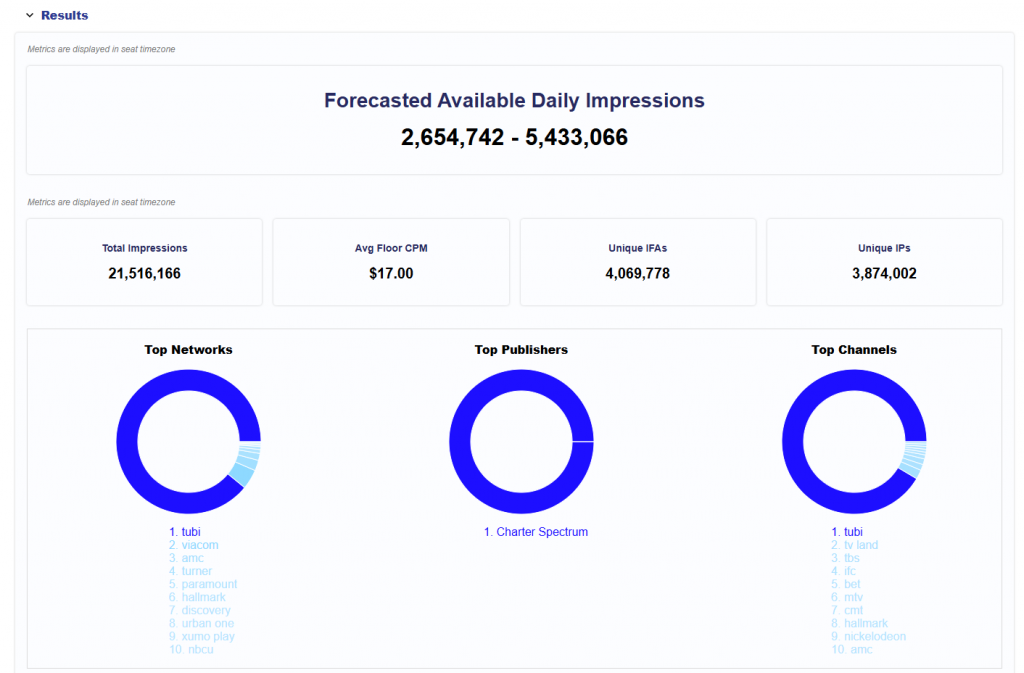
- Forecasted Available Daily Impressions: Range of estimated daily impressions available.
- Total Impressions: Estimated total impressions available over a 30-day period.
- Avg Floor CPM: The average floor CPM for the inventory included in the report.
- Unique IFAs: The estimated number of unique device identifiers available.
- Unique IPs: The estimated number of unique households available, based on IP address.
- Top Networks: Pie chart showing the most popular networks. Hover over each section to view the number of impressions over the 30-day period.
- Top Publishers: Pie chart showing the most popular networks. Hover over each section to view the number of impressions over the 30-day period.
Top Channels: Pie chart showing the most popular channels. Hover over each section to view the number of impressions over the 30-day period.
The report includes individual sections for the following:
- Exchanges
- Deals
- Channel
- Network
- Publisher
- Genre
- Series
- Titles
- Apps
- Device Types
- Livestream
- Zip Codes
- Sample Requests: Provides deeper insights into impression-level parameter combinations.
- For example:
- If a specific Deal ID is selected, charts will display available Networks and Channels.
- Sample logs will illustrate how specific networks grant access to certain channels within that deal.
- For example:
Exchanges
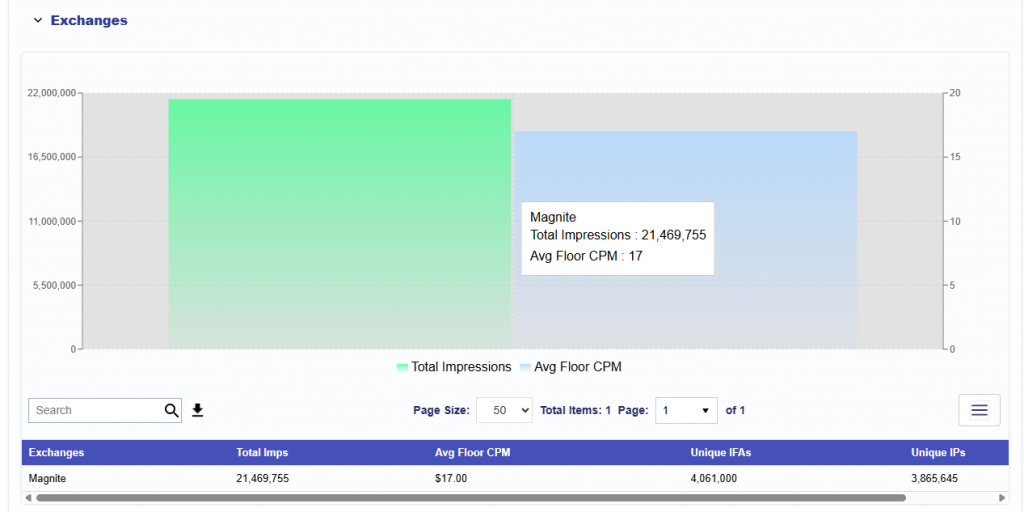
This section shows the exchanges included in the Inventory Availability report. It provides exchange-level details for Total Impressions, Avg Floor CPM, Unique IFAs, and Unique IPs.
The chart compares total impressions and average floor CPM by exchange. Hover over the chart to view the exchange name, total impressions, and average floor CPM. The table below provides the same exchange-level data in table format and can be downloaded as a CSV for further investigation.
Deals
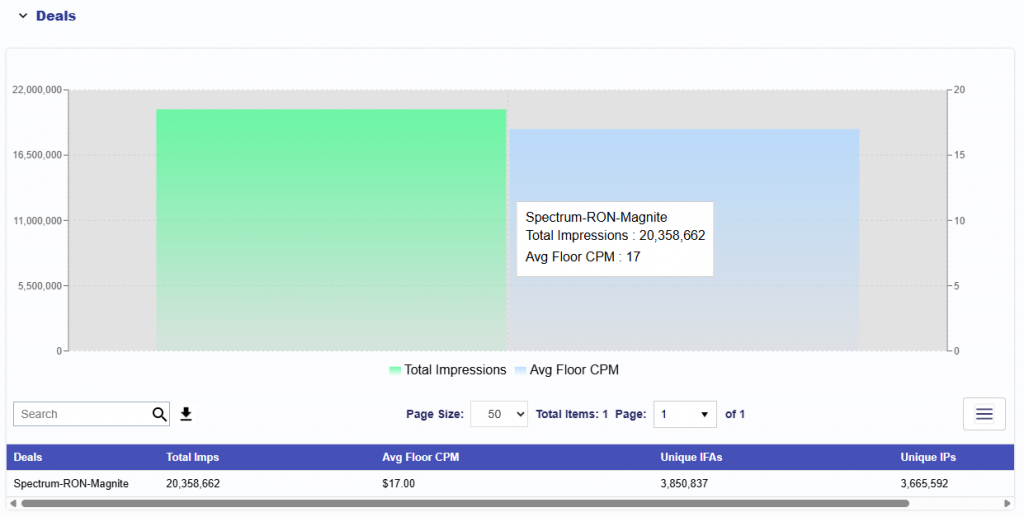
This section shows the deals included in the Inventory Availability report. It provides deal-level details for Total Impressions, Avg Floor CPM, Unique IFAs, and Unique IPs.
The chart compares total impressions and average floor CPM by deal. Hover over the chart to view the deal name, total impressions, and average floor CPM. The table below provides the same deal-level data in table format and can be downloaded as a CSV for further investigation.
Networks
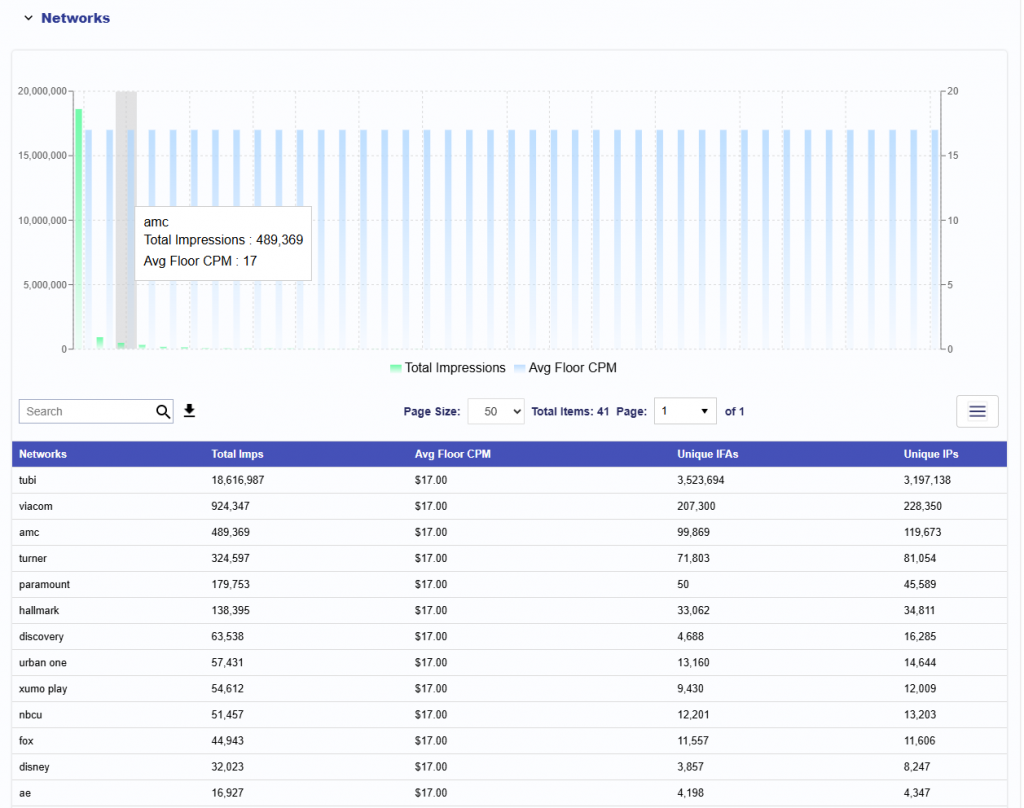
This section shows the networks included in the Inventory Availability report. It provides network-level details for Total Impressions, Avg Floor CPM, Unique IFAs, and Unique IPs.
The chart compares total impressions and average floor CPM by network. Hover over the chart to view the network name, total impressions, and average floor CPM. The table below provides the same network-level data in table format and can be downloaded as a CSV for further investigation.
Channels
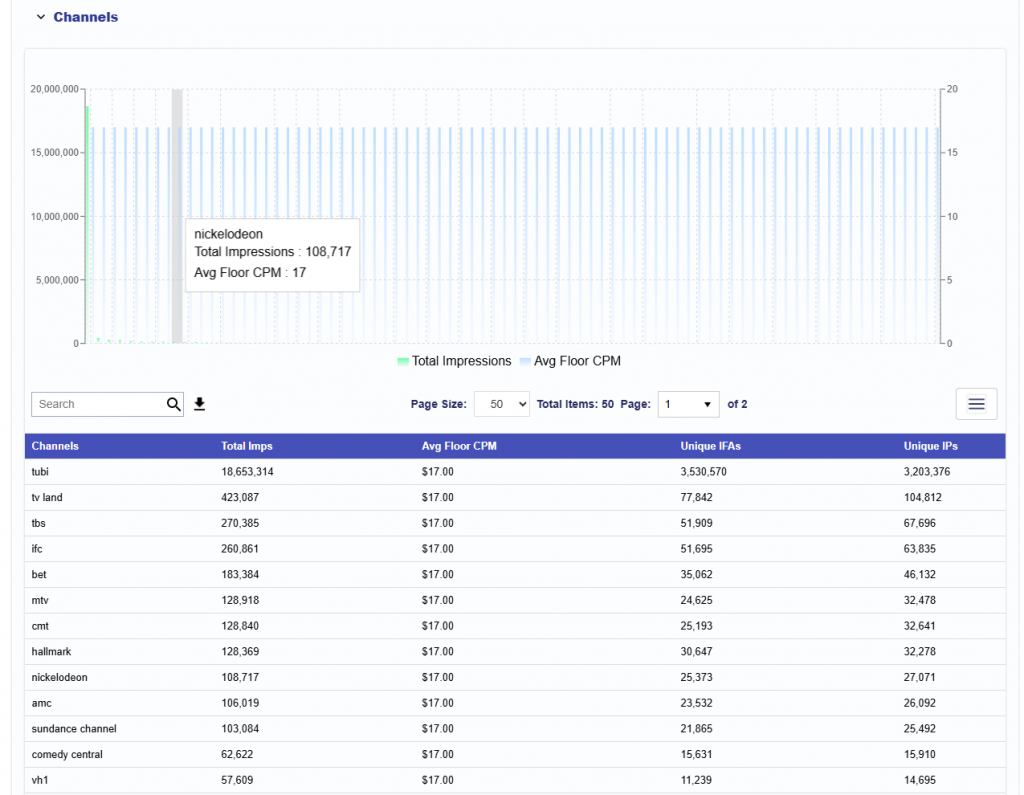
This section shows the channels included in the Inventory Availability report. It provides channel-level details for Total Impressions, Avg Floor CPM, Unique IFAs, and Unique IPs.
The chart compares total impressions and average floor CPM by channel. Hover over the chart to view the channel name, total impressions, and average floor CPM. The table below provides the same channel-level data in table format and can be downloaded as a CSV for further investigation.
Publishers
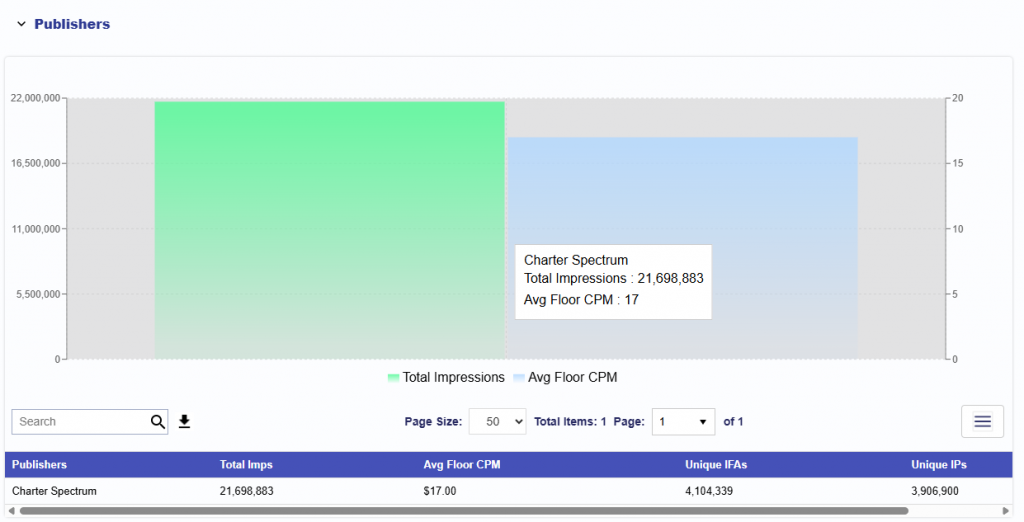
This section shows the publishers included in the Inventory Availability report. It provides publisher-level details for Total Impressions, Avg Floor CPM, Unique IFAs, and Unique IPs.
The chart compares total impressions and average floor CPM by publishers. Hover over the chart to view the publisher name, total impressions, and average floor CPM. The table below provides the same publisher-level data in table format and can be downloaded as a CSV for further investigation.
Series
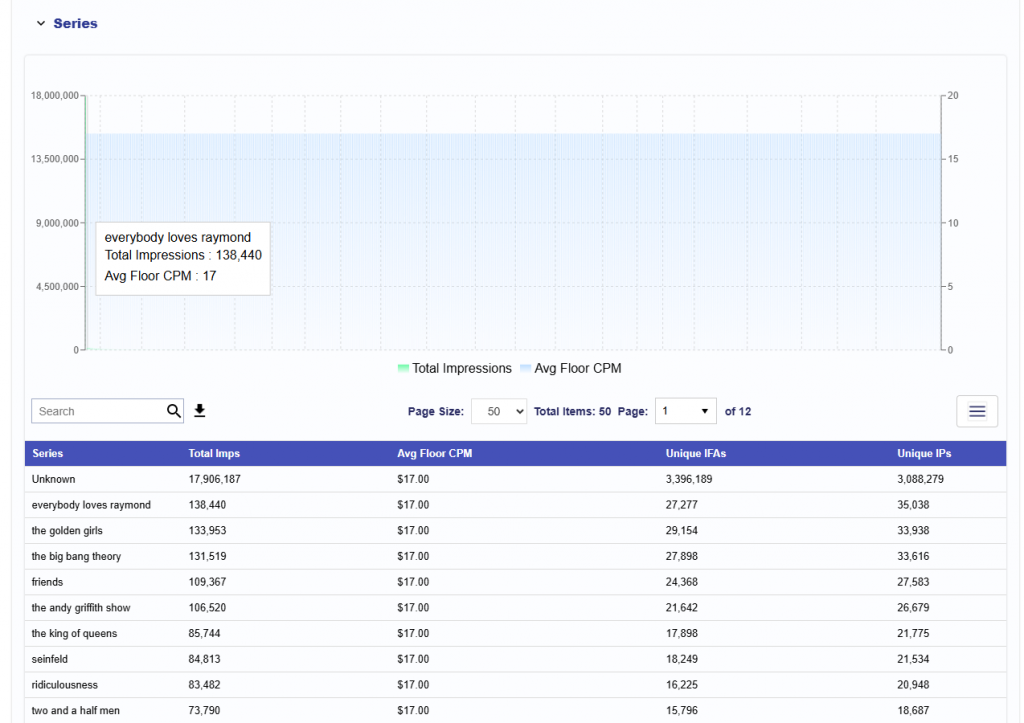
This section shows the series included in the Inventory Availability report. It provides series-level details for Total Impressions, Avg Floor CPM, Unique IFAs, and Unique IPs.
The chart compares total impressions and average floor CPM by series. Hover over the chart to view the series name, total impressions, and average floor CPM. The table below provides the same series-level data in table format and can be downloaded as a CSV for further investigation.
Titles
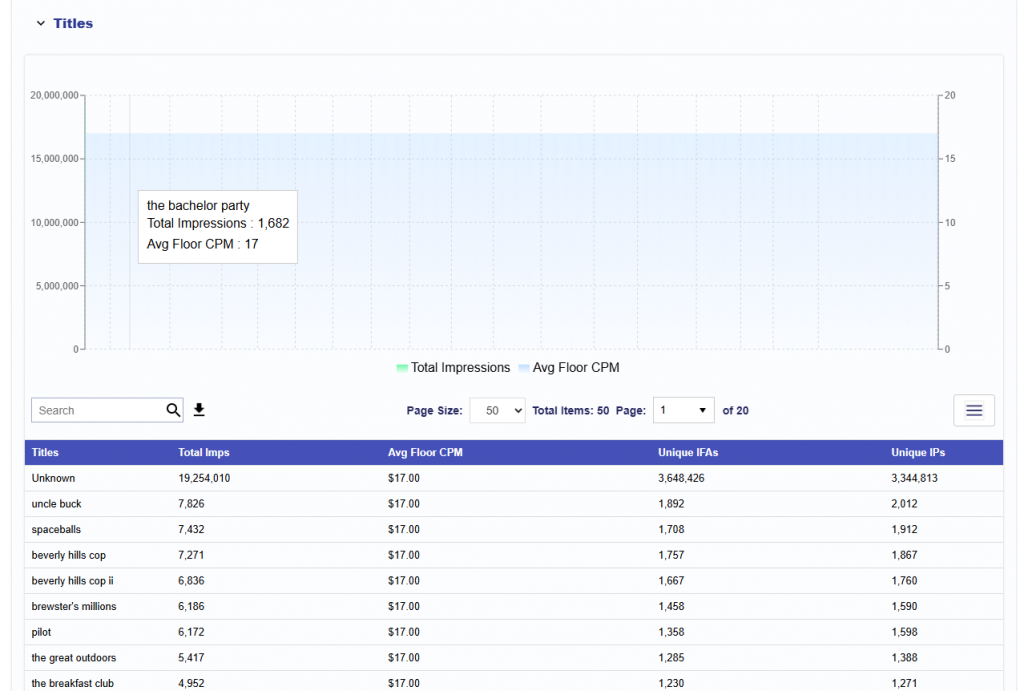
This section shows the titles included in the Inventory Availability report. It provides title-level details for Total Impressions, Avg Floor CPM, Unique IFAs, and Unique IPs.
The chart compares total impressions and average floor CPM by title. Hover over the chart to view the title name, total impressions, and average floor CPM. The table below provides the same title-level data in table format and can be downloaded as a CSV for further investigation.
Genre
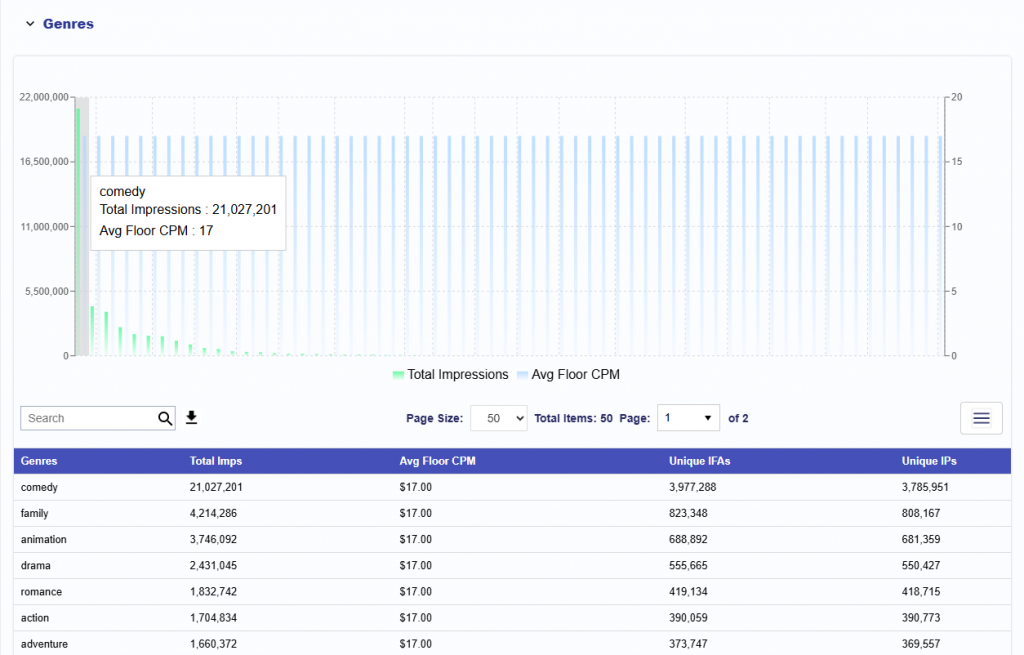
This section shows the genres included in the Inventory Availability report. It provides genre-level details for Total Impressions, Avg Floor CPM, Unique IFAs, and Unique IPs.
The chart compares total impressions and average floor CPM by genre. Hover over the chart to view the genre name, total impressions, and average floor CPM. The table below provides the same genre-level data in table format and can be downloaded as a CSV for further investigation.
Livestream
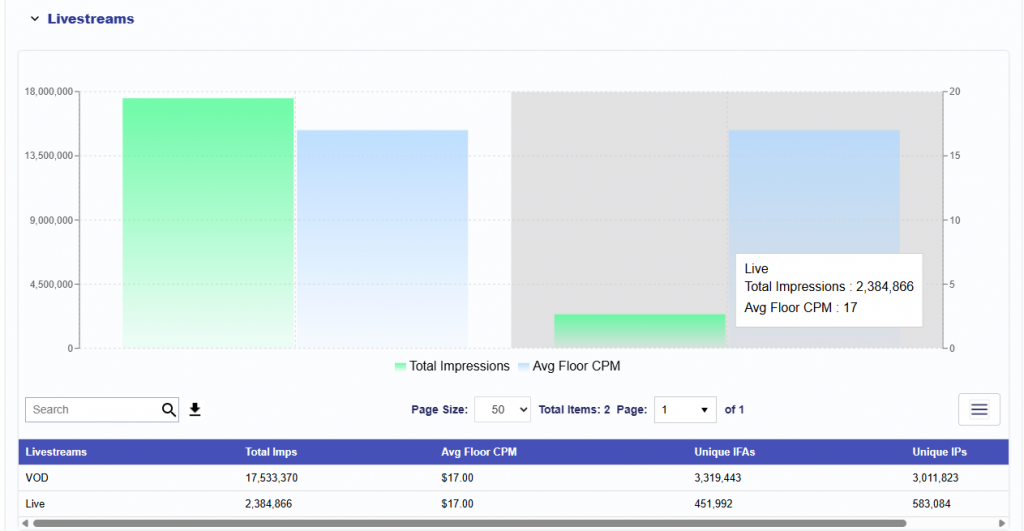
This section shows the livestream categories included in the Inventory Availability report. It provides livestream-level details for Total Impressions, Avg Floor CPM, Unique IFAs, and Unique IPs.
The chart compares total impressions and average floor CPM by livestream category. Hover over the chart to view the category name, total impressions, and average floor CPM. The table below provides the same livestream-level data in table format and can be downloaded as a CSV for further investigation.
Apps
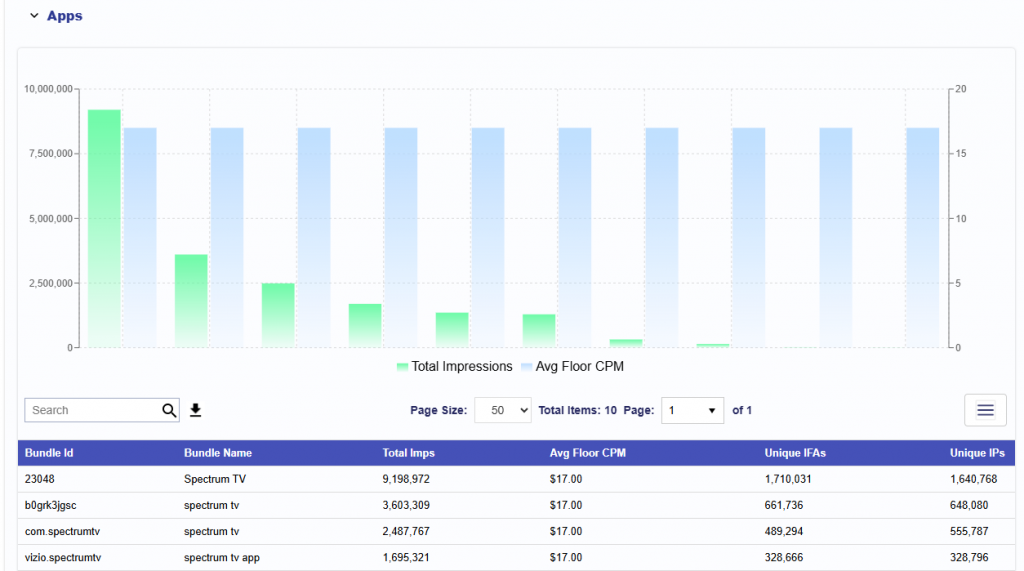
This section shows the App Bundle ID and Name included in the Inventory Availability report. It provides app-level details for Total Impressions, Avg Floor CPM, Unique IFAs, and Unique IPs.
The chart compares total impressions and average floor CPM by app. Hover over the chart to view the app name, total impressions, and average floor CPM. The table below provides the same app-level data in table format and can be downloaded as a CSV for further investigation.
Device Types
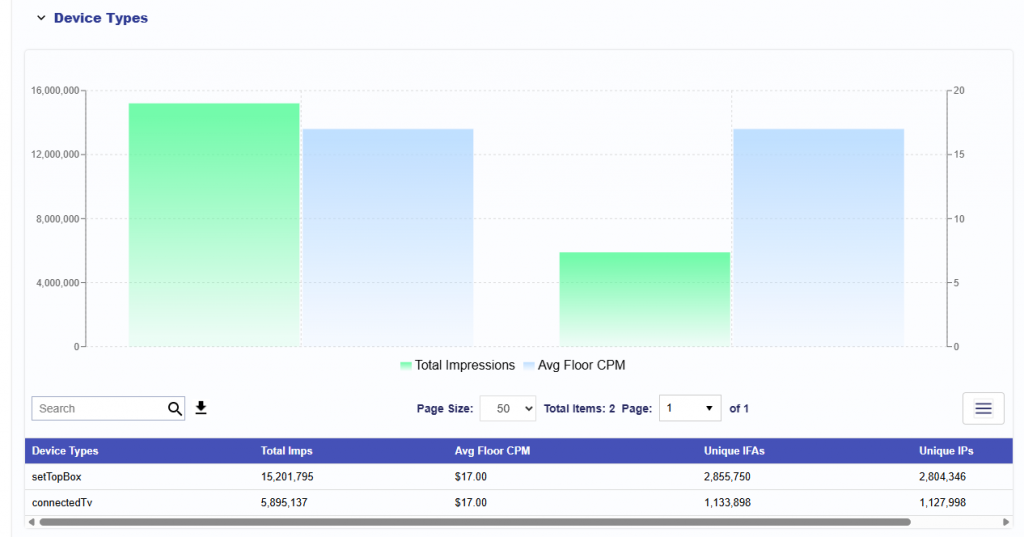
This section shows the device types included in the Inventory Availability report. It provides device type-level details for Total Impressions, Avg Floor CPM, Unique IFAs, and Unique IPs.
The chart compares total impressions and average floor CPM by device type. Hover over the chart to view the device type, total impressions, and average floor CPM. The table below provides the same device type-level data in table format and can be downloaded as a CSV for further investigation.
Zip Codes
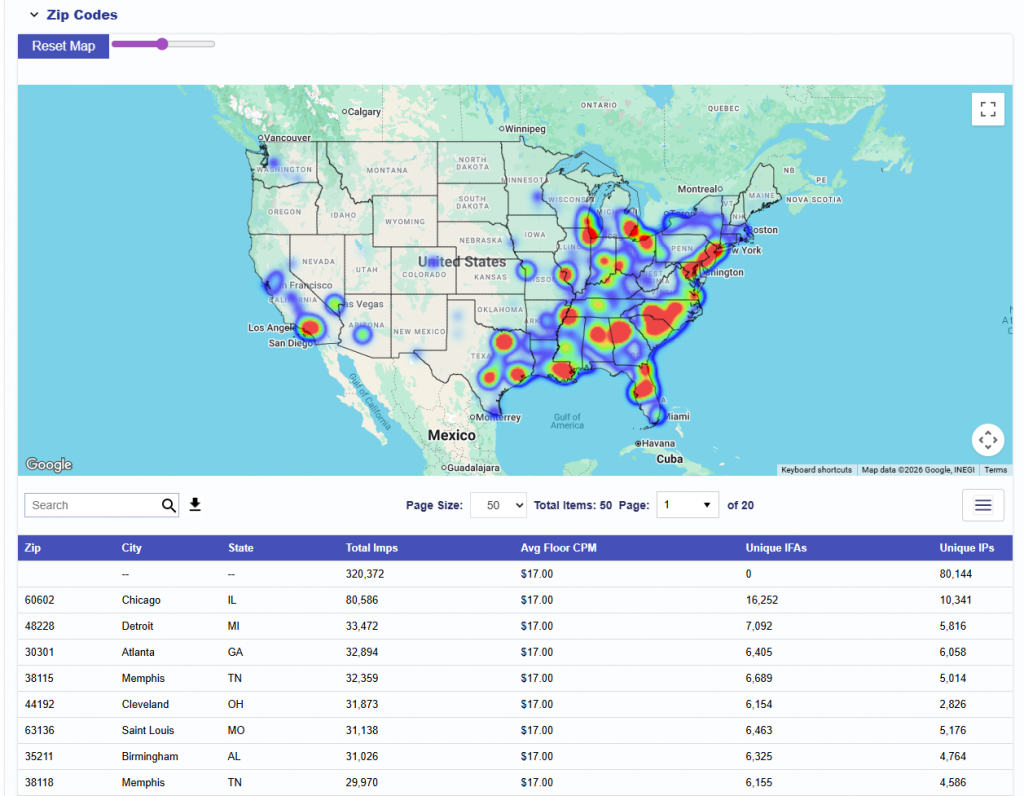
This section shows the zip codes included in the Inventory Availability report. It provides zip code-level details for City, State, Total Impressions, Avg Floor CPM, Unique IFAs, and Unique IPs.
The map displays inventory availability by zip code, with higher-density areas highlighted. Use the map controls to zoom, adjust the view, or reset the map. The table below provides the same zip code-level data in table format and can be downloaded as a CSV for further investigation.
Sample Requests
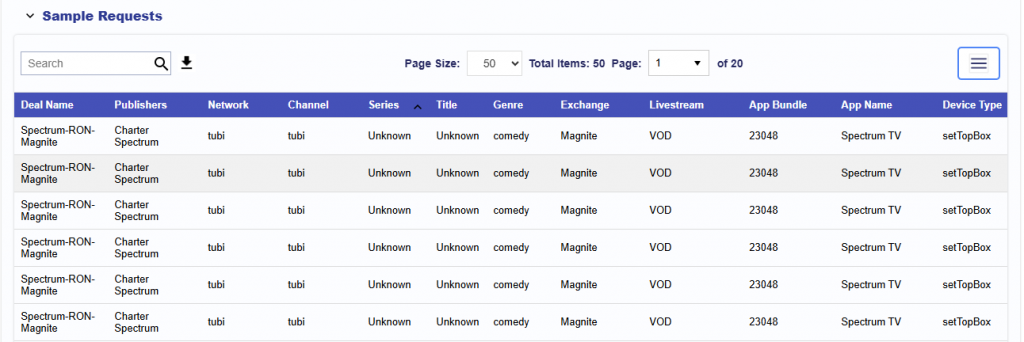
This section shows the Deal level Sample Requests included in the Inventory Availability report. It provides Deal Name, Publishers, Network, Channel, Series, Title , Genre, Exchange, Livestream, App Bundle, App Name, Device Type, Zip Code, and Impressions.
The table can be downloaded as a CSV for further review or investigation.
Audience Research Tool
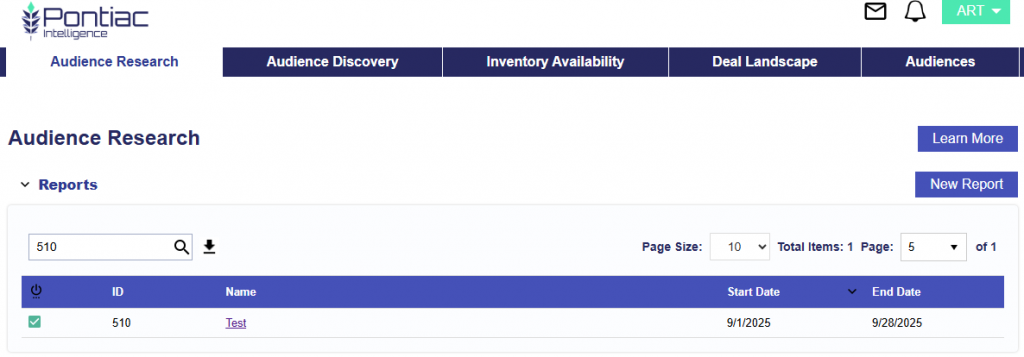
Locate & understand the highest value users to your brand by utilizing the traffic on your website, or a list of U.S. zip codes, to create detailed insight reports, and leverage look-a-like modeling to find new targets that share key characteristics with your existing audience. For more information, please see the full ART Audience Research Tool documentation.
Audience Discovery Tool
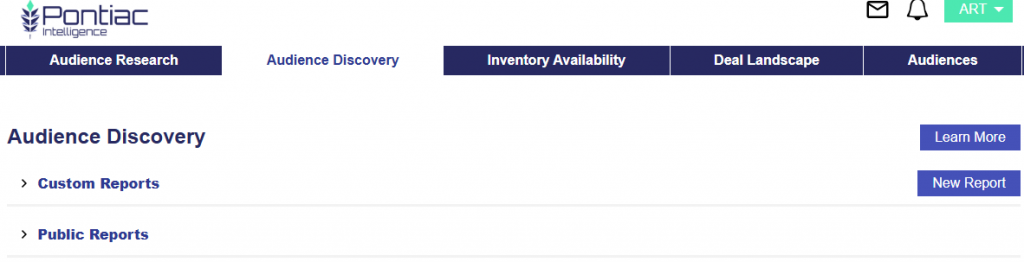
Create your target Audience profile from the desired demographic variables to discover new zip code targets with the highest propensity match to your desired Audience profile. Leveraging the correlation between zip codes and demographics, ADT uses US Census Data to find the zip codes with the largest deviation from the US mean across the selected variables. Leveraging impression data and deep contextual analysis, interest categories can also be evaluated for each zip code to find areas that are over-indexing in content consumption for the selected topics. Audience Discovery data can be exported for targeting across all channels and media types. Additionally, browse our public reports to see if there is a report that fits your campaign needs already. For more information, please see the full ART Audience Discovery Tool documentation.
Analytics Suite
Pontiac Analytics Suite Overview
Understand > Activate > Prove
Insights are only as powerful as your ability to act on them. With Pontiac’s Analytics Suite, you can move from analysis to optimization instantly by applying model outputs directly to your campaigns with no manual translation or workflow gaps.
No complex integrations. No big lift. Just seamless activation within the same platform where you run your campaigns.
Deep Dive
- Analytics Documentation: Deep dive into each pipeline and how to generate reports
- Planning Documentation: Learn how to build AI-assisted media plans using campaign inputs, audience insights, and Pontiac marketplace data to recommend inventory and expected scale.
- Audience Documentation: Learn how to understand your audience, build personas, and identify high-value and lookalike segments
- Targeting Documentation: Explore how to identify performance drivers and apply optimizations to campaign delivery
- Incrementality Documentation: Understand lift measurement, control vs exposed methodology, and true performance impact
No black boxes. No guesswork. Just transparent models, seamless activation, and results you can stand behind.
What is the Analytics Suite?
The Pontiac Analytics Suite is built around three core pipelines that cover the full campaign lifecycle:
- Planning: Build smarter media plans before launch
- Uses LLM-powered research and Pontiac marketplace data to recommend audiences, content, inventory, and expected scale
- Helps align campaign goals, targeting strategy, budget, and available inventory
- Produces a plan that can be reviewed, refined, and launched directly in the platform
- Audience: Know who converts, what defines them, and where to find more of them before you spend a dollar.
- Builds personas using privacy-safe, census-based data
- Identifies high-value ZIP codes and lookalike expansion opportunities
- Helps guide targeting and messaging strategy
- Targeting: Activate and optimize performance in-flight
- Surfaces key performance drivers across geo, device, content, time of day, and more
- Applies insights directly to bidding and delivery
- Reduces waste and improves efficiency with no manual breakouts
- Incrementality: Prove the true impact of your media
- Compares exposed vs control groups to isolate true lift
- Calculates real CPA and statistically validated performance
- Identifies where to scale, test, or reduce spend, with the ability to automatically apply those optimizations
Every model is fully transparent, showing exactly how decisions are made. And when you’re ready to act, applying those insights takes just a few clicks.
From Analysis to Activation
The Analytics Suite doesn’t just generate insights, it enables immediate action. Follow these simple steps:
- Generate a Targeting, Audience, Incrementality, or Full Analysis report
- Navigate to the Targeting section at the Campaign or Line level
- Select the Custom Model tab
- Enable Use Custom Models
- Choose your model from the available list
Once enabled, your model is applied directly to Campaign and or Line delivery.
Bid Recommendations
Bid recommendations vary by media type, inventory source, Deal requirements, targeting, and auction competition.
The recommendations below are intended as starting points. Actual clearing prices may vary, and bids may need to be adjusted based on delivery and available inventory.
For information on configuring Basic Bid, Bid at Total eCPM, Bid at Floor Price, Bid at Floor Price Plus, and Advanced Bid Controls, see Line Setup.
Bid Recommendations by Media Type
CTV
Typical CTV pricing ranges from approximately $28–$40 CPM, with premium inventory often available above $40 CPM.
When targeting a CTV Deal, the publisher will provide a CPM floor. We generally recommend setting the bid approximately 10–20% above the minimum floor to improve auction competitiveness.
CTV inventory may also be available through the Open Exchange at lower CPMs. However, PMP Deals are generally recommended when greater control over publisher and inventory quality is desired.
OTT
OTT PMP Deals operate in real-time bidding environments with a publisher-defined price floor. The price floor represents the minimum CPM required to participate in the auction.
These auctions can be competitive, and clearing prices may be approximately 20–40% above the Deal Price Floor. Closing CPMs commonly fall within the $20–$40 range, although actual pricing varies significantly based on factors including:
- Publisher and inventory quality
- The Deal’s position within the publisher’s waterfall
- Auction competition
- Content format, such as Live or Short Form
- Seasonality and time of year
As a starting point, we generally recommend bidding approximately 10–20% above the Deal Price Floor. If the Line is not achieving the desired scale, gradually increase the bid.
OLV
Bid prices vary depending on the video inventory and Deal. As a starting point, we generally recommend a base bid of at least $5–$10 CPM.
Run an Inventory Availability Report to review average CPMs based on your Campaign targeting and available inventory.
Audio
Audio inventory can be purchased through either the Open Exchange or PMP Deals.
Open Exchange: Typically clears between $7–$13 CPM
PMP Deals: Commonly ranges from $9–$20 CPM
Individual PMP Deals may have their own recommended bid ranges or floor prices.
Display
Display bid prices vary based on targeting criteria and Audience data. A standard starting recommendation is approximately $2–$4 CPM, although recommended bids may increase as targeting becomes more granular.
Native
Native bid prices vary based on inventory, targeting criteria, and Deal requirements. As a starting point, we recommend a bid of approximately $4 CPM. PMP Deals may have specific floor prices or bid recommendations that should be used as guidance.
Bidding Above the Floor
For inventory with a defined floor price, bidding exactly at the floor may reduce auction competitiveness.
As a general starting point, consider bidding approximately 10–20% above the floor, particularly for competitive CTV, OTT, and PMP inventory.
Pontiac’s Bid at Floor Price Plus functionality can also be used to automatically add a CPM amount or percentage above the observed floor while respecting the configured Max Bid Price.
For configuration instructions and examples, see Line Setup.
How Audience and Attribution Fees Affect Cost
By default, Audience, data, and attribution fees are applied separately from the media bid and do not need to be manually added to the Line’s Bid Price.
The Line’s media bid determines how much Pontiac can bid for the inventory, while applicable additional fees are reflected in Total Cost.
For example, if a Line has a $2.50 media bid and targets a third-party Audience with a $1.50 CPM data cost, Pontiac can bid up to $2.50 CPM for the media. The $1.50 Audience fee is applied separately when calculating Total Cost.
As a result:
- Bid Price / Media Cost CPM reflects the cost of the media.
- Total Cost / Total Cost CPM reflects the media cost plus applicable Audience, data, attribution, and other platform fees.
Note: When Bid at Total eCPM is enabled, Pontiac adjusts the media bid to account for certain applicable fees so that the total eCPM remains within the configured Bid Price. See Line Setup for the fees included in this calculation and configuration instructions.
Third-Party Audience Fees
Third-party Audiences may have an associated CPM data cost. This fee is applied separately from the media cost and included in Total Cost.
Examples of third-party Audience costs include:
- LiveRamp CRM segments: Associated Audience CPM
- TransUnion CRM segments: Associated Audience CPM
- OnSpot / Geoframed segments: Associated Audience CPM
- Other Third-Party Audiences: Associated CPM displayed for the Audience
Depending on the Audience and seat configuration, additional data commissions may also be included in Total Cost.
Contextual AI and ART Audience Fees
Contextual AI and ART Audiences may also have associated data fees. These fees are applied separately from the media bid and included in Total Cost.
If no applicable third-party Audience fee is present:
- A targeted Contextual AI Audience may apply the seat’s configured Contextual fee.
- A targeted ART Audience may apply the seat’s configured ART fee.
Foot Traffic Attribution Fees
Foot Traffic Attribution fees are also applied separately from the media bid and included in Total Cost. They do not need to be added to the Line’s bid recommendation.
Foot Traffic Attribution pricing varies based on negotiated pricing and may differ by media type.
For example, a CTV Line with a $15.00 media bid and Foot Traffic Attribution enabled will continue to bid up to $15.00 CPM for media. The applicable Foot Traffic fee is added separately when calculating Total Cost.
If Bid at Total eCPM is enabled, the Foot Traffic fee is instead accounted for when Pontiac adjusts the media bid to remain within the configured total eCPM.